
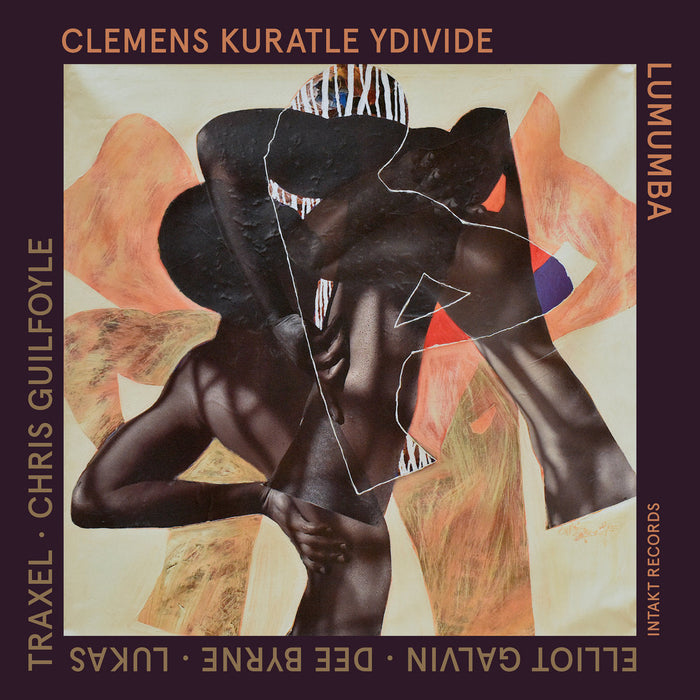
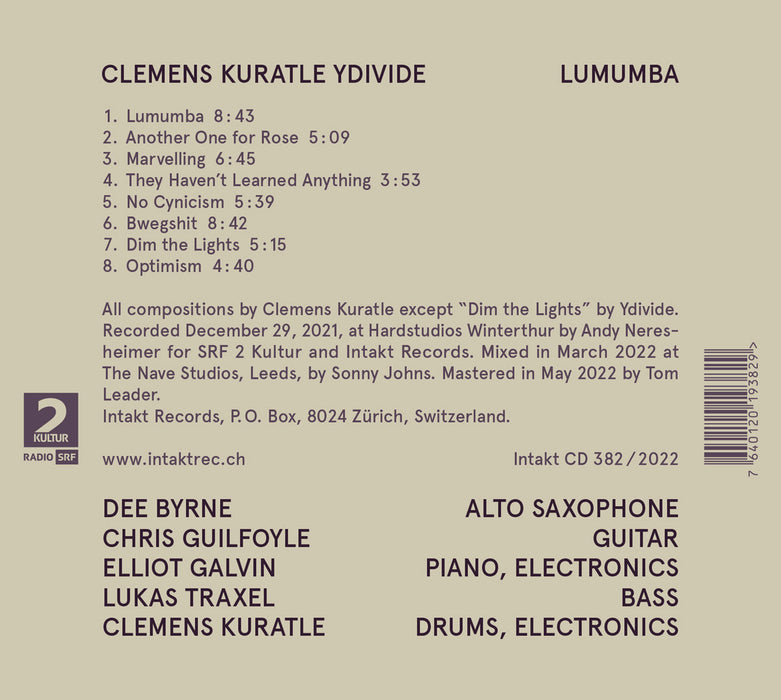
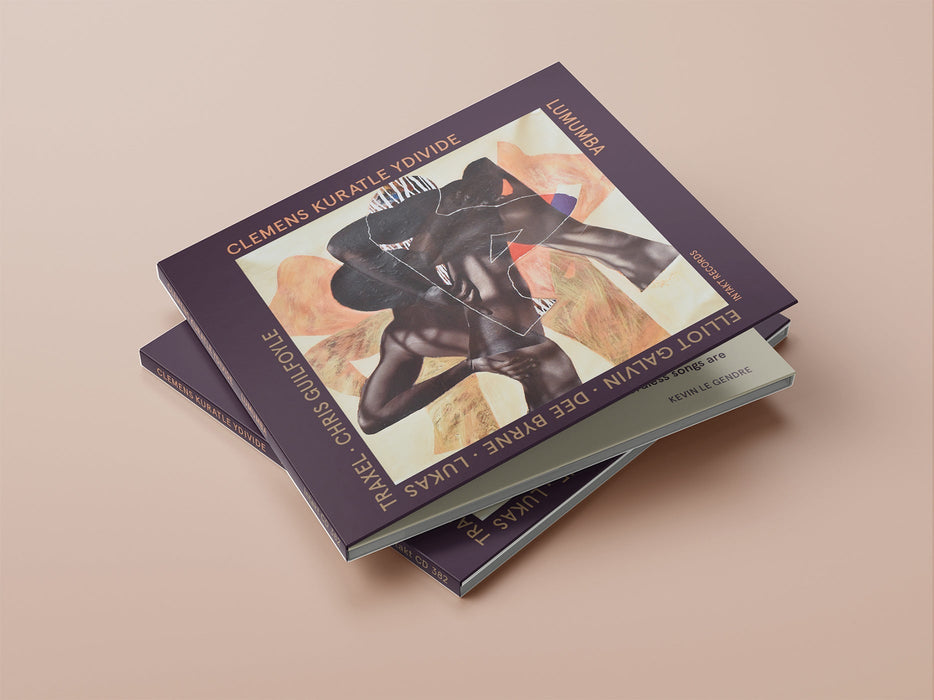
382: CLEMENS KURATLE YDIVIDE. Lumumba
Intakt Recording #382/ 2022
Dee Byrne: Alto Saxophone
Elliot Galvin: Piano & Electronics
Chris Guilfoyle: Guitar
Lukas Traxel: Bass
Clemens Kuratle: Composition, Drums & Electronics
Recorded December 29, 2021, at Hardstudios Winterthur by Andy Neresheimer for SRF 2 Kultur and Intakt Records.
Sale
Sale
Original price
CHF 12.00
-
Original price
CHF 30.00
Original price
CHF 30.00
CHF 12.00
-
CHF 30.00
Current price
CHF 30.00
| /
More Info
Many important drummers are great bandleaders. With their overview and their sense of rhythm and form they show the band the way. The young Swiss drummer Clemens Kuratle has made a name for himself in jazz and pop formations as a sensitive and accomplished musician. Now he has launched Ydivide: a quintet that unites the hip, young British and Swiss jazz scenes. “International bands have existed for many years in the world of improvised music. Exciting things can happen when borders are crossed and curious individuals come together to create their own language in sound, even though they may not have the same mother tongue or cultural references. Ydivide, a fine European ensemble, is a case in point. The discipline of composition and freedom of improvisation steer the music, and the presence or rhythms that crackle with dance-like energy as well as bursts of harmonic turbulence and meditative choruses point to Kuratle‘s embrace of both ‚in‘ and ‚out‘ sounds. Most importantly, his wordless songs are saying something.” writes Kevin Le Gendre in the liner notes.
Album Credits
Cover art: Collin Sekajugo
Graphic design: Jonas Schoder
Liner Notes: Kevin Le Gendre
Photo: Palma Fiacco
All compositions by Clemens Kuratle except "Dim the Lights" by Ydivide. Recorded December 29, 2021, at Hardstudios Winterthur by Andy Neresheimer for SRF 2 Kultur and Intakt Records. Mixed in March 2022 at The Nave Studios, Leeds, by Sonny Johns. Mastered in May 2022 by Tom Leader. Cover art: Collin Sekajugo. Graphic design: Jonas Schoder. Liner Notes: Kevin Le Gendre. Photo: Palma Fiacco. Produced by Clemens Kuratle and Intakt Records. Executive Producer: Florian Keller. Published by Intakt Records.
- 5 stars: 15 (100%)
- 4 stars: 0 (0%)
- 3 stars: 0 (0%)
- 2 stars: 0 (0%)
- 1 star: 0 (0%)
G
Guido Festinese È sempre un buon segno quando un musicista che ha contribuito a creare nuove dimensioni per il proprio strumento cerca e trova il confronto con colleghi molto più giovani. Sia per i maestri alla ricerca di energie fresche e imprevedibili, sia per coloro che potrebbero anche essere sopraffatti dall'emozione e invece si mettono in gioco con semplicità. Günter "Baby" Sommer ha oggi settantanove anni e continua ad avere lo spirito incendiario di quando ne aveva trenta, i tempi in cui anche il jazz europeo aveva trovato una sua personale via alla metabolizzazione delle istanze "free". I Lucaciu Brothers (Antonio al sax contralto, Simon al pianoforte, Robert al contrabbasso), tedeschi come lui, hanno meno della metà dei suoi anni e una conoscenza profonda della storia del jazz diventata pratica strumentale in azione.
Si parte già bene, qui, con "Dunkle Wonken", un traditional struggente in cui Sommer stende una coltre tambureggiante poliritmica quasi tribale e si alza nobile e febbricitante il canto del sassofono, punteggiato dal piano quasi gospel di Simon: il primo riferimento va al gemito fremente di Albert Ayler. È invece uno scatto alla Ornette Coleman la seconda traccia, introdotta da tre minuti memorabili di assolo di Sommer, una pirotecnia di ritmi incrociati. Il titolo del disco, che ovviamente occhieggia alla "Caravan” di Duke Ellington, è anche quello di una poesia del dadaista tedesco Hugo Ball: è il settimo brano e qui c'è un'ulteriore sorpresa, con la voce grande, grossa e per nulla stropicciata dagli anni di Sommer a declamare il testo tra scatti brucianti e sonorissime sillabe. Un disco memorabile, ma soprattutto godibile e, per molti versi, trascinante.
C
Chris Searle Round-ups 2022: Jazz albums with Chris Searle
MY RECORD of the year is the reissue of the marvellous Joe Harriott Swings High (Cadillac Records), originally released in 1967 and created in a session held at, according to Harriott’s longtime Jamaican bass confrere Coleridge Goode, “a pokey little independent studio somewhere in East London.”
Goode continued: “Joe plays so fiercely that at times it seems as though he’s about to blow his alto apart.”
Hear his searing choruses on The Rake or Blues in C, but he plays with a beautiful lyricism too — alongside trumpeter Stu Hamer on A Time for Love, or as the lone horn on Polka Dots and Moonbeams.
This was an era of rampant street racism, perhaps a motivation for Harriott’s sonic ferocity. Burton-on-Trent’s master drummer Phil Seamen and pianist Pat Smythe are fully attuned too and play with a powerful empathy. It’s a very moving revival: sounds of its time and for our times too.
Take 15 endangered species and 11 powerful jazz virtuosi and create a record which campaigns for the species’ survival.
“My hope is that Red List (Palmetto Records) will help to facilitate critical yet uncomfortable conversations about changing our global habit of destroying nature for our own gain,” writes project instigator, composer and baritone saxophonist Brian Landrus.
From African Elephant to Mariana Dove, Javan Rhino to Vaquita, the notes pound, lyricise, create melody and improvise for the very future of Earth’s life.
Hearken to ex-Jazz Messenger Geoffrey Keezer’s urgent piano message on Canopy of Trees, Landrus’s committed horn and Rudy Royston’s urgent drums on the title track, altoist Jaleel Shaw’s worrisome testimony on Tigris or bassist Lonnie Plaxico’s tortured solo on Only Eight.
“Before we’d track the music we’d have a conversation about each animal,” asserts Landrus. A potent album this, with music and earthly survival locked together in beauty and defiance.
Boyhood memories of my first African hero came tumbling back as I listened to the evocative title track of the album Lumumba (Intakt Records). Led by the Swiss drummer Clemens Kuratle, his band consists of Irish guitarist Chris Guilfoyle, two English musicians — saxophonist Dee Byrne and pianist Elliot Galvin — and fellow Swiss bassist Lukas Traxel.
The heart of Europe is here, expressing the 1961 tragedy of Africa, when Congo’s Lumumba was murdered with full European connivance. “I realised what eurocentrism meant then,” says composer Kuratle, and the band plays with new European unity and hope, all through tracks like Marvelling, with some reflectively inventive Galvin and Byrne, and Guilfoyle’s awakening solo on They Haven’t Learned Anything.
Collin Sekajugo’s affectingly beautiful sleeve art, pictured, empathises with the music and the entire record is both a tribute to African heroism and a condemnation of imperial atrocity. Get hold of it for it is as much now as it is then.
In his sleeve notes to the first release of their 1989 duo performance The Art is in the Rhythm (Jazz in Britain Records), the great Yorkshire-born alto saxophonist Trevor Watts remembers his first encounters with the Irish drummer Liam Genockey and how they were “both into the rhythmic side of the music in a big way,” but with different rhythmic perspectives.
Watts has always responded to powerful drummers, whether it was his early partner in the Spontaneous Music Ensemble, John Stevens, or the brilliant Ghanaian percussionists of Moire Music, but his ripostes to Genockey’s thumping Irish rhythms are startlingly innovative, as in the maze of hornsound of Rhythmic Variants.
In the other tracks, Echoes of Bird and Dedicated to Eric D, the duo salute Parker and Dolphy respectively with inspired rhythmic union. As Genockey scuttles, crackles, rumbles and booms, Watts’s alto sings, trills, swirls and peals in a uniquely cogent recording.
https://morningstaronline.co.uk/article/b/round-ups-2022-jazz-albums-with-chris-searle
S
Simon Camatta Wenn man dieses Album einmal durchgehört hat, braucht man zuerst einmal eine kleine Pause. Die fünf in England lebenden Musiker produzieren nämlich eine ganz schöne Wand an Sound. Allerdings nicht durch Lautstärke oder Chaos, sondern durch sehr diszipliniertes Musizieren und ein, vor allem auf rhythmischer Ebene, tightes Zusammenspiel. Unter den teils ausufernden Soli liegt eigentlich immer ein dickes Brett an Backings, und das drückt gewaltig. Alles ist sehr perfekt auf eine amerikanische, moderne Art, aber auch immer mit viel Leidenschaft und ordentlich Feuer gespielt. Die Kompositionen sind abwechslungsreich und mit kleinen Überraschungen, jedoch schon sehr genretreu. Es gibt die obligatorische Ballade und ab und zu ein paar elektronische Spielereien. Ein wenig Politik ist sowohl mit dem Titel als auch mit dem schönen Stücktitel Bwegshit geschickt untergemischt. Eine in ihrer leichten Wildheit sehr kontrollierte, sehr gut eingespielte Band mit einem überzeugenden Erstling. File under Modern Jazz/Snarky Puppy.
M
Maurice Hogue There is plenty of new releases in this edition of One Man's Jazz, headed by a retrospective of earlier works of William Parker and a who's-who of guests (Universal Tonality). Also tracking back in time are releases from drummer Idris Muhammad and with his own retrospective of his ECM releases, guitarist Steve Tibbetts. From Europe come new albums by Swiss drummer Clemens Kuratle & Ydivide and Polish bassist Wojtek Mazolewski plus a debut from the Lisbon, Portugal quartet, Apophenia, and from Argentina pianist Ernesto Jodos. We also check out the latest from pianist Julius Rodriguez and bassist Shawn Lovato.
Playlist
Santiago Leibson Sextetto "K" from Aperecerse (Kuai) 00:00
Host speaks 08:47
Wojtek Mazolewski Quintet "Spirit To All" from Spirit To All (Whirlwind) 10:12
Whit Dickey Quartet "Space Quadrants" from Astral Long Form: Staircase In Space (Tao Forms) 21:35
Julius Rodriguez "Two Way Street" from Let Sound Tell All (Verve) 28:17
Host speaks 32:13
Clemens Kuratle Ydivide "Bwegshit" from Lumumba (Intakt) 34:32
Fade In "L'Esterofilo" from Live Fast Die A Legend (Clean Feed) 43:14
Host speaks 48:39
Ernesto Jodos "Biombos" from Donde El Mundo Ocurre (Ears&Eyes) 49:45
James Brandon Lewis "Bird Of Folk Cries" from Days Of Freeman (Okeh) 58:28
Host speaks 1:05:33
James Brandon Lewis & The Messthetics "Fear Not" from single release (ANTI-) 1:06:54
Lisa Hoppe's Third Reality "Dinner With Abstract Poetry" from Dinner With Abstract Poetry ( Self-released) 1:14:45
Lisa Hoppe's Third Reality "Attias" from Dinner With Abstract Poetry (Self-released) 1:17:52
Joachim Kuhn Trio "It's Only For You" from Scream For Peace (Linoleum) 1:22:03
Host speaks 1:30:36
William Parker "Tails Of A Peacock" from Universal Tonality (AUM Fidelity) 1:32:18
Idris Muhammad "Peace and Rhythm Suite—Rhythm" from Peace And Rhythm (Craft/Concord) 1:43:11
Host speaks 1:49:06
Steve Tibbetts "Hellbound Train" from Hellbound Train: An Anthology (ECM) 1:51:16
Angles "Muted Reality" from A Muted Reality (Clean Feed) 1:528:25
Host speaks 2:13:56
Apophenia "Frenesim Do Ponto De Vista De Um Gnomo" from Prötzeler (Robalo) 2:15:11
Apophenia "Melody Fragments" from Prötzeler (Robalo) 2:26:47
Artur Malecki & The Creature "Stwor" from Widocki (FSR) 2:33:07
Will Vinson "Things" from Tripwire (Whirlwind) 2:43:57
Host speaks 2:50:51
Shawn Lovato "Microcosms—opening" from Microcosms (Ears&Eyes) 2:52:54
https://www.allaboutjazz.com/william-parker-clemens-kuratle-ernesto-jodos-and-apophenia-william-parker
A
Arnold Loimer Das Quintett Ydivide wird vom Schweizer Schlagzeuger und Kompo-nisten Clemens Kuratle geleitet. Kuratle, in seinem Spiel beeinflusst von Trommlern aus Burundi, dem indonesischen Gamelan oder der Gnawa Music aus Marokko, wird hier begleitet von Landsmann Lukas Traxel am Bass, dem irischen Gitarristen Chris Guilfoyle sowie den beiden Engländern Elliot Galvin am Piano und Dee Byrne am Saxophon in einem Projekt, das die Improvisation hochhält und durch Präzision besticht. Schon im Titeltrack Lumumba" zu Beginn werden Harmonien jongliert, und das spannende und kraftvolle Zusammenspiel der Musiker lädt zum genaueren Hinhören ein. Gewidmet ist das Stück dem ersten Premierminister des Kongo, Patrice Lumuba, der 1961 in einem Putsch ermordet wurde. Besonders turbulent wird es in „They Havent Learned Anything", wenn sich Byrnes Saxophonlinien mit ausgesuchten Gitarrenakkorden kreuzen. By the way: Der Bandname Ydivide stellt eine Kurzform von „Why Divide" dar - als Antwort auf den Bre-xit 2019, dem Jahr als die Formation zusammengefunden hat.
S
Selwyn Harris Swiss drummer/electronic artist/composer Clemens Kuratle is highly impressive on composing, arrangements and his propulsive kit-work fires up a versatile young Brit-Swiss quintet, the former including Dee Byrne on sax and Elliot Galvin on keys, which shifts cohesively from abstract collective dialogue to a more structured lyricism.
W
Wolfgang Gratzer Der couragierte Beginn macht hellhörig: sich wiederholende Töne aus dem Inneren eines präparierten Klaviers gehen in perkussiv gehämmerte Schläge und Höhenflüge am Saxophon über. Inspiration für den Opener >>Lumumba<< wie für das sehenswerte Cover (Collin Sekajugo) - war die verstörende Geschichte der Unabhängigkeits- und Putschbewegungen auf afrikanischem Boden. Teil dieser Geschichte ist die zuweilen geleugnete Mitverantwortung der internationalen Staatenwelt bei der Ermordung des kongolesischen Politikers Patrice Lumumba im Jahr 1961. Hiervon beeindruckt, ging Clemens Kuratle an die Formierung seiner neuen, bewusst international besetzen Band. Mechanische Rhythmen sind seine Sache nicht. Seine Vorliebe gilt vielmehr jenen kollektiv gewobenen, komplexen Rhythmen, wie diese Ornette Coleman für den Jazz fruchtbar machte. Die Kollegenschaft des initiativen Schweizer Schlagzeugers bekommt dementsprechend viel zu tun. Der aus Dublin angereiste Gitarrist Chris Guilfoyle und der Schweizer Kontrabassist Lukas Traxel teilen das von Rasanz geprägte Power-Konzept. Pianist Elliot Galvin bringt wie Kuratle Electronics ins Spiel. Besonders eindrücklich gerät das emotionsgeladene, mitunter >>schreiende<< Spiel der Saxophonistin Dee Byrne. Schon bei den Favourite Animals und im London Improvisers Orchestra auffällig geworden, lässt die hochtalentierte, Kreativität und Entschlossenheit ausstrahlenden Britin die Wände beben. In den Winterthurer Hardstudios von Andy Neresheimer exzellent aufgenommen, weicht der wuchtige, dabei nie derbe Sound dieses Quintetts auf, wenn wie im intim musizierten >>Marvelling<< oder in >>Dim the Lights<< das Tempo gedrosselt wird. Die Lichter sind da freilich noch nicht am Ausgehen. Den Schlusspunkt findet das Quintett im noch einmal die eigenen Stärken auskostenden, pushenden Rumba-Statement >>Optimism«.
J
Jean Buzelin Poursuivons avec un autre batteur, le jeune suisse Clemens Kuratle, qui a organisé un quintette anglo-irlando-suisse (au moment du Brexit !), Ydivide, comprenant Dee Byrne (saxo-alto), Chris Guilfoyle (guitare), Elliot Galvin (piano, electronics) et Lukas Traxel (contrebasse). Lumumba, marche à la mémoire du leader congolais assassiné en 1961, annonce la couleur : Kuratle est un homme de conviction possédant une conscience politique qu’il tente de mettre en musique sans tirer la couverture à lui. Mais c’est un vrai leader qui sait faire tourner un groupe et l’inscrire dans le langage universel du jazz d’aujourd’****. « Lumumba »
https://culturejazz.fr/spip.php?article3852
K
Ken Waxman Aiming to mix activism and improvisation, Swiss drummer Clemens Kuratle directs an international quintet through a selection of his compositions on this diversified session. The musicianship is of prime quality. But just as revolution rather than passive resistance is more likely to lead to social change, intense playing is more distinctive than relaxed iterations.
Case in point is the title track, named for Patrice Lumumba, the murdered first president of the independent Congo. Starting with Kuratle’s martial drags and stirring ruffs mixed with inner piano string rustling from the UK’s Elliot Galvin, the introduction ascends to an exposition defined by emphasized tongue stops and harsh split tones from fellow Brit alto saxophonist Dee Byrne. With vibrant head recapping in the penultimate sequence, a coda of drum patterns and keyboard clips upholds the tune’s initial strength. Some variation on a hip-hop waltz the following “Another One for Rose” makes room for horizontal frails mixed with **** twisting effects and twangs from Irish guitarist Chris Guilfoyle that face-off with concentrated drum ruffs and rumbles plus reed trills. The set’s other standout, though the title seems more scatological than subversive is “Bwegshit”. Defined by Swiss bassist Lukas Traxel’s taut and darkened string plucks and an underlying electronic drone, Bryne’s studied flattement and pressurized triple tonguing may express individuals’ frustration when change is thwarted. This is confirmed by Kuratle’s syncopated groove, although Guilfoyle’s vertical movement down the scale suggesting compromise.
Although contrapuntal reed tonguing, sometimes live processed, electrified buzzes. guiro-like cymbal ratchets, double bass thumps and string slithers enliven other tracks, some are too quietly balladic and atmospheric more Menshevik than the Bolshevik explosions of the more intense and livelier ones. The concluding “Optimism” with pedal point percussion rumbles mixed with sliding reed tonguing lives up to its idealistic title though. Yet like the band’s name, which can be expressed as Why Divide, collectivism is one virtue, but so is individual engagement in politics or music.
https://www.jazzword.com/reviews/clemens-kuratle-ydivide/
L
Ludovico Granvassu It's hard to believe that August is over, and just like the months going by at the speed of light so do new CDs and LPs... And this is why we are here with another edition of Mondo Jazz for which we have cherry-picked some of the best new albums and singles out there.
Happy listening!
Playlist
Ben Allison "Mondo Jazz Theme (feat. Ted Nash & Pyeng Threadgill)" 0:00
Stéphane Kerecki "The Booster" Out of the Silence (Outnote) 0:16
Host talks 4:48
Tom Harrell "Zatoichi" Oak Tree (Savant) 6:19
Host talks 11:37
Clemens Kuratle Ydivide "Bwegshit" Lumumba (Intakt) 12:57
Ernesto Jodos "Biombos" Donde el mundo ocurre (ears&eyes) 21:39
Host talks 30:20
John Escreet "Digital Tulips" Seismic Shift (Whirlwind) 32:46
Kristin Berardi "Bunker" The Light and the Dark (Earshift) 37:14
Run Logan Run feat. Annie Gardiner "Silver Afternoon" Silver Afternoon—Single (Worm) 42:56
Host talks 52:13
Mysteries Of The Revolution "Babylon Everything" Longing for the Dawn (Blue Serene Focus) 54:49
Yussef Dayes Experience "Rhythms of Xango" Live at Joshua Tree (Brownswood) 59:31
https://www.allaboutjazz.com/kristin-berardi-tom-harrell-john-escreet-clemens-kuratle-and-other-new-releases
H
Hiroki Sugita スイスの若手ドラマーが率いるユニットのデビュー作
アフリカ植民地の歴史を学んだクレメンスが、コンゴの初代大統領の名前を拝借して人々の分断に異を唱えるメッセージ作。困難を乗り越えて前進する姿勢が浮き彫りになる①、アルトとギターが力強く主張する②、一転して叙情的な③、アルトの多重録音による混沌から一筋の道が拓ける④, 前曲からの流れでバンドの一体感を打ち出したハイライト曲⑤、と進行。ドラムとのデュオを含むピアノの活躍による⑧に至って、納得の結末が訪れる。
G
Guido Festinese Capita di frequente che giovani batteristi siano a capo di ensemble creativi. La pulsazione diventa collante di tutto un gruppo, il ritmo informa le altre strutture musicali facendo palpitare la polpa sonora. Succede ad esempio con Clemens Kuratle che con i suoi Ydivide (contralto, pianoforte, chitarra, basso, tocchi d'elettronica da tastierista e leader) sfoggia una invidiabile maturità, costruendo brani ariosi e serrati al contempo, strutturati ma con diversi spazi riservati alle nervature libere di improvvisazione. Un grande esordio.
R
Rigobert Dittmann Lumumba (Intakt CD 382) ist mein Erstkontakt mit CLEMENS KURATLE, einem 1991 in Bern geborenen Drummer, der bereits bei Murmullo als Leader von sich Reden machte. Mit YDIVIDE präsentiert er sich international, mit, neben seinem im Marie Krüttli Trio ebenso wie im Christoph Stiefel Inner Language Trio fingerfertigen Landsmann Lukas Traxel am Bass, noch Chris Guilfoyle, in Dublin seinerseits Leader von Umbra, sowie zwei Londoner*n: dem mit Emma-Jean Thackray's Walrus und Laura Jurd's Dinosaur Future-Jazz-gewieften Pianisten Elliot Galvin und der Saxerin Dee Byrne mit ihren Erfahrungen im LIO, mit Cath Roberts und als Leaderin von Entropi, die schon mit Moonmot ihre Fühler in die Schweiz ausgestreckt hat. Why Divide? Das ist einerseits der schmeißfliegenumsurrte, kniebrecherische Brexit ('Bwegshit') in verkrachtem Karacho. Andererseits wird mit Pa-trice Lumumba der kongolesische Vorkämpfer afrikanischer Unabhängigkeit geehrt, der 1961 von Schergen der belgischen Noch-Kolonialherren, dem MI6 und den lokalen Schurken Mobutu und Tschombé abgeschlachtet wurde. Sprich, es gibt gute Gründe für Loslösungen. Und Fälle, in denen man besser fest- und zusammenhält. Katerstimmung gibt es so oder so, und so jammert M. Mosebachs Boutros Ghali (in „Das Blutbuchenfest"): Es war ein furchtbarer Fehler, den Türken jemals den Balkan wegzunehmen... ruiniert von den Paschas, ohne Paschas noch ruinierter... Doch solchem Es-kommt-nichts-Besseres-nach und resignativen 'They Haven't Learned Anything' stellt Ydivide gitarrenvirtuos und in melodieseliger Wallung 'No Cynicism' und 'Optimism' als pianogehämmerten Trommelgroove entgegen, den imperialen Schlägen einen ebenso ostinaten Widerstand, dunkel monotonem Tritt helle, luftige, flammende Reedstöße und dezisionistische Griffe in die Tasten. Galvin pflückt Rosen mitsamt Dornen, Guilfoyle und Byrne schnuppert daran, die Gitarre quirlt und rennt gegen das rhythmische Grundmuster an. Das Piano perlt tagträumerisch verwundert, das Saxofon schließt sich sehnsuchtsvoll an, und die Unbelehrbaren, die weiterhin die Marschtrommel rühren, überschwemmt es mit vielzungigen Klangkaskaden. Bei zu krassem Schwarz-Weiß hilft manchmal: 'Dim the Lights' – besser melancholisches Grau-in-Grau als knalliges Splattern.
J
Jan van Leersum Het gebeurt vaak dat drummers uitstekende bandleiders blijken te zijn, ze hebben het overzicht en het gevoel voor ritme en daarmee kunnen zij de band leiden. Bekende voorbeelden zijn Buddy Rich, Art Blakey, Max Roach, Jack DeJohnette, Günther Baby Sommer en Aldo Romano. De jonge Zwitserse drummer Clemens Kuratle kan worden toegevoegd aan het rijtje, hij heeft naam gemaakt in jazz en popgroepen en nu lanceert hij Ydivide, een quintet dat de hippe Engelse en Zwitserse jazz verenigt. De groep bestaat uit Clemens Kuratle leider en drummer, zijn landgenoot Lukas Traxel op contrabas, de Ierse gitarist Chris Guilfoyle, pianist Elliot Galvin en saxofonist Dee Byrne, beiden uit Engeland. Een echt internationaal gebeuren dus hetgeen al langer gebeurt in de wereld van de geïmproviseerde muziek, opwindende zaken kunnen plaatsvinden als er grenzen worden overschreden en leergierige individuen samenkomen om hun eigen geluidstaal te creëren zelfs al hebben ze niet dezelfde moedertaal of culturele referenties.
Het album werd opgenomen in ruwweg 6 uur na een paar concerten waaronder BeJazz in Bern en Unerhört ! in Zürich. Het hoogtepunt van deze cd is ongetwijfeld het titelnummer “Lumumba”, een onderbroken mars die zich ontwikkeld tot een diep aangrijpende lofzang. Het was geïnspireerd op de eerste premier van Congo Patrice Lumumba die werd vermoord in 1961 door een coup georganiseerd door de leidende landen van de “ontwikkelde wereld” met de Belgen voorop. Dankzij een ontmoeting met Mandla Mlangeni, een Zuid Afrikaanse trompettist, en een discussie met hem over apartheid, raakte hij geïnteresseerd in de koloniale geschiedenis en dan vooral die van het Afrikaanse continent. De vrijheidsstrijd van de Democratische Republiek Congo raakte hem diep, hij herinnerde zich de toespraak van Lumumba op de dag van de geboorte van de onafhankelijkheid, het ingrijpen van het Westen schokte hem en hij begreep nu wat eurocentrisme betekent. Zo ontstond het idee voor dit nummer, aldus de hoestekst. Ook de andere nummers hebben min of meer een politieke c.q. morele boodschap. Zoals de naam van de groep Ydivide staat voor Why Divide, zo staat de naam van het nummer “Bwegshit” voor Brexit, toen hij de band begon was Brexit overal in het nieuws, hij was zelfs bang dat de band Zwitserland niet zou bereiken toen ze samenkwamen in 2019. De naam van de band voelt nog steeds goed, hoewel hij in geen enkel opzicht wil dat het in verband wordt gebracht met de Russische propaganda over een “verenigen” met Oekraïne.
Verre van dat, het gaat over wereldwijde eenheid om de ongelijkheid, de hebzucht en de oorlog te bestrijden en de klimaatramp te voorkomen. Mooie woorden in de hoestekst maar terug naar de muziek, “Another one for Rose” heeft een aangenaam huppelend ritme onderhouden door piano drums en bas waarover Byrne met zijn altsax soleert gevolgt door Guilfoyle met spetterend gitaarspel. “Marvelling” is een heerlijk sereen nummer ingeluid door sfeervol pianospel, waarbij zich langzaam de andere instrumenten bijvoegen, een nummer om bij weg te dromen. En zo rollen we van de ene in de andere fraaie compositie, het zit allemaal uiterst gelikt in elkaar, van het donkere “Bwegshit” tot het vrolijke “Optimism” met een aanstekelijk ritme. Een prima album van een aantal klasse muzikanten die elkaar prima weten aan te voelen, ik kijk al uit naar hun volgende album.
https://rootstime.be/index.html?https://rootstime.be/CD%20REVIEUW/2022/AUG1/CD46.html
R
Rigobert Dittmann Und die nannten Los Angeles La-La-Land. Im Vergleich zum Nahen Osten war meine Heimatstadt so zugeknöpft und steif wie Zürich...? Roger Smith hat halt nie was von Intakt gehört. Lumumba (Intakt CD 382) ist mein Erstkontakt mit CLEMENS KURATLE, dem 1991 in Bern geborenen Trommler, der bereits bei Murmullo als Leader von sich Reden machte. Mit YDIVIDE präsentiert er sich international, mit, neben seinem im Marie Krüttli Trio ebenso wie im Christoph Stiefel Inner Language Trio fingerfertigen Landsmann Luxas Traxel am Bass, noch Chris Guilfoyle, in Dublin seinerseits Leader von Umbra, sowie zwei Londoner*n: dem mit Emma-Jean Thackray's Walrus und Laura Jurd's Dinosaur Future-Jazz-gewieften Pianisten Elliot Galvin und der Saxerin Dee Byrne mit ihren Erfahrungungen im LIO, mit Cath Roberts und als Leaderin von Entropi, die schon mit Moonmot ihre Fühler in die Schweiz ausgestreckt hat. Why Divide? Das ist einerseits der schmeißfliegenumsurrte, kniebrecherische Brexit ('Bwegshit') in verkrachtem Karacho. Andererseits wird mit Patrice Lumumba der kongolesische Vorkämpfer afrikanischer Unabhängigkeit geehrt, der 1961 von Schergen der belgischen Noch-Kolonialherren, dem MI6 und den lokalen Schurken Mobutu und Tschombé abgeschlachtet wurde. Sprich, es gibt gute Gründe für Loslösungen, und Fälle, in denen man besser fest- und zusammenhält. Katerstimmung gibt es so oder so, und so jammert M. Mosebachs Boutros Ghali: Es war ein furchtbarer Fehler, den Türken jemals den Balkan wegzunehmen... ruiniert von den Paschas, ohne Paschas noch ruinierter... Doch solchem Es-kommt-nichts-Besseres-nach und resignativen 'They Haven't Learned Anything' stellt Ydivide gitarrenvirtuos und in melodieseliger Wallung 'No Cynicism' und 'Optimism' als pianogehämmerten Trommelgroove entgegen, den imperialen Schlägen einen ebenso ostinaten Widerstand, dunkel monotonem Tritt helle, luftige, flammende Reedstöße und dezisionistische Griffe in die Tasten. Galvin pflückt Rosen mitsamt Dornen, Guilfoyle und Byrne schnuppert daran, die Gitarre quirlt und rennt gegen das rhythmische Grundmuster an. Das Piano perlt tagträumerisch verwundert, das Saxofon schließt sich sehnsuchtsvoll an, und die Unbelehrbaren, die weiterhin die Marschtrommel rühren, überschwemmt es mit vielzungigen Klangkaskaden. Bei zu krassem Schwarz-Weiß hilft manchmal: 'Dim the Lights' – besser melancholisches Grau-in-Grau als knalliges Splattern.