
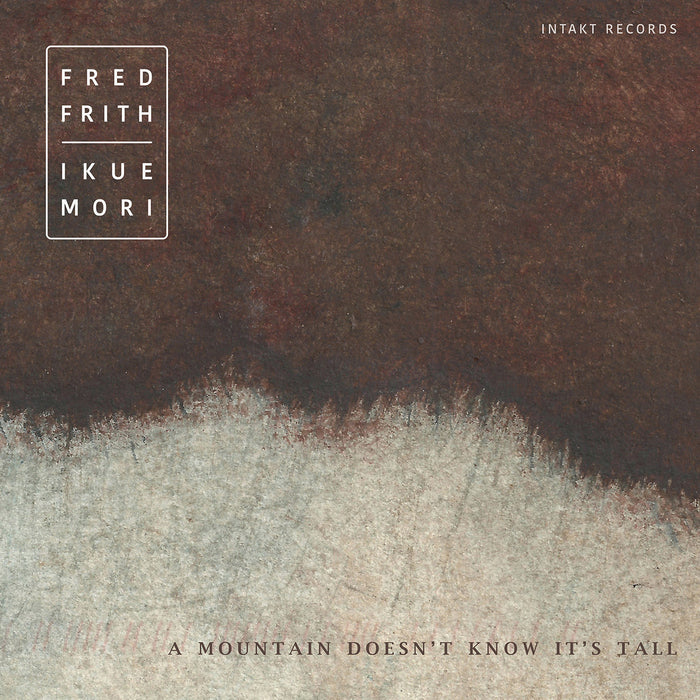
352: FRED FRITH – IKUE MORI. A Mountain Doesn’t Know It’s Tall
Intakt Recording #352/ 2021
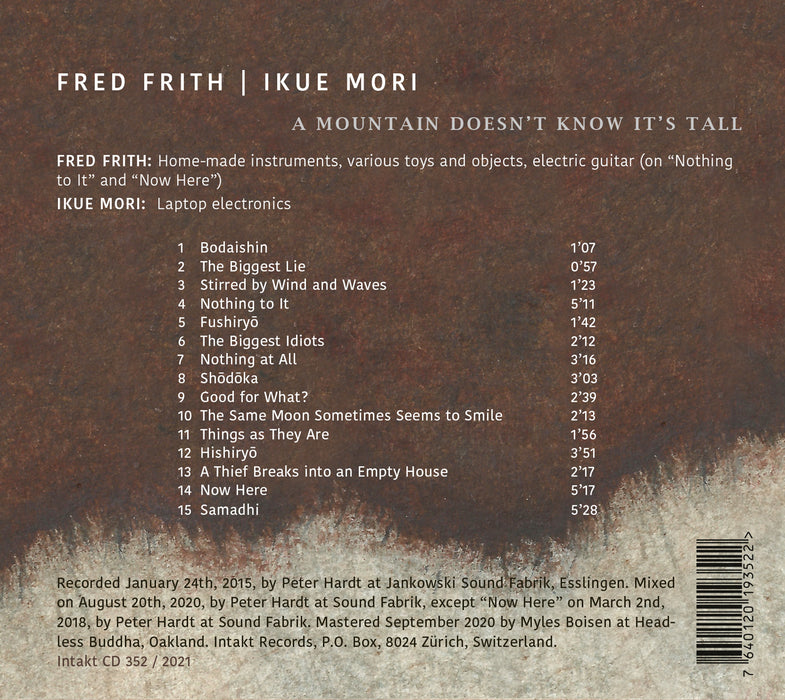
Fred Frith: Home-Made Instruments, Various Toys and Objects, Electric Guitar
Ikue Mori: Laptop Electronics
Recorded January 24th, 2015, by Peter Hardt at Jankowski Sound Fabrik, Esslingen.
Sale
Sale
Original price
CHF 13.00
-
Original price
CHF 30.00
Original price
CHF 30.00
CHF 13.00
-
CHF 30.00
Current price
CHF 30.00
| /
More Info
A Mountain Doesn't Know It's Tall. The title reflects the mood of this duo record of Fred Frith and Ikue Mori – playful, poetic, mysterious and open. The guitarist and the sound-artist have been working together for forty years. Live excerpts from their work are documented on Fred Frith's 3 CD box set Live at the Stone (Intakt CD 320).
In January 2015, Frith and Mori met in Germany to record the music for a radio play for Werner Penzel, the filmmaker and longtime friend of Fred Frith, for his film Zen for Nothing. After finishing their work, they used the free studio day to record their first duo album together. Influenced by the film music and inspired by the long friendship 15 pieces were created that are both wonderful sound sculptures and fascinating dialogues.
Fred Frith writes: “Air moving through ears and hair and lungs and pores, through songs,and scrapes, and scraps of this, that and the other.” And Ikue Mori writes: “... it was about playing with the every- day noises that arise when cooking, playing ping-pong, and especi- ally when laughing. There is a lot of joy in working with these recor- dings, interacting with them and making music.”
Album Credits
Cover art: Heike Liss
Cover and graphic design: Fiona Ryan
Photo: Ayako Mogi
Recorded January 24th, 2015, by Peter Hardt at Jankowski Sound Fabrik, Esslingen. Mixed on August 20th, 2020, by
Peter Hardt at Sound Fabrik, except “Now Here” on March 2nd, 2018, by Peter Hardt at Sound Fabrik. Mastered September 2020 by Myles Boisen at Headless Buddha, Oakland. Produced by
Fred Frith and Intakt Records. Published by Intakt Records, Patrik Landolt, Anja Illmaier, Florian Keller, P.O. Box, 8024 Zürich, Switzerland
- 5 stars: 23 (100%)
- 4 stars: 0 (0%)
- 3 stars: 0 (0%)
- 2 stars: 0 (0%)
- 1 star: 0 (0%)
K
Kevin Whitlock Avant-guitarist Frith and sound artist Mori have worked together for years now and this collaboration, taped in 2015, is inspired by film music and their long friendship; the 15 'sound sculptures' here make for fascinating dialogues between Frith's guitar and home-made instruments and Mori's computer and electronics.
G
Guy Peters Een vrije studiodag leidde tot het eerste studioalbum van Frith en Mori, ook al kruisen hun paden intussen al 4 decennia via allerhande projecten en concerten. De muziek draagt vaag nog de sporen van de soundtrack over een Japans klooster die ze de dagen ervoor maakten, maar is vooral een duik in geluid en vrijheid. Mori staat zoals gewoonlijk garant voor een delirische stroom van druppel-, fluit- en knisper-elektronica, terwijl Frith, tja, geen idee wat die precies uitspookt. De gitaar maakt 2 keer z'n opwachting, maar daarnaast is hij vooral in de weer met allerhande metalen objecten, dingen die klinken als duimpiano's, deksels, tollen, kinderbestek en springveren. Spontane interactie met een surreëel-ritualistisch randje voor open oren die geen plaatje nodig hebben om de verbeelding op hol te jagen.
A
Alberto Bazzurro Elettronica a gogo in questo album inciso oltre sei anni fa, nel gennaio 2015, a Esslingen, sud-ovest tedesco, tra due degli improvvisatori più radicali (ma per altri versi anche sufficientemente versatili, visti i molteplici terreni toccati nelle loro ormai lunghe carriere) in circolazione, Fred Frith, classe 1949, da Heathfield, East Sussex, e Ikue Mori, classe 1953, da Tokio.
Le coordinate del lavoro possono essere a questo punto anche piuttosto intuibili, e in effetti non ci si discosta troppo (forse per niente) da quanto potevamo attenderci da un album del genere, fortemente sperimentale e a tratti rumoristico, e tuttavia piuttosto vivo, specie nella prima parte (grosso modo i primi sei dei quindici brani), dopo di che, abbastanza gioco forza, certe situazioni tendono a ripetersi e non accade nulla che non fosse già accaduto in precedenza.
Si procede così per poco meno di tre quarti d'ora, non senza fremiti periodici, ma con un ascolto che si fa—anche qui gioco forza—via via più distratto, discontinuo. Il che non ci impedisce di salutare il lavoro come degno di attenzione e certamente meritevole di esser portato dopo lunga attesa agli onori della cronaca.
https://www.allaboutjazz.com/a-mountain-doesnt-know-its-tall-fred-frith-ikue-mori-intakt-recordss
R
René van Peer HET VERHAAL VAN FRED RECORDS
Een muzikaal monument in drie kartonnen doosjes
GEWEZEN SCHATTEN
Onlangs verscheen 'The Fred Records Story', een monumentale verzameling van muziek die gitarist en componist Fred Frith in de loop van veertig jaar heeft gemaakt. 27 cd's in drie doosjes bieden een rijk geschakeerd overzicht van liedjes, improvisaties en briljant muzikaal knutselwerk.
Het licht verende, dansende geluid van een mondharp krijgt gezelschap van een wat aarzelende bas. Over die ritmische tandem ontvouwt zich een vriendelijke, bijna kinderlijk aandoende melodie op gitaar, alsof de speler dromerig met het hoofd in de wolken loopt. Al snel mengt zich een keyboard in dit samenspel met één steeds herhaalde hoge toon. Een luide kreet doorbreekt die idylle van muzikale rust, waarna een koor van blokfluitjes een extatisch rondedansje begint. De bas zwelt aan, vervormt. Het keyboard gaat akkoorden spelen die de lucht doen betrekken. Door deze muziek heen **** je een rollend blikje en straatkinderen die elkaar aanmoedigen. Dan, na een paar wilde akkoorden op de toetsen, stort alles in.
Zo eindigt het album 'Speechless' van Fred Frith, een van de 27 titels verzameld in 'The Fred Records Story'. Twintig jaar geleden begon deze gitarist, improvisator en componist, ooit lid van de baanbrekende Britse band Henry Cow, met het uitbrengen van zijn muziek op Fred Records. Het was een sublabel van RēR Megacorp, dat geleid wordt door zijn oude kompaan Chris Cutler. Frith besloot daartoe toen Rec Rec Music, een maatschappij die een aantal albums van hem had uitgebracht, over de kop ging. De rechten kwamen hem weer toe. Iets vergelijkbaars gold de platen die hij had uitgebracht bij Ralph Records, het label van The Residents. Een van die platen was 'Speechless'.
IMPRO-PUNK
Tussen 2001 en 2015 kwamen die albums uit, aangevuld met opnamen uit zijn archief. Samen bieden die een omvangrijk overzicht van Friths werk, dat overigens verre van compleet is. Zijn totale catalogus omvat meer dan tweehonderd titels. De albums op zijn eigen label zijn nu gebundeld uitgebracht, in drie stevige kartonnen doosjes. In elk doosje zit een boekje met uitgebreide informatie op basis van interviews met ene 'Piet Schaap, klaarblijkelijk een pseudoniem. En niet alleen dat, op navraag laat Frith weten dat hij de interviewer uit het oog verloren is, maar dat hij diens wens om onbekend te blijven wil respecteren. Behalve omvangrijk is het overzicht in de drie delen van 'The Fred Records Story' ook rijk geschakeerd. Het is ondoenlijk om die diversiteit in detail te beschrijven. Er zijn cd's met liedjes, zoals 'Cheap At Half The Price' (met Frith op een Casio-keyboard), 'Prints' en de twee albums die hij met Skeleton Crew maakte. Er zijn geïmproviseerde cd's, zoals 'Guitar Solos' uit 1974 en 'Live in Japan', waar hij solo op speelt, Art of Memory II' (waarop hij in gezelschap is van John Zorn) en de ruige impropunk op 'Killing Time' van het trio Massacre, met Bill Laswell op bas. Het derde deel van de verzameling bevat vooral muziek die Frith bij dansvoorstellingen maakte.
Frith drumde een basritme, vegend met een kwast over een microfoon.
LIEDJES
De verzameling maakt onomstotelijk duidelijk hoe veelzijdig en flexibel Frith altijd is gebleven. Van de teugelloos raspende, overstuurd gierende en zoemende klanken die hij al improviserend uit zijn 'gitaar op de tafel' haalt in de Japanse concerten, de al dan niet verknipte dansen op 'Gravity', de knorrige stem vol zelfspot in 'Same Old Me' op 'Cheap At Half The Price' tot het uitbundig recycleren van zijn eigen werk op 'Field Days', een album met muziek voor een voorstelling van het Nederlands Dans Theater op een choreo-grafie van Amanda Miller. En, niet te vergeten, 'Impur' en 'Impur II': een evenement in een Franse muziekschool waarbij groepen studenten in verschillende lokalen gelijktijdig stukken speelden die Frith daar tijdens een residency geschreven had.
Gevraagd naar de rode draad in deze veelheid aan vormen is Frith heel stellig. 'Liedjes. Dat is mijn achtergrond. Ik begon met optreden in folkclubs in de jaren 1960, en daar voel ik me het meest bij op mijn gemak. De consequentie daarvan is dat ik, zelfs wanneer ik aan het improviseren ben, altijd de neiging heb om met relatief korte eenheden te werken, met een verhalende draad die daar doorheen loopt en ze aan elkaar verbindt. Al moet ik er meteen bij zeggen dat dat nooit van tevoren zo is opgezet. Ook de meeste muziek die ik voor dans maak, bestaat uit afzonderlijke delen van verschillende lengte. In zekere zin zou je dat ook 'liedjes' kunnen noemen, ze hebben dezelfde opzet. Ongeacht wat voor stijlen of richtingen je in mijn muziek denkt te kunnen onderscheiden, wat ze allemaal gemeen hebben is die achtergrond.
KWAST
Wat ze zeker ook gemeen hebben, is een speelse omgang met muzikaal materiaal. 'Ik gebruik gevonden geluiden, omgevingsopnamen en opnamen van plekken waar ik op een bepaald moment woon. Daartoe horen ook de New Yorkse ki...
T
Tom Greenland Machines are putting people out of work, doing those repetitive (and not-so-repetitive) jobs faster and better, without tiring. In the jazz place, humans needn't worry they'll be replaced, as it's inherently impossible to pre-program a musical 'surprise'. In fact, three recent releases suggest that men and machines are learning to work together, to the benefit of both.
Berlin-based Ignaz Schick imaginatively deploys turntables, samplers and live electronics in a variety of settings, especially duos. Altered Alchemy, a duet with pianist Achim Kaufmann recorded in the winter of 2016, is a generous two-CD set (comprised of 8 tracks averaging 15 minutes in length), which, as the title suggests, shows how the sound worlds-acoustic piano prepared with various implements and battery of custom electronics-collide, blend and transmogrify their creative elements. Here the 'natural' and mechanical materials are not at odds -one never overpowers the other and there is no patent leadership - rather they collectively engender a kind of musical gnosis. Some samples seem familiar (dogs, rain, people murmuring), but most are metaphorical in character: hissings and creakings, whirrs and rumbles, sirens and static-all highly suggestive, few with overt references.
Under the Sun is similar in the sense that it amalgamates the realms of 'acoustica' and electronica through spontaneous improvisation, different because it is four musicians performing live. Led by Rafael Toral, who plies a handheld controller (akin to those used by gamers) to exhort acoustic and electronic feedback from his amp, the Space Quartet also has bassist Hugo Antunes, drummer/percussionist Nuno Morão and Nuno Torres, who switches between alto saxophone and electronics, thereby shifting the electronic-to-acoustic ratio between 1:3 and 2:2. A pair of 20-minute pieces were recorded in October 2019 in Portugal, the title track at ZDB in Lisbon, "Beneath the Moon" at Teatro Viriato in Viseu. Toral's approach to electronic synthesis (complemented by Torres') is notable for his juxtaposition of vocalistic tones evoking the cries of feral beasts with overtly robotic tones reminiscent of Star Wars droid R2-D2.
In spite of their almost 40-year association, A Mountain Doesn't Know It's Tall is the first duet record by Ikue Mori and Fred Frith, the former featured on laptop electronics, the latter on guitar and home-made instruments and found objects (including "toys"). If the alchemists of the first disc favored epic musical poems, the quartet of the second shorter stanzas, then Mori and Frith are working in the milieu of haiku: terse statements of a minute or two or three, musical pictographs inspired by programmatic titles (or was it the other way around?) such as “Stirred by Wind and Leaves” or “A Thief Breaks into an Empty House". Of the electronic musicians featured here, Mori is perhaps the most abstract, but even her most eccentric gestures are so intimately entwined with Frith's that the two are often indistinguishable.
R
René van Peer Improvisaties kunnen een flinke tijd in beslag nemen. Zo geven de deelnemers zichzelf de mogelijkheid om in alle rust (of hectiek) een muzikale conversatie op te bouwen en te zien waar hun inspanningen toe leiden.
Doorgaans volgen opnamen dat traject. Gitarist Fred Frith (ooit begonnen bij Henry Cow) en digitaal slagwerker Ikue Mori, beiden door de wol geverfd, hebben op 'A Mountain Doesn't Know It's Tall' gekozen voor een heel andere aanpak. Vijftien tracks, waarvan er maar drie boven de vijf minuten uitkomen, en één nog geen minuut lang is. Al hebben ze nog niet eerder een duo-cd uitgebracht, blijkbaar zijn de twee zo goed op elkaar ingespeeld dat ze meteen ter zake komen. Mori trekt de trukendoos van haar laptop wagenwijd open. Daarbij raakt ze ver verwijderd van de gebruikelijke elektronische percussie. Frith speelt vooral zelfgebouwde instrumenten en allerhande voorwerpen en speelgoed. Slechts op een paar tracks pakt hij zijn gitaar erbij. Het resultaat is een verzameling stukken die alle kanten op schieten. Soms zijn de klanken zo hybride dat niet uit te maken valt wie van de twee er precies verantwoordelijk voor is. Maar steeds weten ze je te verrassen met fijnzinnige interacties en dialogen, die versmelten tot een kernachtige uitspraak. Wanneer Frith in 'Nothing To It' aan de snaren van zijn gitaar plukt, stelt Mori daar verwante klanken tegenover, om vervolgens op te bloeien in een veelheid aan geluiden die qua diversiteit kunnen wedijveren met een gezonde jungle. Onderwijl gaat Frith zich te buiten aan prachtig schrijnende akkoorden. Buitenissig en inspirerend.
H
Hannes Schweiger Elektro-akustische Musik, erfunden im Zuge eines freien Improvisations-prozesses. Geprägt von einem perkussiven Klangbild, das sich primär aus punktuellen Ereignissen formiert. Tradierte Formvorstellungen sind in diesen Momentstudien gänzlich aufgehoben. Bestreben in diesem Duo ist das differenzierte Agieren/Reagieren mittels der elementaren Schichten von Klang und Rhythmus. Die Kleinteiligkeit des Klangbildes erlebt in den kurzen Sketches einen breitgefächerten Variantenreichtum, bevorzugt
aber hinsichtlich Bewegungsdynamik eine fein abgestimmte Unruhe. Das Zusammenspiel funktioniert überhaupt auf hohem Niveau gegenseitigen Verständnisses und Aufspürens von Aktionen. Zuweilen vermittelt sich das Gehörte als elektronische Musik mit analogen Klangschlieren, andererseits als Analogie zu musique concrète, jedoch ausgespielt mit den Klangqualitäten und der rhythmischen Vitalität von Jazz und Rock grandios verschmolzen. Es klingt futuristisch und archaisch zugleich. Eine Folge einerseits wegen des trocken sperrigen Sounds der DIY-Instrumente und Spielzeuge (Frith), andererseits der oszillierenden, gefilterten, verfremdeten, artifiziellen Sounds (Mori) wegen. Amalgamiert sind sie allerdings zwingend kompatibel mit der Gegenwart. Dieser Session vorausgegangen ist die Arbeit der beiden an einem Soundtrack zu einer Dokumentation über ein japanisches Zen-Kloster. Somit entschleunigte sich der Dialog ab und an auch zur Meditation über intuitive Musik.
W
Wolfgang Suschnig Gab es eine Zeit vor Fred Frith? Es hat den Anschein, ihn und auch seine improvisierende Partnerin Ikue Mori hätte es schon immer gegeben. Beider Diskografien umfassen zusammen wohl mehr als 700 Alben. Umso erstaunlicher, dass Mori und Frith hier zum ersten Mal als Duo in Erscheinung treten. Beide hatten 2015 nach der Arbeit am Soundtrack für Werner Penzels Film Zen for Nothing noch einen Tag Studiozeit, die für diese Aufnahmen genutzt wurde. Vielfach stehen sie noch unter dem Eindruck der Arbeit an Penzels Film über das Leben in einem buddhistischen Kloster in Japan (z.B. Bodaishin, Fushiryõ oder Shõdõka). Zur elektrischen Gitarre greift Frith (laut liner notes) nur in zwei Stücken, sonst bedient er jede Menge Spielzeug, selbst gebaute Instrumente, eigentlich alles, womit man Klänge und Geräusche erzeugen kann und was in Esslingen damals greifbar gewesen sein muss. Selbst Luftzüge werden hörbar gemacht. Dazu gesellt sich mit Schalk im Nacken Mori mit ihrem elektronischen Equipment, einem Laptop. Selbst Gelächter, Tischtennis- und Kochgeräusche werden verfremdet in einen improvisatorischen Kontext gesetzt. Es empfiehlt sich, nicht nebenbei ein Essen zuzubereiten. Pfeift der eigene Schnellkochtopf, oder sind es die Geräusche aus den Boxen (wie der Rezensent persönlich erfahren musste)? Wie sagte schon Kurosawas Kagemusha: „Der Berg bewegt sich nicht."
B
Ben Taffijn De invloed van Fred Frith op de hedendaagse muziek kan moeilijk worden overschat. Hij speelde in Henry Cow, John Zorn's Naked City, Massacre en nog zo wat andere grensverleggende bands op het snijvlak van rock, noise en vrije improvisatie. De laatste jaren is hij vooral meer opgeschoven naar dat laatste, zoals ook weer blijkt uit het recent verschenen 'A Mountain Doesn’t Know It’s Tall' dat hij voor Intakt Records opnam met laptopkunstenares Ikue Mori. Takashi Masubuchi is voor mij nieuw - en ik zal niet de enige zijn. Toch bouwde ook hij de afgelopen jaren aan een aardige discografie, met drie albums in het afgelopen jaar, waaronder het bij Headlights verschenen 'Dripping Nocturne', waarin we hem horen met bassist Shizuo Uchida.
Frith en Mori kennen elkaar zo'n veertig jaar, maar maakten vreemd genoeg nooit eerder samen een geïmproviseerd album. En als ze toen in januari 2015 niet een dag over hadden gehad, ze werkten samen aan een soundtrack, was dit album er wellicht ook nooit gekomen. Soms zit het ons dus mee. Het bijzondere aan dit album is dat we Frith kennen als gitarist, maar dat hij maar in twee stukken, 'Nothing To It' en 'Now Here', op dit instrument is te horen! Op de achterzijde van het album staat verder 'home-made instruments, various toys and objects'. En dat, in combinatie met de laptop van Mori, levert een enorme diversiteit aan geluiden, samenvallend tot een kaleidoscopisch kunstwerk waarin het experiment vooropstaat. En probeer daarbij vooral niet om uit te vinden wie nu precies welk geluid maakt, onbegonnen werk. We missen die gitaar dus geenszins, al klinkt hij prachtig gruizig, tegen noise aanleunend in 'Nothing To It', meeslepend in 'Now Here' en denken we hem te horen in 'Hishriyo', maar blijkbaar is dat Mori's laptop.
https://draaiomjeoren.blogspot.com/2021_04_01_archive.htmll
M
Mark Corroto Have you experienced a performance of John Cage's composition "4:33"? If you are not familiar, while studying Zen Buddhism, Cage wrote "four minutes, thirty-three seconds" to be performed solo or in any combination of instruments or players. The instructions were for the performers to NOT play their instruments for the allotted 273 seconds. Their 'silence' was not silence at all. The audience was immersed in the environmental sounds of the concert hall, amphitheater, or room. What one heard was the 'noise' (Cage's notes) of the space, which could be the audience's muffled coughs and breathing, and the wind or creaky chairs, and if you listened closely enough, one's own heartbeat.
That same Zen Buddhist experience is available to you with Fred Frith and Ikue Mori's A Mountain Doesn't Know It's Tall. Not that the pair played nothing, but the sounds they created could easily be those heard during a performance of "4:33," at least one performed on an orbiting space station's soundstage. Frith, first known for his guitar work in Henry Cow and Art Bears and later as bassist for John Zorn's Naked City, only picks up a guitar on two of the fifteen tracks here. Mostly it is home—made instruments, toys and unidentified objects that he (plays?) manipulates. That same massage happens with Mori's electronics. Her progression from drumming in the downtown trio DNA with Arto Lindsay in the late 1970s and early 80s to drum machines in Death Ambient evolved to laptop electronics. Mori can be heard with Satoko Fujii, Mette Rasmussen, Ken Vandermark, and Wadada Leo Smith, to name just a few musicians. Like Frith, in improvisation circles, she is in high demand.
That Zen connection is the motivation here. After scoring music for a radio play and soundtrack, both Zen Buddhist-related, Frith and Mori found they had an extra studio day. These 15 tracks came together, not as random improvisations, but more like a continuous whole. The music is, if anything, extraterrestrial. Woolly electronics, are they emanating from the body, the soul, or the mind? Does the Bladerunner have a dial-up modem? Is there a basilica on the moon? Mori's sound has evolved from beats to an electric elocution. Her language is circuits and atmospheres. Frith and Mori participate in a cyborg dialogue, part binary code/part organic. If we haven't told you enough about the actual sounds, that's because everyone hears something different during "4:33."
https://www.allaboutjazz.com/a-mountain-doesnt-know-its-tall-fred-frith-and-ikue-mori-intakt-recordss
B
Ben Taffijn De invloed van Fred Frith op de hedendaagse muziek kan moeilijk worden overschat. Hij speelde in Henry Cow, John Zorn’s Naked City, Massacre en nog zo wat andere grensverleggende bands op het snijvlak van rock, noise en vrije improvisatie. De laatste jaren is hij vooral meer opgeschoven naar dat laatste, zoals ook weer blijkt uit het recent verschenen ‘A Mountain Doesn’t Know It’s Tall’ dat hij voor Intakt Recordings opnam met laptop kunstenares Ikue Mori. Takashi Masubuchi is voor mij nieuw en ik zal niet de enige zijn, toch bouwde ook hij de afgelopen jaren aan een aardige discografie op, met drie albums in het afgelopen jaar, waaronder het bij Headlights verschenen ‘Dripping Nocturne’, waarin we hem horen met bassist Shizuo Uchida.
Frith en Mori kennen elkaar zo’n veertig jaar maar maakten vreemd genoeg nooit eerder samen een geïmproviseerd album. En als ze toen in januari 2015 niet een dag over hadden gehad, ze werkten samen aan een soundtrack, was dit album er wellicht ook nooit gekomen. Soms zit het ons dus mee. Het bijzondere aan dit album is dat we Frith kennen als gitarist, maar dat hij maar in twee stukken, ‘Nothing to It’ en ‘Now Here’, op dit instrument is te horen! Op de achterzijde van het album staat verder “Home-made instruments, various toys and objects”. En dat, in combinatie met de laptop van Mori, levert een enorme diversiteit aan geluiden, samenvallend tot een kaleidoscopisch kunstwerk waarin het experiment voorop staat. En probeer daarbij vooral niet om uit te vinden wie nu precies welk geluid maakt, onbegonnen werk. We missen die gitaar dus geenszins al klinkt hij prachtig gruizig, tegen noise aanleunend in ‘Nothing to It’, meeslepend in ‘Now Here’ en denken we hem te horen in ‘Hishriyo’, maar blijkbaar is dat Mori’s laptop.
https://www.nieuwenoten.nl/fred-frith-ikue-mori-a-mountain-doesnt-know-its-tall-takashi-masubuchi-shizuo-uchida-dripping-nocturne-cd-recensie//
M
Marcello Lorrai Fra i più brillanti musicisti europei di area jazzistica affermatisi nel nuovo millennio compirà quarant'anni nel prossimo maggio Alexander Hawkins da qualche anno ha trovato un interlocutore non occasionale nella Intakt, e in puntate di Jazz Anthology del 2019 e 2020 che potete trovare in podcast abbiamo seguito le sue uscite con l'etichetta svizzera: siamo adesso alla quarta, Togetherness Music, un ambizioso lavoro all'incrocio fra scrittura e improvvisazione, con una compagine di sedici elementi dalla fisionomia abbondantemente cameristica in cui figura però anche un maestro della free music europea come il sassofonista Evan Parker con improvvisazioni senza compromessi al sax soprano. Gli interessi della Intakt si estendono anche a musiche di ricerca che non rientrano propriamente in un'area definibile come jazzistica: nel caso del duo di Fred Frith altro artista che ha con la Intakt un rapporto importante e di Ikue Mori c'è comunque una fantastica dimensione improvvisativa, che si coniuga con il rumorismo e l'elettronica in seducentissimi paesaggi sonori, vivissimi, giocosi, pieni di humour e di musicalità.
https://www.radiopopolare.it/podcast/jazz-anthology-di-lun-15-03-21//
J
Jean Buzelin Fred Frith, pilier de la maison suisse Intakt, retrouve en 2015 Ikue Mori, compositrice de musique électronique installée à New York depuis 1977, avec qui il a déjà travaillé (voir notamment Intakt CD 320) et enregistré, entre autres en compagnie de l’Ensemble Modern de Francfort. Dans les domaines des musiques dites improvisées, la musicienne japonaise a joué avec Marc Ribot, Zeena Parkins, Dave Douglas, Sylvie Courvoisier (Intakt), Craig Taborn... et John Zorn en particulier (une vingtaine de disques ensemble). Ce nouveau duo, très ouvert et aéré, comprend quinze petites pièces variées, fines, subtiles, souvent légères malgré les bruitages, tapotements, frottements et autres raclements d’instruments bricolés, jouets et objets divers – Fred Frith n’utilisant sa guitare que sur deux morceaux. Sur son laptop électronique, Ikue Mori fournit souvent les soubassements, mais indique également avec grande précision, les directions à prendre, à l’aide de sonorités particulièrement bien choisies. Un bel exemple de rencontre réussie entre la free music et la musique électroacoustique contemporaine.
https://www.culturejazz.fr/spip.php?article3662
S
S. Victor Aaron Fred Frith and Ikue Mori are not just big names in the world of experimental music, they’ve both held that status for ages, so their early 2021 release A Mountain Doesn’t Know It’s Tall is a welcome meeting of old pros. Frith co-founded the Canterbury ensemble Henry Cow that thrived in the 70s and all I can think of when I listen to my Unrest CD is how much Frith’s guitar sounded like some forward-thinking guitar player of the 21st century was dropped into 1974. Since then, he’s built an exhaustive catalog of wide-ranging material under his own name and teamed up with a number of liked-minded avanteers.
Mori was the drummer in that groundbreaking no-wave band DNA for a few short but critical years with Arto Lindsay in the late 70s around the time Henry Cow was splitting apart. Afterwards, she moved on to programmed drums and started dabbling into sampling, finally settling on the laptop computer. There, she completely mastered the art of creating on the fly from an arsenal of an endless array of noises. She’s collaborated with many fellow prominent experimentalists and filmmakers over the years and lately we’ve been getting a heaping helping of her skills on recordings involving fellow Japanese native Satoko Fujii.
A Mountain Doesn’t Know It’s Tall is collaboration of artists very familiar with each other; Frith and Mori have worked together for more than four decades. They were even in the same band in the 90s along with bassist Kato Hidek, called Death Ambient. That was back when Mori was playing drum machines; Mountain pits Frith one-on-one against Mori — now on laptop — for the first time.
Most of these tracks run less than three minutes; several of them under two. But it’s best to take in this record not as a discreet set of “songs” but a continuous string of extemporaneous performances. Frith’s clinical, yet chaotic approach to guitar, along with home-made instruments, “various toys and objects” with all its unusual timbres makes it such an impeccable fit for Mori’s randomized menagerie of bent circuit sounds both tonal and percussive. Often, it’s hard to pull the two apart.
“Nothing To It” is only one of a couple of occasions where Frith is playing guitar. It’s also the first track that runs long enough to evolve and amid Mori’s symphonic, threatening backdrops and random chirping is Frith’s heavy fuzztone articulating the tension suggested from the laptop. “Nothing At All” shows that these artists of noise can deftly create and manipulate silence and hushed moments. “Hishiryo” is a Japanese-sounding title and similarly, the music has a distantly Japanese folk flavor to it, a reminder us that this synthetic music is organically inspired.
“Now Here” begins with a church-like solemnity while Frith noodles on his guitar as the later sounds of a guitar looped backwards contrasts with it. The concluding track “Samadhi” runs through a succession of trippy phases where Mori’s laptop mimics the resonance of an organ from ****.
This is obviously not music for all tastes but if you know about Fred Frith and Ikue Mori, then you know how good they are at making noise; for A Mountain Doesn’t Know It’s Tall they make beautiful noise together.
https://somethingelsereviews.com/2021/03/15/fred-frith-ikue-mori-a-mountain-doesnt-know-its-tall-2021/
P
Piercarlo Poggio Il pianista inglese ha provveduto a tirare nuovamente fuori l'artiglieria pesante e in "Togetherness" si presenta in ampia compagnia: dal soprano-mantice di Evan Parker a una formazione di otto elementi diretta da Aaron Holloway-Nahum e agli archi del Riot Ensemble. La scrittura per così tanti strumentisti e la predisposizione delle fasi improvvisate diventa non poco impegnativa, ma Hawkins dimostra comunque di saperci fare in questa programmata organizzazione del caos. Rinuncia invece in parte a prodursi al pianoforte e quando lo fa (Leaving The Classroom Of A Beloved Teacher, Optimism Of The Will) il suono entra in dinamiche meno pretenziose e più jazzisticamente riconoscibili. Parker occupa e guida Indistinguishable From Magic sino a quando verso il termine viene sopraffatto da ondate d'archi, il trombettista Percy Pursglove gode di uno spazio analogo in Sea No Shore, elevandosi sul canovaccio percussivo di Mark Sanders. Disco intricato e problematico, non così rivoluzionario come forse aspirava ad essere. (7) Anche se fa strano dirlo, "A Mountain Doesn't Know It's Tall" è la prima volta che Frith e la Mori incidono un intero album insieme. È la sommatoria delle loro individualità rumoriste, che si adattano e collimano senza alcuna difficoltà, stimolandosi a vicenda. Le tracce hanno durata contenuta, sono frammenti sovente evocanti suoni quotidiani, altre spazi siderali e misteriosi. Non pare però di poter dire che nell'occasione 1+1 sia uguale a 3, come a volte accade nei meeting tra artisti dotati di super-poteri. (7)
Il piano trio della Takase è in apparenza di impianto classico (Weber è al contrabbasso, Griener alla batteria) e riesce tuttavia a non risultare scolastico, grazie all'esperienza che può mettere in campo. Lei come sempre fatto si presenta con fraseggi sciolti e dinamici, qualche volta persino impetuosi, però spezzati e interrotti di continuo, per non correre il rischio di diventare troppo didascalica. Negli interstizi dei suoi interventi crescono e prosperano le individualità dei compagni, da lei stessa stimolati a offrire di continuo nuove prospettive all'ipotesi tematica del brano. Sul piano stilistico si avverte netta la sensazione del riposizionamento incessante tra le modalità afroamericane e quelle europee, riassunte in una sintesi in molti punti equili-
W
Werner Siebert Die japanische Computer-Impro-Klangkünstlerin Ikue Mori hat sich für diese Einspielung an einem Tag im Jahr 2015 mit dem bekannten Gitarren-Geräusch-Schrammler Fred Frith zusammengetan für ein Sammelsurium an kurzen und längeren gemeinsam improvisierten Tracks. Im Jahr 2020 gemischt und gemastert, hören wir Theremin-artiges, allerlei Plingeln und Rumpeln, darüber oder darunter Geräusche verschiedener homemade instruments sowie aus der präparierten Gitarre. Oder einer Gitarre, die mit verschiedenen Materialien bearbeitet wird. Das alles konnotiert mir nicht mit einem im Unbewussten schlummernden Bergriesen, ganz im Gegenteil. Es ist ein nettes, ziemlich mäßig spannendes Mit- bzw. Nebeneinander, zu dem Mori den viel-leicht interessanteren Teil beiträgt.