
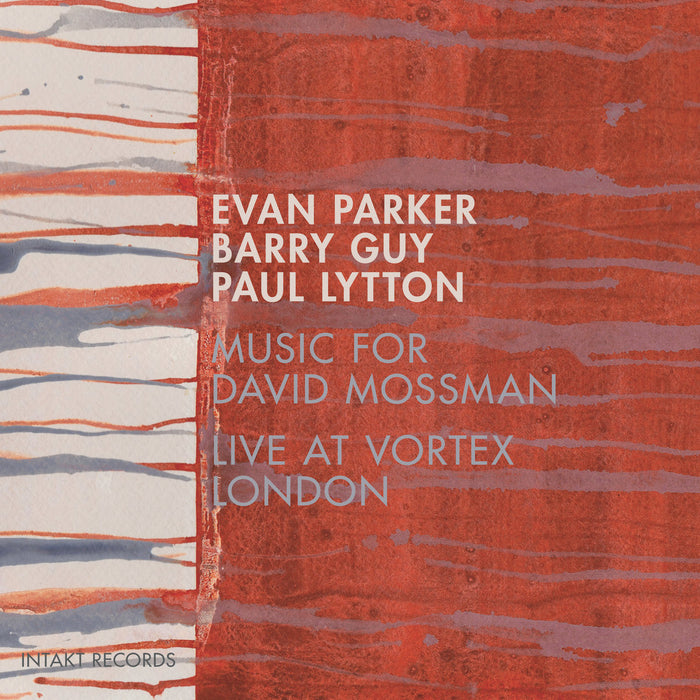
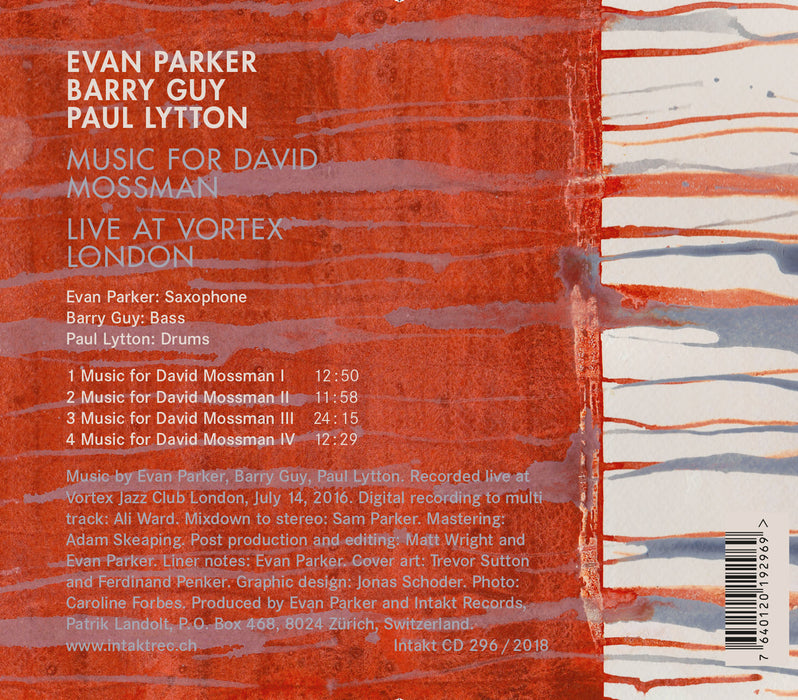
296: EVAN PARKER – BARRY GUY – PAUL LYTTON. Music For David Mossman - Live At Vortex London
Intakt Recording #296/ 2018
Recorded live at Vortex Jazz Club London, July 14, 2016.
Original price
CHF 12.00
-
Original price
CHF 30.00
Original price
CHF 30.00
CHF 12.00
-
CHF 30.00
Current price
CHF 30.00
More Info
Album Credits
G
Dans les notes qu'il signe pour ce nouvel enregistrement du trio qu'il forme avec Barry Guy et Paul Lytton, Evan Parker rend hommage à John Stevens avant de revenir sur sa longue collaboration avec une paire rythmique d'exception: << J'ai rencontré Paul Lytton pour la première fois en 1967 à l'occasion d'un festival de musique qui se tenait dans un parc de Birmingham où je jouais en duo avec John... >>
Compagnons du London Jazz Composers Orchestra de Barry Guy, Parker et Lytton ont joué en duo puis, dès 1980, en trio avec le contrebassiste. Si Tracks, le premier enregistrement de l'association, a paru en 1983 sur Incus, sous œuvre a été publiée par une pléiade de labels (Emanem, Leo, Marge, Clean Feed, CIMP et bien sûr Maya et psi) que vient aujourd'**** grossir Intakt.
Ce sont-là deux sets enregistrés le 14 juillet 2016 au Vortex de Londres et quatre pièces que le trio dédie au fondateur du club, David Mossman. Solos, duos, trios: les combinaisons changent et, avec elles, les directions de cette nouvelle et saisissante épreuve d'improvisation libre. Et puisque les musiciens, en plus d'être capables, sont depuis longtemps intimes, ils adaptent leurs discours personnels sans jamais faillir: ce sont Guy et Lytton qui s'expriment avec une même retenue (II), Parker qui invente en frénétique à la suite de Lytton (III), Guy qui rejoint Parker au son d'un archet fragile (IV)... Quant à la première pièce du disque, sa mise en place augurait une heure fabuleuse: et c'est ce qui est arrivé.

B
Regardless of one’s field of interest or study, there are texts that are occasionally, if not regularly revisited, either to refresh the conviction that they are important, or extract a potentially phosphorescent quote. When it comes to improvised music, Derek Bailey’s Improvisation: its nature and practice in music is central. The iconic guitarist’s exacting perspective set the bar for discourse about improvised music, while his softly prodding approach as an interviewer yielded gem-like statements from improvisers of disparate stripes. Having read the book several times since the early 1980s, there are phrases and passages from it that come to mind, at times vaguely, when listening or writing; yet, they never fail to ring true when reread. The most recent instance involves an intriguing quote from Wadada Leo Smith about what he called the independent center of an improvisation, which Bailey referenced in regards to the limited lifespan of most improvising groups. Here is the relevant passage as printed in the first version of Bailey’s book, published by Moorland in 1980:
“[T]he played-out improvising group suffers a loss of what Leo Smith describes as the ‘independent centre’ of the improvisation; that part of the music which exists independently of the performers, intentions and seems to be created by a sort of second-degree or sub-conscious relationship between the players. The undefinables get defined or disappear.” [Page 145]
What stood out, grammatically, was a disruptive, even ill-placed comma between “performers” and “intentions.” Graphically, it suggested a fallen apostrophe, which would have sharpened the sentence. Perhaps a correction in the second version would allow the passage to be quoted without a bracketed phrase masking the comma, or the more stinging option of leaving the blemish and injecting [sic]. Surprisingly, the chapter from which the passage concluded its lead paragraph – Limits and Freedom I – was not listed as such in the second version’s table of contents; apparently, the two Limits and Freedom chapters from the first version were compressed into one for the second version of the book. Certainly, this critical passage had been retained, for it supported one of Bailey’s core positions – that ad hoc ensembles were indicated for improvised music.
However, the passage was gone. Because the second version of Improvisation included a name index – the absence of one in the first version being a recurring frustration – a quick check was possible to see if the passage centered on Smith’s phrase had simply been moved elsewhere in the book. It hadn’t – it had been expunged from this vital text. This spurred the curiosity to discern what else had been cut. A comparably important passage beginning on the very next page had also been removed, the implications of which were more far reaching.
The passage pivots on Bailey’s articulation of the “semi-ad-hoc” ensemble, “[a] situation in which the players, although familiar with each other’s playing, manage to avoid permanent commitments ... This, it seems to me, might be the ideal approach to free improvisation ... [allowing groups] to avoid the usual two or three years life and have found a way of apparently endless survival. Evan Parker gave me his account of why his duo with Paul Lytton, formed in 1969, has survived.
“One of the reasons could be that the actual playing we do is intermittent. There are periods when we play very often but there have always been periods of not playing. And neither of us limit our activities to the group. We play in other situations with other people. The thing is to maintain some sort of balance between the positive aspects of the relationship and the possible repetitive ones. Also, there’s a good common bond of friendship between Paul and I which perhaps enables us to overlook periods of non-productive effort in the interest of sustaining the social side of the relationship.
“I put it to Evan Parker that the changes that come over long-lasting groups [results] in the improvisation more and more resembling idiomatic improvisation. Certain elements become fixed: – identities, relationships, vocabulary often, and the improvisation of other elements is carried out in relation to these fixed points. He thought this development useful: – [sic; another strange use of punctuation presumably in the service of clarity]
“Things that are established as known between yourselves probably form as useful a context for the evolution of something new as anything. But the inter-personal relationships should only form the basis of working, they shouldn’t actually define the music too clearly, which they often do.
“Evan Parker also said:
“In practice the closest I would get to a laboratory situation is working with the people I know best. It can make a useful change to be dropped into a slightly shocking situation that you’ve never been in before. It can produce a different kind of response, a different kind of reaction...

L
Passant par maints cols et brèches, le trio Evan Parker, Barry Guy et Paul Lytton improvise sans relâche et comme au premier jour. Certes, il ne s'agit plus de défricher le terrain, de découvrir d'autres territoires: c'est fait depuis longtemps. Il ne s'agit pas, non plus, d'entretenir une science aussi forte et originale soit-elle. Il s'agit de circuler de l'un à l'autre, de resserrer le cercle, d'emporter l'un vers l'autre et de retrouver intact ce trio à nul autre pareil. Car le temps passe et tout est à recommencer- redécouvrir: le souffle continu (au ténor!) d'Evan Parker de plus en plus large, de plus en plus ouvert; les tambours de Paul Lytton toujours plus fins et toujours aussi précis; la contrebasse mille-pattes de Barry Guy fourmillant et déployant ses ailes (des ailes ou des pattes: faudrait savoir monsieur le chroniqueur!) en autant de flèches hirsutes.
Et quand tous trois (part 3) utilisent les mêmes canaux, battissent les mêmes et solides ouvrages, c'est la fraternité qui parle. Fraternité et beauté ainsi mêlées en cette soirée du 14 juillet 2106 (soit une prise pacifique du Vortex) et offerte au fondateur de ce même Vortex, Monsieur David Mossman. Immanquable!

A
BEST OF 2018
LIVE ALBUMS
PARKER/BARRY GUY/PAUL LYTTON
Music for David Mossman
(Live at Vortex London)

A
A stunning home game of the three pioneers of European free music. Parker, Guy and Lytton in top form and an honourable tribute to the recently deceased founder of the Vortex Club, David Mossman.
https://londonjazznews.com/2018/12/29/ljn-year-end-lists-3-recorded-memory-of-the-year-2018/

J
Over 35 years and counting. It's fair to say that the British trio of saxophonist Evan Parker, bassist Barry Guy and drummer Paul Lytton constitutes one of the longer-lived units in the free improvised realm, a domain often distinguished by its tendency towards ad hoc groupings. So, with a discography over two score in size, you can be sure that when a new release arrives it documents something worth hearing.
And that is indeed the case with Music For David Mossman, dedicated to the founder of London's Vortex Jazz Club where the music was recorded in concert, which hints at a more serene, more introspective aspect of what can still be a ferociously focused outpouring. Maybe that's at least partly a consequence of the subsequent editing and programming undertaken by Parker, to construct the four pieces presented here from two live sets.
Even though they now only come together a few times each year, the connections between the three men have never seemed stronger. That's obvious straight from the off in "I," which begins with a wonderful duet between Guy and Lytton. Although out of the blocks gingerly, once the bassist echoes Lytton's tappy patter, it results in the drummer ramping up the emphasis, and the interplay soars. But if that suggests an impending all out assault, it's not to be. In one of the many mercurial transmutations which pepper this disc, the impetus abruptly ceases and, when Parker joins Guy's glacial resonances, it's in subdued, even melancholy, mood.
Notwithstanding such switchbacks, the default remains rapid-fire interaction notable for the density of information imparted at pace, due not only to speed of thought but also speed of execution. Each is a groundbreaking and influential master of his instrument. Guy's unaccompanied introduction to "II" draws on some of his innovations, as he extracts wobbling metallic overtones through a rod threaded between his strings, alternated with sharp plucks and ringing twangs, with all the elements made audible through judicious use of a volume pedal.
Lytton enjoys a brace of turns in the spotlight on the lengthy "III," one showing his proficiency on the conventional sonorities from bass drum, cymbals and snare, but the other made up of simultaneous rustling, rattling and scraping noises from the array of percussive implements which supplement his kit. For his part Parker not only indulges in the expected prolonged passages of circular breathing, generating a querulous falsetto to crown his burnished serrated lines, but also edges within shouting distance of lyricism on more than one occasion. But at the start of "IV" that reflective mode becomes prominent once more, as he initially holds back from leaping into another note-filled extravaganza.
Put simply, it's a dazzling account from a superlative threesome revealing a hitherto underappreciated emotional dimension to the richly-detailed tapestry they weave.
https://www.allaboutjazz.com/music-for-david-mossman-evan-parker-intakt-records-review-by-john-sharpe

G
Le magie del trio
Il giorno dell'incisione del primo od che trattiamo, Triad (Long Song Records), ad opera di Satoko Fujii, Joe Fonda e Gianni Mimmo, Fujii compiva 60 anni: la signora del pianoforte jazz d'avanguardia giapponese ha poi dichiarato di aver lavorato una vita, per arrivare a incidere con serenità musica improvvisata di questa caratura. Con il sax soprano inimitabile di Mimmo, erede delle spericolate divagazioni di Lacy, e il contrabbasso pensoso di Fonda alternato a un altro strumento che maneggia da maestro, il flauto traverso. Grande musica, dunque. E belle note in improvvisazione le trovate anche in Live Constructions (Slam Records), ad opera di un altro trio che comprende Daniel Carter a tromba e sassofono tenore, Hilliard Greene al contrabbasso, David Haney al piano: anche qui i tre non avevano mai suonato assieme prima, e il miracolo accade. Fiamme e incendio di impro music con gli scafatissimi Evan Parker, Barry Guy e Paul Lytton in Live at Vortex, sottotitolo Music for David Mossman: un mecenate e mentore grazie al quale queste note coraggiose e poco allineate possono ancora risuonare in spazi pubblici.

J
Dans un domaine pourtant étroit et pointu – la free music – qu’ils exploitent ensemble depuis 1980, Evan Parker (saxophone), Barry Guy (contrebasse) et Paul Lytton (batterie) arrivent encore à se renouveler, grâce notamment à une maîtrise absolue, une conscience aiguë de leur travail, et une écoute attentive mais sans concession. Les improvisations collectives se succèdent, avec tantôt la mise en avant de l’un ou l’autre ; notons en particulier le discours inouï d’Evan Parker – il ne joue que du ténor – dont le jeu a de plus en plus d ’envergure. Cette construction spontanée, amenée par une logique et un vrai plaisir des musiciens, conduit à une puissance de jeu phénoménale.
Ce disque a été réalisé à Londres, au club Vortex, là où ils avaient enregistré pour la première fois ensemble, et ils l’ont dédié à David Mossman, le défunt patron du club. « Music for David Mossman »
https://www.culturejazz.fr/spip.php?article3360

D
The title's dedicatee, David Mossman, was the founder of the Vortex live music venue in east London, which, as Evan Parker points out in his liner note, “[for] over 30 odd years has become an essential part of London's musical life”. But, while we're honouring longstanding musical institutions, this trio itself is surely a contender. Their new offering – recorded at the Vortex, naturally – is the latest in a series that began in 1980 with the now out-of-print Tracks. Their shared history goes back a lot further than that. Parker's friendship with drummer Paul Lytton began more than half a century ago in 1967, while Parker and bassist Barry Guy were working together as part of Spontaneous Music Ensemble as early as 1966. Unsurprising, then, that the three of them trade in a dense, information-rich music through which they seem to achieve the holy grail of free-improvisation: the group mind. In a sense, it feels like those early experiences with SME, trying hard to navigate a path away from American free-jazz, have come full circle, as the three of them dig with a bullish, muscular energy and Parker's tenor sounding gruffer than ever. Make way for the originals.
https://www.jazzwise.com/review/evan-parker-barry-guy-paul-lytton-music-for-david-mossman-live-at-vortex-london

M
De titel verwijst naar de grondlegger van de Londense Vortex jazzclub, waar iedereen die past in het circuit van de collectieve improvisatie zijn gading vindt. Dit is dan ook geen toegankelijke muziek: het is jazz pur sang, de allerindividueelste expressie in het moment. Verwacht ratelende drums, bruitages, een gemartelde sax en puntige basmeppen. De cd komt over als één brok gedreven energie, en de kracht waarmee deze 3 muzikanten elkaar bestuiven grenst aan het ongelofelijke: naarmate de nummers vorderen neemt de dynamiek exponentieel toe. Dat soort vuurwerk produceren ze al sinds 1967. Een luistersessie vraagt een open en getraind oor. Maar wie zich laat onderdompelen wordt beloond met een uur durende reis doorheen klankwerelden die echt niet alledaags zijn. Hoed af voor zoveel bruusk maar harmonisch geweld!
https://jazzandmo.be/music-david-mossman-live-vortex-london

T
Fritt frem fra veteraner
Engelskmennene Evan Parker, Barry Guy og Paul Lytton har holdt sammen siden 1980. De har fortsatt mye unikt på hjertet.
Veldig mange kom opp i frijazzbevegelsen gjennom trommeslageren John Stevens borte på fotballøya. To av dem var bassisten Barry Guy og tenor- og sopransaksofonisten Evan Parker. Allerede i 1967 møttes Parker og trommeslageren Paul Lytton og de spilte sammen i flere konstellasjoner, blant annet i Barry Guys London Jazz Composers Orchestra. 13 år seinere oppsto trioen Parker - Guy - Lytton og her møter vi dem i en klubbopptreden på Vortex i London for knappe to år siden.
Det er med andre ord solide veteraner vi har med å gjøre. Herrene er mellom 71 og 74 år nå og har vært med på hele reisa til den europeiske frijazzen. De har aldri kompromissa på noe som helst og det virker det heldigvis ikke som om de har tenkt å gjøre i fremtida heller.
Den 14. juli 2016 inntok de klubben Vortex og de fire «låtene» som varer fra knappe tolv minutter til vel 24, forteller oss om tre svært langt framskredne og grensesprengende musikanter med vidåpne ører.
Dette er totalt fri musikk der garantert ingenting er avtalt på forhånd - det som skjer det skjer basert på de utallige initiativene som kommer fra de tre. Her er det sjølsagt ikke noen tradisjonell melodikk eller rytmikk - dette er «låter» mer som abstrakte malerier der assosiasjonene strømmer på uten stans. Musikken er tilegna David Mossman, mannen som satte i gang Vortex og som har gjort det mulig for disse tre og mange andre å skape kompromissløs og spennende musikk.
PS Dessuten synes jeg Trump bør avsettes så snart som mulig.
https://www.nettavisen.no/meninger/torhammero/fritt-frem-fra-veteraner/s/[****]

S
"Kollektive freie Improvisation ist der utopische Zustand, den man in diesem anderen 'kleinen Leben' erreicht, wie der verstorbene John Stevens den geistigen Raum des Musizierens nannte, der entsteht, wenn gleichgesinnte Musiker ('birds of a feather') frei miteinander spielen." So beginnt Evan Parker seine Liner Notes zum neusten gemeinsamen Album einer Reihe, die das Trio 1980 begonnen hat. Die Frage darf gestellt werden, was an dieser Konstellation denn noch wirklich frei sein kann. Die drei kennen sich, ihre Sprachen, ihre Vorlieben und Reaktionen dermassen gut, dass die Musik nur selten ganz frei wirkt, die drei eingespielten Kämpen fahren in vollster Überzeugung längs und quer durch die Zeit. Sie schneiden locker und bestimmt jede Kurve im vorausahnenden Wissen, dass sie gelingt. Nur selten nehmen sie den Fuss vom Gas, etwa bei einer Weggabelung, die sie nicht im vollen Karacho nehmen, sondern mal langsamer und wohltuend leiser treten. Drei Schwergewichte der europäischen Improvisationsszene, drei Könner, die mit Leichtigkeit Stoff zu einem gewiss fantastischen Live-Konzert am Londoner Intakt-Festival 2016 lieferten und uns mit der Konserve eine Ahnung vom utopischen Zustand des Trios vermitteln.

C
Davis Mossman gründete den Vortex Jazzclub in London und entwickelte daraus so etwas wie den Dreh- und Angelpunkt der britischen Szene. Um ihm Reverenz zu erweisen, haben drei der profiliertesten englischen Impromusiker einen Tonträger live im Vortex aufgenommen. Eine Art vierteiliger Suite ist dabei herausgekommen, vom Saxofonisten Evan Parker, dem Bassisten Barry Guy und dem Drummer Paul Lytton trefflichst intoniert. Die drei erzählen Geschichten vom Entstehen und Vergehen, vom Aufbäumen und der Resignation. Die ersten beiden Teile beginnen jeweils mit einem zarten Solo Barry Guys, in das dann die anderen beiden einsteigen und sorgfältig ihre Sounds darum bauen. Seit 1980 spielt das Trio immer wieder zusammen, das hört man, und bei aller Vertrautheit erstarrt das nie in Routine, bei aller Abgeklärtheit vermitteln sie immer noch das Gefühl von Dringlichkeit und der Notwendigkeit, solche Klänge zu produzieren.
Sehr feiner Tonträger.

H
„Genres sind mir zu beliebig.“
Evan Parker gehört zu den Vielspielern der freien Szene. Auf mehr als 400 Aufnahmen ist er mittlerweile zu hören, und die Zahl der Auftritte bewegt sich im mittleren vierstelligen Bereich. Früh hat der in Bristol geborene Musiker schon gewagt, Elektronik einzusetzen oder Pop-Platten zu veredeln. Als Meister der Zirkularatmung und „Hero of nine fingers" hat er zudem im Saxofonspiel Maßstäbe gesetzt. Kurz gesagt: Der 74-Jährige ist eine der prägenden Figuren des freien Jazz - und das seit mehr als einem halben Jahrhundert. Im freiStil-Gespräch zieht er eine Zwischenbilanz und redet dabei u. a. über das Spontaneous Music Ensemble, Jah Wobble, Machine Gun, das Schlippenbach Trio, Anthony Braxton, Alfreda Benge & Robert Wyatt, John Stevens, Paul Rutherford und über elektroakustische Musik.
Evan, wer deine Konzerte allein im letzten Jahr verfolgt hat, stellt fest, dass du nach mehr als einem halben Jahrhundert in der frei improvisierenden Szene immer noch auf der Suche bist nach neuen Klängen und Konstellationen. Bist du niemals satt?
Musik ist für mich wie eine gut ausbalancierte Ernährung. Ich pflege die alten Kontakte und die daraus entstandenen Formationen. Mit dem Schlippenbach Trio bin ich jährlich auf Winterreise. Darüber hinaus probiere ich immer wieder neue Konstellationen aus und verfolge natürlich auch mein Solospiel. All diese unterschiedlichen Aktivitäten inspirieren sich gegenseitig.
Gibt es trotz der permanenten Wechsel keine Konstellationen, die du bevorzugst? Immerhin spielst du in Gruppen wie dem Schlippenbach Trio oder deinem eigenen Trio mit Bary Guy und Paul Lytton, die seit Jahrzehnten existieren.
Für mich gibt es keine Hierarchien, weder in der Auswahl der Mitspieler noch in jener der Musik. Beide Gruppen improvisieren, beide haben aber auch Material, das sie in vielen ähnlichen Versionen über die Jahre gespielt haben. Die Trios bestehen aus Individuen, die besondere Fähigkeiten und Präferenzen an ihren Instrumenten haben. Man könnte es auch einen eigenen Stil nennen. Ich muss dabei immer an Jim O'Rourke's Aussage denken, dass Parker/Guy/Lytton nicht improvisieren, sondern dass sie Parker/ Guy/Lytton-Musik spielen. Entscheidend ist, wie sich Musik entwickelt und wie Ideen ausgetauscht werden, neu entstehen und weiterverarbeitet werden.
Wir gehören zwar zu den letzten Überlebenden der sogenannten ersten Generation, aber Jahr für Jahr tauchen neue Musiker in der Szene auf, die ihre eigenen Ideen haben. Die Entwicklung geht weiter. Diese Art von Musik wird immer stark von der Persönlichkeit, der Geschichte, der Szene geprägt sein und immer auch eine Musik für Minderheiten bleiben, dennoch wächst die Szene permanent, und wir erreichen immer wieder neue Zuhörer.
Trefft ihr überhaupt Absprachen bei den Auftritten? Keith Rowe sagt zum Beispiel, dass es bei AMM in all den Jahrzehnten keinerlei Diskussionen gab - weder vor noch nach Konzerten.
Manchmal ist es nötig, manchmal überflüssig, mal nehme ich daran Teil, mal nicht. Es hängt von der Situation ab. Mitunter wird man nach Konzerten von den Zuhörern angesprochen - meistens, weil es ihnen gefallen hat. Gerade auf den Festivals, wo der Kontakt zu den Leuten ein intensiverer ist als bei Einzelkonzerten. Das freut mich natürlich, es hat aber nur insofern Einfluss, als wir damit mehr Leute erreichen.
Welche Rolle spielt die Community bei Festivals, wie in Nickelsdorf, Ulrichsberg, Mulhouse oder, etwas größer, in Moers oder Saalfelden?
Festivals, wie jene in Nickelsdorf, Ulrichs- berg oder Mulhouse haben ihre eigene Sprache, dort sind Leute verantwortlich, die wissen, worum es geht, die den Kern der Musik erfasst haben. Es sind, wie erwähnt, mehr als nur Konzerte. Moers ist speziell, mit einer völlig eigenen Geschichte. Einiges von dem, was dort geschieht, bleibt mir bis heute schleierhaft - nicht nur, was auf der Bühne geschieht. Es ist eine eigener Kosmos. Durch die Akustik und die Sound-Crew habe ich dort die Möglichkeit, meine Musik wesentlich klarer, differenzierter zu spielen - auch zeitgenössische Musik. Und das vor einem Publikum von mehr als tausend Leuten.
Als du angefangen hast, Musik zu spielen, war die frei improvisierende Szene in Europa noch in ihren Kinderschuhen, es gab lediglich den Free Jazz, der sich in den USA entwickelt hatte und der seine Wurzeln in der afroamerikanischen Szene hatte. War der Schrei nach Freiheit bis in deine Heimstadt Bristol oder bis nach London zu hören?
Ja, natürlich, der Schrei war extrem laut. Ich habe damals vor allem die Musik gehört, die aus New York kam. Die späten Aufnahmen von John Coltrane, Cecil Taylors Trio mit Jimmy Lyons und Sunny Murray, Milford Graves, Don Pullen und natürlich Ornette Coleman und Don Cherry. Allerdings war mein Spiel auch von Lester Young und Paul Desmond beeinflusst und natürlich von Steve Lacy. Der Weg in die freie Szene war dann etwas schräg, wie bei vielen meiner Freunde. Gavon Owen, ein Filmemacher am Royal College of Art, fra...
