
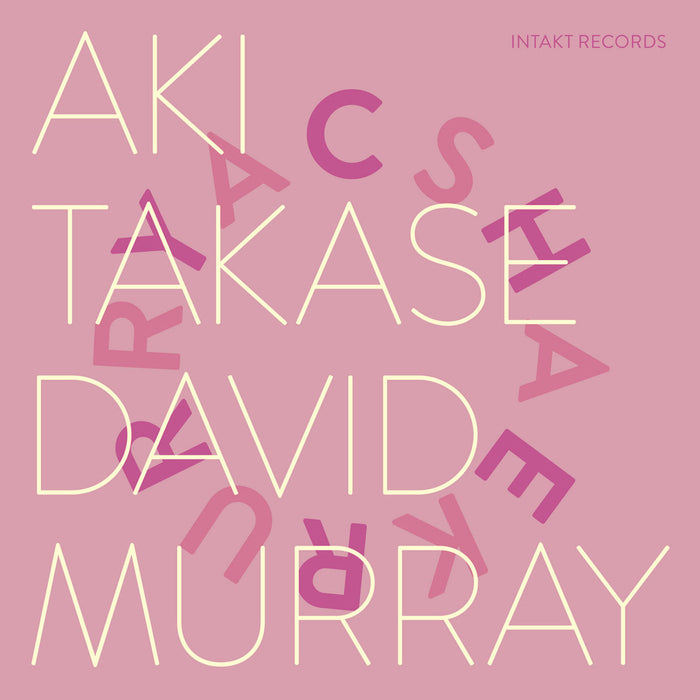
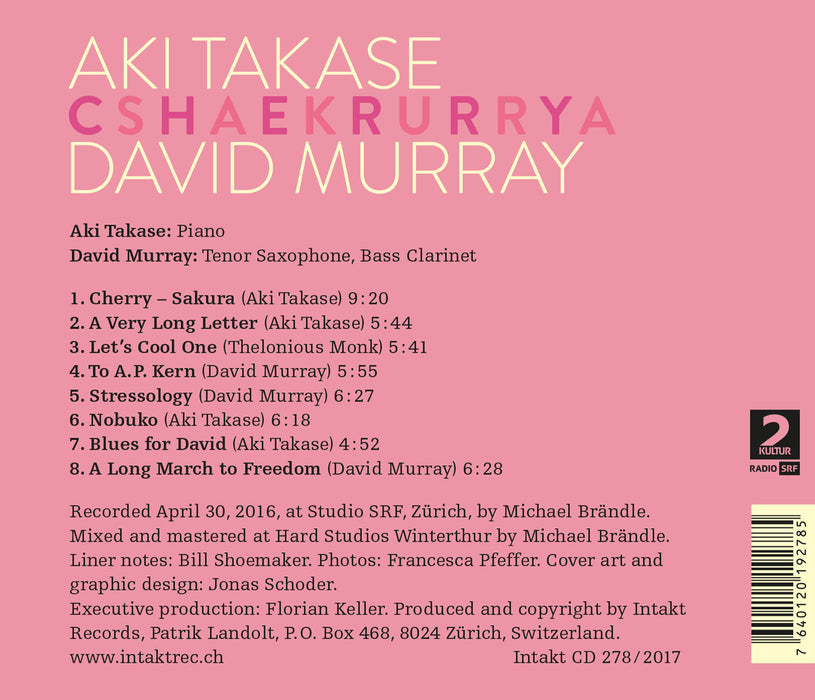
278: AKI TAKASE – DAVID MURRAY. Cherry - Sekura
Intakt Recording #278/ 2017
Recorded April 30, 2016, at Studio SRF, Zürich.
Original price
CHF 12.00
-
Original price
CHF 30.00
Original price
CHF 30.00
CHF 12.00
-
CHF 30.00
Current price
CHF 30.00
More Info
Album Credits
T
Spennende samtaler
Den japanske pianisten Aki Takase og den amerikanske tenorsaksofonisten og bassklarinettisten David Murray har funnet hverandre igjen etter over 20 års opphold. Aki Takase og David Murray har mye å fortelle oss – og hverandre.
Musikk for meg er ofte sammenliknbart med samtaler. Takase (70 ) og Murray (63) fant tonen på alle vis for nesten 25 år siden da de spilte inn «Blue Monk». Når har de plukka opp igjen tråden som om om det var i går og «Cherry – Sakura» har blitt nok en samtale av høy byrd.
De to kommer fra forskjellige tradisjoner – Takase med sin japanske bakgrunn og så frijazzbevegelsen i Europa. Hun har bodd i Berlin i mange tiår og er gift med en annen pianist i avantgardismens elitedivisjon, Alexander von Schlippenbach. Murray hører hjemme i den amerikanske tradisjonen med både modernisme og masse blues i seg.
Til troass for dette så har altså de to funnet det nyttig og spennende å utfordre hverandre – eller kanskje akkurat derfor. Denne gangen møttes de på halvveien, i Zürich i Sveits. Murray er nå nemlig bosatt i Portugal. Repertoaret er også bortimot 50/50 – de har skrevet halvparten hver pluss at de tolker forbildet Thelonious Monks "Let´s Cool One".
De to fører uten unntak meningsfulle og originale samtaler basert på sine enorme referanser. Det er ikke vanskelig å høre at Murray, som også var en del av World Saxophone Quartet, har en sterk tilknytning til alt og alle fra Ben Webster og Coleman Hawkins til Albert Ayler og John Coltrane, mens Takase bidrar med alt fra sin japanske oppvekst til Monk og enda friere toneganger.
Til sammen har det blitt et nytt, flott og tidløst møte med to strålende og originale musikanter.
https://torhammero.blogg.no/1525114416_spennende_samtaler.html

J
Twenty three years after their first studio date Blue Monk (Enja, 1993), Japanese pianist Aki Takase and American saxophonist David Murray reunite in Switzerland. There has been one live recording since, Valencia (Sound Hills, 1997), but the question remains what took them so long? The saxophone/piano axis has been a favored format for both. Murray's companions include Mal Waldron, John Hicks, Randy Weston and most frequently Dave Burrell, while Takase's partners encompass Rudi Mahall, Silke Eberhard, Louis Sclavis and Daniele D'Agaro. The attraction of the barebones set-up is obvious in the starkly lit stage and direct communication it affords.
The program of four by Takase, three by Murray and a lone interpretation of Monk contains a lovely mix of the bracing and the beautiful, which in a way sums up both their playing. Takase combines hints of tradition and modernity into a personal but appealing mélange. Murray displays a breathy full tone with just the occasional acerbic twist, deployed in a blend of dashes and suspensions which keep the listener guessing as to where he will end up. He also gives his accustomed control of the upper registers a thorough airing, though he does so in such a way that it enhances the emotional charge.
Half the pieces are tributes of one sort or another and they engender empathy by the barrel load. The ravishing title track gets the album off to a searing start, part mantra and part lament, before opening for Murray's tumbling tenor over Takase's rippling chords. Both take an unaccompanied break, Murray ascending into finely wrought falsetto, Takase edging towards dissonance, before a tender theme restatement which nonetheless takes some tangential liberties. That establishes the template, where the two take conventional roles, time and melody usually near at hand.
Of the other dedications, they swaddle Murray's "To A.P. Kern" in rich harmonies and murmuring Ben Webster-isms, while Takase's "Nobuko" is another gorgeous hymnal, bittersweet with traces of joy, in honor of her late mother and her "Blues For David" comes across as wryly affectionate. Elsewhere "A Very Long Letter" begins choppy and tense as Murray's agitated jostling cuts across the pianist's line, but after a bout of muscular piano introspection they end in jaunty unison. A similar breathless quality pervades "Stressology" where Murray hits the stratosphere. Perhaps unsurprisingly they are at their most playful on a sprightly "Let's Cool One," enlivened by Murray's insouciant bass clarinet. Two old hands in full command.
https://www.allaboutjazz.com/cherry--sakura-aki-takase-intakt-records-review-by-john-sharpe

G
Het is iets meer dan twee decennia geleden dat pianiste Aki Takase en saxofonist David Murray ‘Blue Monk’ uitbrachten. Nadien ging eenieder zijn eigen weg om zoveel jaar later opnieuw samen de studio in te duiken.
Deze keer geen openlijke ode aan Monk. Toch staat er nog een Monk-compositie op het repertoire, namelijk ‘Let’s Cool One’. Meteen een speelse duik in de jazzgeschiedenis toen pianisten nog stille films begeleidden. Aansluitend is er het zwoele en bluesy ‘To A.P.Kern’ met Murray in pure Ben Webster-stijl. Kenmerkend voor het hele album trouwens het uiterst hoog toegankelijkheidsgehalte. Niets mis mee natuurlijk want ook titels als ‘Nobuko’, ‘Blues For David’ en zelfs ‘A Long March For Freedom’ bieden genoeg kanttekeningen om te blijven luisteren naar wat deze twee elkaar toevertrouwen.
Wie hen eerder verkiest op het scherp van de snede, opteert voor de twee eerste nummers en het epileptisch funky ‘Stressology’ waarin beiden om beurt elkaar ophitsen met meer snedige uithalen.
Duidelijk een plaat van twee artiesten die heel wat watertjes doorzwommen maar niet **** uitpakken met elk hun trukendoos. Integendeel, ze doseren op een ongelooflijke manier. Voor diehard fans van het extremere werk misschien net wat te evenwichtig. Toch durven we te hopen dat ze geen 23 jaar meer wachten om nog eens een duo-cd op te nemen.
http://www.jazzenzo.nl/?e=3738

C
Parmi les habitués du label, la pianiste d’origine japonaise Aki Takase : son dernier album, « Cherry Sakura », un duo passionnant avec David Murray. Chacun a une longue expérience du duo : un gage de complicité. Retour à la tradition avec Let’s Cool One de Monk (joué à la clarinette basse), un blues (Blues for David), des thèmes en forme d’hymnes (A Long March to Freedom), des tempos survoltés avec envolées du ténor et déluges de notes du piano. Aki Takase a aussi enregistré d’autres duos : avec Louis Sclavis (« Yokohama »), Han Bennink (« Two For Two »), le clarinettiste Rudi Mahall (« Evergreen »), le pianiste Alexander von Schlippenbach (« Iron Wedding ») ou la violoniste Ayumi Paul (« Hotel Zauberberg »). En solo, elle a aussi enregistré « My Ellington ».
http://jazzaroundmag.com/?p=16219

N
Un dialogo iniziato oltre vent'anni fa, quello tra Aki Takase e David Murray, quando incisero Blue Monk, un album dedicato alle composizioni di Thelonious Monk. Il pianista di Rocky Mount, nume tutelare della tradizione non allineata del jazz moderno, ritorna anche in questo Cherry—Sakura, che include una bella versione di "Let's Cool One." A parte questo brano, l'unico non originale, il disco è (quasi) equamente diviso tra composizioni di Takase (quattro) e Murray (tre).
Vale la pena partire proprio da "Let's Cool One," dove Takase trova subito il giusto equilibrio tra supporto armonico e divagazioni ritmiche, a sostegno di un Murray scatenato al clarinetto basso, che coniuga agilità tecnica e incisività timbrica, senza mai perdere di vista le coordinate melodiche della composizione.
Questo brano è in qualche modo emblematico dell'approccio condiviso dai due musicisti, che lungo tutto il disco dimostrano non solo rispetto, ma soprattutto un sincero affetto per la tradizione del jazz, muovendosi prevalentemente nei confini di un mainstream di livello assoluto, con qualche sporadica sortita in territori più avventurosi.
I brani più originali in questo senso sono quelli di Takase, che dimostra una capacità di scrittura inusuale—dall'escursione frenetica di "A Very Long Letter" al tempo sospeso di "Cherry—Sakura" e alle atmosfere dolenti di "Nobuko"—riuscendo a fornire qualche spunto inaspettato pur tenendo ben presenti le regole del jazz più classico.
Le composizioni di Murray sono in qualche modo più prevedibili, anche se sempre efficaci, e a ben vedere incarnano perfettamente un'idea musicale che è rimasta costante nella lunga carriera del sassofonista: abbracciare senza preconcetti le diverse "tradizioni" del jazz, e scardinarle in qualche modo dall'interno, grazie a idee chiare e un talento strumentale smisurato, tuttora evidente.
È sempre un piacere ascoltare due maestri all'opera, soprattutto se, come in questo caso, oltre che sulle capacità tecniche e il proverbiale interplay, l'intesa si fonda sulla concezione condivisa della tradizione jazz come campo di ricerca aperto, dove anche i confini stilistici più rigorosi permettono di trovare sempre, in qualche modo, qualcosa di nuovo da dire.
https://www.allaboutjazz.com/cherry-sakura-aki-takase-intakt-records-review-by-nicola-negri

K
The vast experience that Takase and Murray have as duet players is heard from the opening bars of the lengthy title track. It is a heavenly melody invested with an emotional depth to match technical mastery, as the long, langoruous tones ease into life like breath itself before gliding gently through the changes with great poise. To the credit of both performers there is very little superfluous activity on this and other pieces in the set, and the moments in which the duo breaks to a solo horn from Murray or solo piano from Takase do not fall prey to hyperbole in the face of solitude. Murray has a sensitivity as an accompanist that belies his reputation as a fearsome one-man whirlwind, and while he does launch some turbulent flights of fancy, which are duly matched by Takase's equally fiery comping, this is a deeply reflective album, pitched between sunlit romanticism and sombre melancholia. At times the spirit of Fats Waller's 'Jitterbug Waltz', recast as a corps in four rather than three, pervades the music, while at others the power of gospel, expertly nuanced by the players, illuminates the themes, none more so than the majestic 'A Long March To Freedom'. It feels very much of yesterday and today.

C
Jetzt sind bei Intakt zwei CDs herausgekommen, die zum Vergleich verführen, wobei das natürlich schwierig ist, noch dazu bei zwei Platten, bei denen das Niveau, die Technik, der Einfallsreichtum etc. sowieso außer Frage stehen. Aber sie haben einiges Gemeinsames und sind doch sehr unterschiedlich. Es handelt sich bei allen Beteiligten um ein wenig in die Jahre gekommene Avantgardisten vergangener Tage. Der jüngste ist David Murray, der älteste Reggie Workman, Bassist des Trio 3. Saxofonist des Trios ist niemand Geringerer als Oliver Lake, den mit Murray eine gemeinsame Vergangenheit im World Saxophone Quartett verbindet. Auf beiden CDs werden Originale der Beteiligten dargeboten – bis auf je eine Nummer, bei Takase/Murray ist es ein Stück von Thelonious Monk, mit dem sich vor allem Takase viel beschäftigt, beim Trio eines von Ornette Coleman. Beide CDs sind makellos musiziert, Murray und Takase achten auf Abgeklärtheit und zuweilen ein wenig übertrieben auf Schönklang. Blues und Gospelartiges spielen eine Rolle. Da teilt David Murray ein wenig die musikalischen Ansichten seines Instrumentalkollegen Archie Shepp, der sich auch vom Revoluzzer zum in sich gekehrten quasi Traditionalisten gewandelt hat. Wenn er aber die Bassklarinette spielt, ist das schon hinreißend, wahrscheinlich die beste seit Eric Dolphy, und sein Einvernehmen mit Takase ist blind und souverän. Frischer klingt die Platte des Trio 3, obwohl Reggie Workman, Oliver Lake und Andrew Cyrille schon auf die 80 zugehen. Da blitzt bei aller Schönheit immer noch so etwas wie ein anarchistischer Schalk durch, der ungebrochene Wille, sich die Welt noch einmal neu zu erfinden, da sind die musikalischen Diskurse ein wenig kontroverser und deshalb auch spannender. Ganz großartiger Tonträger.

K
It's hard to ask for much more than what the duo of pianist Aki Takase and reed player David Murray provides. Each in their own way is unafraid of pushing at the edges of jazz but neither is beholden to such efforts. They share a forward-looking traditionalism, a passion for past masters, without wanting to go back in time. But what perhaps defines the duo most is the warmth and fullness of their playing. The natural voices of Takase's piano and Murray's tenor saxophone and bass clarinet are pushed to capacity without being allowed to break. There are passages on their new album where it's staggering how much music-not noise, not sound, but in-the-pocket melody and harmony-two people can make.
Their only other album together is 1993's Blue Monk, where they matched four of Thelonious Monk's tunes with some of their own and a few standards. They use a different strategy here, playing four of Takase's pieces and three of Murray's alongside Monk's "Let's Cool One", strategically positioned in the first half of the program. Murray states the bouncing theme on bass clarinet before Takase provides a slow stride accompaniment. It's a few joyful moments in an album that isn't melodramatic but for the most part has more serious concerns. Takase dedicates pieces to Murray ("Blues for David") and in one of the album's most gorgeous melodies-to her recently departed mother. Murray references his own "Stressology" and "A Long March to Freedom", as well as the dedicatee of an Aleksandr Pushkin poem. It's not a dark album but certainly isn't frivolous.
It would be best at this point in time to refrain from thinking about all the records we could have had from this duo over the past 23 years and just be glad that, at last, we have another.

J
Duets are so revealing. They require the utmost attention from two musicians-either in support or in discussion, entwined or independent. Playing with another person means playing solo and support simultaneously, and when it works well, it can be absolute magic.
Japanese pianist Aki Takase, long a Berlin resident, has been on a roll with great duets for Intakt, but this one might be the best yet.
She and reedist David Murray have instant rapport, a kind of innate connectedness that seems related to a shared respect for form and controlled volubility. Murray is at the top of his game. I've not heard a more fulsome and becoming recording from him in a long while; it's nice and close, but rich and full toned.
Throughout, Murray is hand-in-glove with Takase's sensitive harmonic playing, nowhere more dramatically than on the pianist's "Blues For David," where she puts down lush and surprising chords. And when Murray plays bass clarinet on a very laid-back take on Thelonious Monk's "Let's Cool One," the pianist offers abstracted stride moves in support.
The title track is an achingly elegant, slowly unfolding song with folk overtones drawn out gorgeously by Murray's tenor. Likewise, the saxophonist's dedication "To A.P. Kern," for the 19th-century Russian memoirist, is a bittersweet ballad, each of the musicians reaching for ways to touch a nerve. In terms of the interplay, the duets of Archie Shepp and Horace Parlan come to mind. But Murray and Takase seem a more adventurous pairing, taking more liberties and more solo space.

J
After a ho-hum opener and a congested free-for-all joust, the music suddenly awakens with Murray's droll bass clarinet on Monk and gets even better from there. A likely high in a high-flying career. -John McDonough
Wise rhythmic variations and an inspired choice of moods help keep this duet album a balanced affair, but I feel like Murray's impressive fireworks are becoming rote at this point. -Jim Macnie
From Takase's deliriously beautiful opening track, "Cherry," to Murray's inspiring manifesto, "A Long March To Freedom," these duets showcase two free improvisers with a deep sense of tradition deeply in sync. -Paul de Barros

A
In 1991, the pianist and tenor saxophonist recorded the duo album Blue Monk, followed later by Valencia. Thelonious Monk is a huge inspiration for Takase, so it's no surprise to find one of his compositions here - a jaunty "Let's Cool One", in the master's stride- style spirit, with Murray on bass clarinet. Otherwise, the programme alternates originals by the pair, both fertile composers. Murray has commented that he sees his music as being the "new standards", but as with other contemporary jazz composers, sadly the jazz community resists taking them up. Takase's poignant, anthem-like title track was inspired by an Ango Sakaguchi short story. "To AP Kern" is one of Murray's sumptuous ballads for tenor saxophone, with unaccompanied cadenza; "Nobuko", with its melody drawing on Romantic pianism, is a tribute to Takase's recently deceased mother.

R
Cherry – Sakura is a veritable classic recording by pianist Aki Takase and the tenor saxophonist and bass clarinetist, David Murray. Through it all, Murray plays with consummate sensitivity and flair, using his sonorous tone, on both tenor saxophone and bass clarinet, and a discerning palette of vibrato to create something vibrantly with Aki Takase. This Swiss performance provides a healthy taste of both Murray’s and Takase’s superlative artistry. Both are as commanding in the penetrating thickets of David Murray’s “A Long March to Freedom” as they are seductive in Aki Takase’s seductive “Cherry–Sakura”. In Thelonious Monk’s “Let’s Cool One” both bass clarinetist and pianist demonstrate that they can toss off technical feats with the best of Charlie Rouse’s and Monk’s. Their collaboration is first-rate and brings commitment and vitality to all of the programme’s intrepid fare.
https://jazzdagama.com/music/intakt-adventure-continues/2/

L
On avait un peu abandonné David Murray ces derniers temps. Et si l'on se réfère à cet enregistrement, reconnaissons-le tout net: on avait largement tort. Douceur et lyrisme, ample sonorité du ténor, grain hérité des Dexter et autre Prez, suraigus nous rappelant le grand Frank Lowe: David Murray n'a rien perdu de son intensité et de son intelligence de jeu. Autre lyrisme chez Aki Takase, entre fougue et retenue, blues et gospel, Monk et stride, free et sérénité: Aki quoi ! Ballade habitée (Cherry - Sakura), joutes homériques (A Very Long Letter), blues et Monk glorifiés (Let's Cool One), réminiscences de l'âge d'or (To A.P. Kern), clarté des phrasés (Stressology), blues dérobé (Blues for David), beauté et abandon (Nobuko, A Long March to Freedom): soit une heure de pur bonheur. Faudrait être con ou macroniste (voire les deux, c'est compatible!) pour s'en priver.

U
Raus aus den Schubladen
FESTIVAL Bei Woman in Jazz kam es in Halles Georgenkirche zu zwei inspirierenden Begegnungen.
HALLE/MZ - Als den Ort für „sehr ausgewählte Konzerte" im Rahmen des Programms von Women in Jazz beschreibt Festivalleiter Ulf Herden die Georgenkirche. Zwei Duo-Konzerte, zwei klug ausgewählte Zweisamkeiten neben dem Mainstream, die unterschiedlicher kaum hätten sein können, bestätigten diesen Anspruch aufs Schönste.
Im Duo der japanischen, lange schon in Berlin lebenden Pianistin Aki Takase mit dem holländischen Schlagzeuger Han Bennink begegneten sich zwei Gestandene des curopäischen Free Jazz, Naqsh nennen die beiden Iranerinnen Golfam Khayan und Mona Matbou Riahi ihr Duo, mit dem sie im vergangenen Jahr beim Münchner Edellabel ECM debü- tierten. Hier harsche Spontancität im Drauflosspielen, dort subtile Strukturen aus ethnischer und moderner zeitgenössischer Musik also.
Aber so einfach ist es nicht mit dem Rubrizieren, weil gerade im Jazz immer anders die Chance gesucht und genutzt wird, aus den vorbeschrifteten Schubladen zu springen. Takase und Bennink sind ein Musterbeispiel dafür mit ihrer bekenntnishaften Liebe zu Altvorderen wie Fats Waller, Ellington oder Monk und was man heute damit anfangen kann. Voller Humor nähern sie sich dem Gestus von damals, ohne dabei in Klamauk abzustürzen. Zwischen Clustern und Melodienseligkeit irrlichtert die Pianistin -und keiner kann das so begleiten, kommentieren, um und ablenken wie Bennink, der auch in sei nem gerade vollendeten 75. Lebensjahr nichts von seiner Reaktionsschnelligkeit eingebüßt zu haben scheint, wenn er ebenso lebensklug wie federleicht seinen gnadenlosen Swing losschickt.
Als „Akrobat auf dem Schlagzeug" kündigt ihn Herden an. Bennink ist mindestens das. Einmal verlautbarte er, sich vorstellen zu können, irgendwann nur noch mit einer Schachtel Streichhölzern zu spielen. Und tatsächlich hat er sein Drumset immer mehr verkleinert. Zwei Becken hat er in Halle neben dem Hi-Hat stehen und wenige Trommeln, doch mit diesem Minimalismus stellt er das Maximale an.
Es beginnt mit ein paar freien Schlägen mit seinem Pullover und wenn er seine Hände braucht, um sein Markenzeichen, das Schweißband um die Stirn zu legen, müssen die Becken halt mit den Füßen erreicht werden. Irgendwann sitzt diese humane Rhythmusmaschine nur mit den beiden Sticks auf dem Bühnenfußboden und es scheint nichts zu fchlen, um den Flow am Laufen zu halten. Immer noch ist er der vitale Fluxus-Mann von einst, doch nun kommt noch die hintersinnige Altersweisheit hinzu. Bennink ist ein Ereignis voller Finten und Finessen.
„Eigentlich haben wir keinen Plan", wirft Aki Takase ein. Wie in einer guten Beziehung erwidert Han Bennink: „Das ist Deine Schuld, Schatz." Dann aber fügt er hinzu: „Man muss dem anderen Typ trauen, dann geht's viel besser in der Welt."
Ja, Vertrauen ist eine Grundvokabel dieser Vorführung von Historiengewändern des Jazz, deren Passgenauigkeit in voller Theatralik demonstriert wird, wenn man sie sich auf den Leib schneidert. Damit das Verfahren aber derart gelingt wie hier, braucht es dic Besten des Genres. Zwei von ihnen waren am Mittwochabend zu erleben.
Szenenwechsel am Folgeabend, das Publikum staunt und empfindet das Fremde so nah. Klarinetten- und Gitarrentöne von höchster Spielkultur, Obertöne, Ornamente und persönliche Geschichten, die von Persien in die Welt führen und doch ganz bei sich bleiben.
Eine musikalische Reise, die das Leben spiegelt, seine Facetten schillern lässt und das Atmen hörbar macht. Feminine Musik voller Schönheit, die aber auch deren Gefährdungen nicht ausspart, was sie so zeitgemäß und dringlich macht. Stille im Saal bei diesen so noch nicht gehörten Klängen, die sinnlich plausibel machen, dass die Welt weit über den Tellerrand hinausreicht. Dann bricht der Beifall los.
