
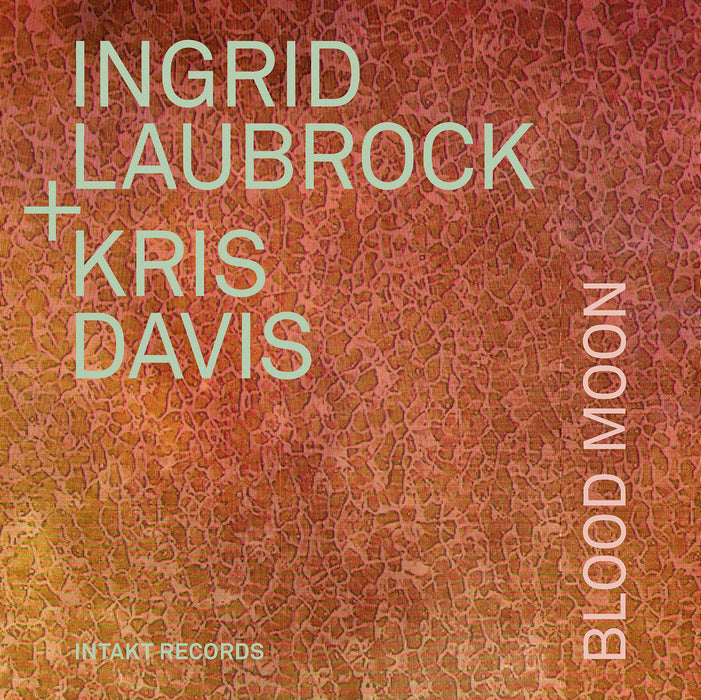
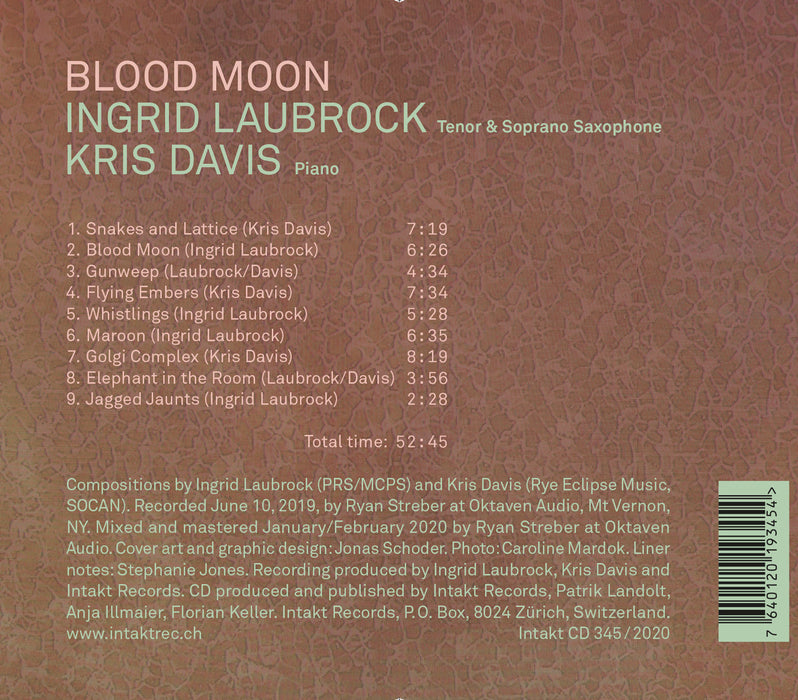
345:INGRID LAUBROCK – KRIS DAVIS. Blood Moon
Intakt Recording #345/ 2020
Ingrid Laubrock: Tenor Saxophone and Soprano Saxophone
Kris Davis: Piano
Recorded June 10, 2019, by Ryan streber at Oktaven Audio, mt Vernon, NY.
Sale
Sale
Original price
CHF 12.00
-
Original price
CHF 30.00
Original price
CHF 30.00
CHF 12.00
-
CHF 30.00
Current price
CHF 30.00
| /
More Info
More than a decade ago, Saxophonist-Composer Ingrid Laubrock met Pianist-Composer Kris Davis at the recently shuttered historic hang Cornelia Street Cafe in Downtown Manhattan, before Laubrock had Moved to New York. Over the next years, Laubrock and Davis would inspire and challenge each other within varied musical contexts – and across a number of recordings – including Laubrock’s critically-acclaimed quintet Anti-House, as well as other traditional instrumental role-resistant small groups and sprawling orchestral settings. For the second installment of Laubrock’s duo series on Intakt (after the Duo laubrock-Takase), she and Davis stretch individual sounds of their like minds around seven original compositions and two improvised tracks, each crafted for the artists’ unique interpretation as a duo. “Over the years we’ve just developed a certain language that’s our language, ” says Laubrock. “We wrote most of the music specifically for the record, but didn’t have an overarching concept. ” And: “i don’t know many people i could do this with other than Kris, ” says Laubrock. “Musically, we are kindred spirits. ” (from the liner notes by Stephanie Jones)
Album Credits
Cover art and graphic design: Jonas Schoder
Photo: Caroline Mardok
Liner Notes: Stephanie Jones
Compositions by ingrid laubrock (PRs/mCPs) and kris Davis (Rye eclipse music, sOCAN). Recorded June 10, 2019, by Ryan streber at Oktaven Audio, mt Vernon, NY. mixed and mastered January/February 2020 by Ryan streber at Oktaven Audio. Produced by ingrid laubrock, kris Davis and intakt Records, P. O. Box, 8024 Zürich, switzerland.
- 5 stars: 34 (100%)
- 4 stars: 0 (0%)
- 3 stars: 0 (0%)
- 2 stars: 0 (0%)
- 1 star: 0 (0%)
B
Ben Taffijn Saxofoniste Ingrid Laubrock maakte vorig jaar een duo album met de pianiste Aki Takase: ‘Kasumi’. De start van wat een serie moet worden, want in het boekje van het eveneens bij Intakt Records verschenen ‘Blood Moon’, het album dat ze maakte met pianiste Kris Davis, lees ik “for the second installment of Laubrock’s duo series on Intakt…” We zijn dus benieuwd. Vrij kort daarna verscheen een tweede album, ‘Dream Twice, Twice Dreamt’, een dubbelalbum met vijf dezelfde stukken, de ondertitel geeft uitsluitsel: ‘Music for Chamber Orchestra and Small Ensemble’. En over duo’s gesproken, via Bandcamp lanceerde ze met partner Tom Rainey in lockdown de ‘Stir Crazy Episodes’.
Maar eerst Laubrock en Davis. Wie beiden de laatste jaren heeft gevolgd, weet dat hun muzikale taal grote overeenkomsten kent. Hun beider muziek is altijd onderhoudend, maar met een speelse kwinkslag, balancerend tussen abstractie en lyriek. En hoezeer ze soms ook kunnen verdwalen in een woud van ongepolijste noten, ineens is daar dan de uitgang, een meeslepend melodisch fragment, een krachtige ritmische frase. Een tweede kenmerk van dit prachtige album is het samenspel van deze twee. Aan alles is te merken dat ze niet voor het eerst samen op het podium staan – ze spelen onder andere samen in Paradoxical Frog – , dat ze dezelfde taal spreken en dus van elkaar haarfijn aanvoelen wat de ander gaat doen. Neem het langzame titelstuk, ‘Blood Moon’ en luister naar de wijze waarop hier wordt samengespeeld, of wellicht is ‘Flying Embers’ een nog mooier voorbeeld. Davis’ spel klinkt hier als een klokkenspel in de wind, terwijl Laubrock zachte, vibrerende klanken uit haar saxofoon laat ontsnappen.
Laubrock heeft zich de afgelopen jaren ook sterk ontwikkeld als componist. Ik gaf er reeds hoog van op bij haar uit 2014 stammende ‘Zürich Concert’ en kan dat nu weer doen aan de hand van dit ‘Dreamt Twice, Twice Dreamt’. Vijf composities die Laubrock baseerde op dromen die ze bijhoudt in haar dromendagboek. Ze schreef ze eerst voor kleine bezetting, vervolgens voor orkest, om daarmee direct die voor kleine bezetting weer aan te passen. Naast Laubrock horen we natuurlijk een keur aan musici, in het orkest tel ik er vijfentwintig, met twee vaste waarden op beide Cd’s: Sam Pluta op elektronica en Cory Smythe op toetsen. Ik beluisterde eerst dit kleine ensemble, Cd 2, met twee stukken voor trio, twee voor kwintet en één voor sextet. Abstractere muziek dan op ‘Blood Moon’, het gaat er al net zo gestructureerd aan toe als in onze dromen. Dat we deze stukken allereerst als serieuze composities moeten zien, blijkt het beste uit ‘Drilling’, tevens ook het langste stuk. Het is vooral de combinatie van elektronica en accordeon, een gastrol van Adam Matlock, die hier opvalt en het disruptieve, spookachtige klanklandschap dat hier wordt ontvouwd. En dan het luisterrijke duo Laubrock – Smythe verderop, waar Pluta letterlijk zo mooi doorheen piept. Tot slot moet hier de heftig ontsporende elektronica in ‘Twice Dreamt’ worden genoemd, in combinatie met de elektrische harp van Zeena Parkins.
En natuurlijk, het compositorische vernuft van Laubrock komt verreweg het best tot zijn recht in de uitvoering door het EOS Chamber Orchestra, onder leiding van Susanne Blumenthal. De grote diversiteit aan klankkleuren geeft Laubrock optimaal de gelegenheid haar dromen gestalte te geven. Als voorbeeld mag bijvoorbeeld dat ‘Snorkel Cows’ dienen dat qua subtiliteit en vormgeving met kop en schouders uitsteekt boven die voor trio. Maar nog mooier is deze versie van ‘Drilling’, een stuk dat gewoon onder de hedendaags gecomponeerde muziek valt. Bijzonder spannend is ook ‘I Never Liked That Guy’, Laubrock horen we hier met een mooie melodie op sopraansax, prachtig ingebed in een wonderlijke klanknevel.
Tot slot noem ik hier nog de ‘Stir Crazy Episodes’ die Laubrock samen met Rainey plaatst op Bandcamp. Tot nu toe zijn er achtenveertig (!) stukken verschenen, te downloaden van haar pagina. Genoeg voor uren en uren heerlijke spontane improvisatie. Beluisteren kan en downloaden ook, wat je ervoor betaald, mag je zelf weten.
Van ‘Blood Moon’ en ‘Dreamt Twice, Twice Dreamt’ zijn fragmenten te beluisteren via Bandcamp. De ‘Stir Crazy Episodes’ zijn allen te beluisteren via Bandcamp en hier ook te downloaden:
https://www.nieuwenoten.nl/ingrid-laubrock-kris-davis-blood-moon-ingrid-laubrock-dreamt-twice-twice-dreamt-ingrid-laubrock-tom-rainey-stir-crazy-episodes-cd-download-recensie//
A
Anonymous Balanço
MELHORES DE 2020
Num ano de salas de espectáculo encerradas, concertos cancelados, projectos adiados e carreiras suspensas, para já não falar dos efeitos da pandemia na sobrevivência de muitos artistas, chegou a parecer que a música se tinha silenciado com a pandemia. Afinal, assim não foi: bastantes discos, e bons, foram editados por todo o mundo e as actuações ao vivo voltaram, a pouco e pouco. Eis aqui o melhor que a jazz.pt ouviu e viu neste annus que conseguiu não ser totalmente horribilis.
É como se a música se tivesse vingado da pandemia e das medidas - em muitos casos erradas - que se tomaram para a combater, numa manifestação de resiliência dos artistas que se traduziu em obras e feitos de enormes qualidade e inventividade. Este balanço poderia ser de excepções, de pálidas tentativas de resistência, mas é bem mais do que isso: uma demonstração de que a alma humana pode mais do que um vírus e do que políticas económicas estapafúrdias.
Ingrid Laubrock: "Dream Twice, Twice Dreamt" (Intakt)
Kaja Draksler Octet: "Out for Stars" (Clean Feed)
Gard Nilssen's Supersonic Orchestra: "If You Listen Carefully the Music is Yours" (Odin)
Muhal Richard Abrams / The Warriors of the Wonderful Sound: "Sound Path" (Clean Feed)
Ingrid Laubrock / Kris Davis Duo: "Blood Moon" (Intact)
Lynn Cassiers: "Yun" (Clean Feed)
Mary Halvorson's Code Girl: "Artlessly Falling" (Firehouse 12)
Carla Bley Trio: "Life Goes On" (ECM)
Shabaka and the Ancestors: "We Are Sent Here by History" (Impulse!)
Nubya Garcia: "Source" (Concord)
Tim Berne's Snakeoil: "The Deceptive 4 Live" (Intakt)
Tim Berne's Snakeoil: "The Fantastic Mrs. 10" (Intakt)
Rob Mazurek Exploding Star Orchestra: "Dimensional Stardust" (International Anthem / Nonesuch)
Alexander von Schlippenbach: "Slow Pieces for Aki" (Intakt)
Maria Schneider Orchestra: "Data Lord" (ArtistShare)
Ballrogg: "Rolling Ball" (Clean Feed)
Agustí Fernández / Jordina Millà: "When Forests Dream" (Sirulita)
https://jazz.pt/artigos/2020/12/28/melhores-de-2020/
J
John Sharpe With so few performance opportunities since March, and musicians in continuing limbo, the continued stream of new releases has been a surprise, but a welcome one. For me, and many others, music has been a source of solace in an otherwise dreadful year. That makes it all the more invidious to pick and choose between honest artistic endeavours. As always it's better to view the selections as a chance to pick up on something that you might otherwise have missed. As a fan I always look forward to the annual year end lists for precisely that reason. If you share the same taste (that's the key bit) then you might well discover some unforeseen delights. So, if you like some of the same things as me, then these ten new issues and one unearthed gem which gave me the most enjoyment among the 200 or so discs that I heard this year, could be for you!
Saxophonist Ingrid Laubrock and Canadian pianist Kris Davis recognized each other as soul mates early on after the German's move to New York City and have remained close collaborators ever since. They've honed their shared sensibilities in Laubrock's Anti-house, Davis' Capricorn Climber and co-operatives such as Paradoxical Frog and LARK. And it's that sense of being entirely on each other's wavelength as they weave a mysterious web between composition and improvisation which makes this date such a winner. Predetermined unisons spring from seemingly unfettered interaction in such a way as to keep the listener guessing, both as to what's notated and what's on-the-fly, and indeed what might be coming next.
https://www.allaboutjazz.com/john-sharpes-best-releases-of-2020-steve-swell
J
John Chacona It's tempting to say that this was the year the music died, and for clubs, concert and festival stages, that might generally be true. Yet, in this most confounding and contrary of years it's thoroughly fitting that as live music grew silent, recordings roared with eloquence, fury and, yes, beauty. Here are the releases that most captivated, moved, consoled and inspired me.
Ingrid Laubrock+Kris Davis
Blood Moon
Intakt Records
https://www.allaboutjazz.com/john-chaconas-favorite-releases-of-2020?fbclid=IwAR3DGYdSEHiNQoKe1wdK6-38UDYL9Abwf1cAhTlhEv5TIS7N19stdES5xPII
P
Peter Rüedi Gespräche ohne Worte
Die deutsche Saxophonistin Ingrid Laubrock, geboren 1970, gross geworden in den neunziger Jahren auf der bewegten Londoner Szene, seit 2008 umgezogenen nach New York, spricht viele Sprachen, aber alle mit einem eigenen, schnell erkennbaren Zungenschlag. Länger schon eine anchor woman des Schweizer Avantgarde-Labels «Intakt», hat sie sowohl eine Vorliebe für Musik im grossen Verband, zwischen ausgeschriebener Komposition und eingestreuten improvisatorischen Sprengsätzen. Eben ist von ihr «Music for Chamber Orchestra and Small Ensemble» erschienen.: «Dreamt Twice. Twice Dreamt». Anderseits liebt Laubrock hoch konzentrierte Kleinformationen, namentlich Duos, in denen ebenfalls nicht immer leicht auszumachen ist, was im Parlando allmähliche Verfertigung der Gedanken beim Spielen, was im voraus konzipiert ist. Ein besonders dichtes Duo-Album ist Laubrock mit einer langjährigen «Seelenverwandten» gelungen, der kanadischen, ebenfalls in den USA lebenden Pianistin Kris Davis (*1980): einer wie sie mit neuer E-Musik vertrauten strukturell denkenden «freien» Improvisatorin. Die Nähe der beiden Partnerinnen meint in diesem Zwiegespräch keinen spannungslosen Einklang. Zwar finden sie sich gelegentlich überraschend zu kurzen Unisono-Parallelläufen, aber die abstrakte Poesie ihrer Musik entwickelt sich im Wesentlichen aus gegenseitigen sanften Provokationen. Das besondere dieser Musik: sie ist abstrakt, aber nicht hermetisch. Auffallend ist bei diesem Dialog ein erzählerisches Element. Es sind Gespräche ohne Worte in zwei Dialekten einer musikalischen Metasprache. Klingt kompliziert, und ist für den Hörer zuweilen mit etwas Arbeit verbunden, die für den, der sich nur erst darauf einlässt, in grosses Vergnügen umschlägt. Im übrigen: so ernst diese jedes Klischee verweigernde Musik zunächst anmuten mag, sie hat gelegentlich auch eine Art überwältigende Kindlichkeit, etwas von musikalischem Fingerpainting. Ihr Ernst ist der Ernst des Spiels. Einzelne Stücke sind in ihrer gestischen Theatralik eigentliche Humoresken. Und bei allem Hang zur Abstraktion klingt in vielen Stellen «eine etwas verzerrte und seltsame Lyrik, die nicht wie eine ‘normale’ Ballade klingt» (Laubrock). Kurz: eine radikale, aber nie gewalttätige Musik, schwebend zwischen Emotionalität und dem kühlen Zauber der Abstraktion.
K
Kurt Gottschalk One thing that might be said about any great ensemble of improvisers is that any subgrouping of members might be isolated and seen as a core. That’s arguably the nature of music built from improvisation, at least when done well: paradoxically, the elements stand alone by leaning on each other.
As such, a core common to saxophonist Ingrid Laubrock’s band Anti-House and the trio Paradoxical Frog, not to mention drummer Tom Rainey’s fine four-piece Obbligato and a few other worthy ensembles, is the duo of Laubrock and pianist Kris Davis. This core is the one extracted for the album Blood Moon. And the core of that duo, in a manner of speaking, is the experience of playing in those other settings together.
Blood Moon is the first duo outing for Davis and Laubrock, and follows a recording by Laubrock and Aki Takase in the saxophonist’s series of piano duets for the Swiss label Intakt. The nine tracks include two open improvisations, but it’s the written works—with spontaneous variation, of course—that show they know what to do with their pairing. They’ve learned what they are from experience. The playing is beautiful, the themes assuredly understated, the music sublime. It’s a music that’s informed and aware, and that’s a point of elucidation in each of their discographies, both separate and shared.
https://www.musicworks.ca/reviews/recordings/ingrid-laubrock-kris-davis-blood-moonn
J
John Fordham The follow-up to saxophonist Ingrid Laubrock's vigorous Kasumi duo album on Intakt with Japanese piano virtuoso Aki Takase is this similarly seamless merger of improv and composition with Vancouver-born pianist Kris Davis – an old connection begun in a Manhattan bar that preceded Laubrock's move from London to New York in 2008, which has also brought Davis into the lineup of the saxophonist's adventurous Anti-House ensemble.
Both artists are imaginative and virtuosic free-improvisers, but it's their creative framing of spontaneity inside structures with distinctive story-shapes that makes their work such an inviting bridge between contemporary-jazz and contemporary-classical music. The slow weave of the title track here almost suggests an old-school ballad, but its melody is lateral and gently dissonant, its improv sometimes busy and staccato, sometimes delicately airy. There are ambient episodes, like ‘Flying Embers’ and ‘Elephant in The Room’, drifting on deep tenor tones or soprano quiverings, gently tracked by trickling treble-piano lines. The extended opener, ‘Snakes And Lattice’, passes through dramatic scene-changes from long-tone interval jumps to unison-melody scampers, to percussively Evan Parkeresque tenor improv, to a spacious, pensive coda. ‘Whistlings’, an engagingly abstract soprano/piano dance, sounds like music for an imaginary ballet, ‘Golgi Complex’ features some scalding Davis soloing over a sinewy free-groove, that bends close enough to orthodoxy to repeat a punchy three-note piano hook in its closing stages. Laubrock says of her relationship with Davis ‘we are kindred spirits’, and that's audible all over this fine session.
https://www.jazzwise.com/review/ingrid-laubrock-kris-davis-blood-moonn
C
Christoph Haunschmid Saxofonistin Ingrid Laubrock und Pianistin Kris Davis verbindet eine umfangreiche Historie gemeinsamer Aktivitäten, Tom Raineys wunderbar sentimentales Obbligato-Quintett und Laubrocks spektakuläre Anti-House Band seien als Beispiele genannt. Nun haben die beiden bei Intakt eine erstklassige Duo-Aufnahme veröffentlicht. Sie teilen sich die Komponierarbeit bei den Stücken von Blood Moon ziemlich gerecht, bei zwei kurzen Einwürfen erscheinen beide als Autorinnen, es dürfte sich um freie Impros handeln. Es beginnt mit einem eckig kantigen Stück von Davis, das folgende Blood Moon Laubrocks ist lyrischer, fast zärtlich, wie eine laue Sommernacht. Klavier und Saxofon ergänzen sich gut, verbinden sich in kunstreichen Verschränkungen. Die Instrumente nähern sich an, entfernen sich voneinander, und mittendrin ruft ein vereinsamtes Sopransax fast sehnsüchtig das Klavier herbei, um umgehend einen aufgeregten Diskurs zu beginnen. Davis und Laubrock verstehen die Kunst von Verdichtung und Entflechtung, bieten einander Unterstützung und suchen, wenn notwendig, auch die Konfrontation. Manchmal wird eine schlichte Melodie ins Extreme gedehnt (Flying Embers), wie ein fernes Echo. Und ganz am Ende, knappe zweieinhalb Minuten lang, kommt noch ein zauberhaftes Getänzel Laubrocks, wie eine kleine Coda. Grandiose Platte.
C
Chris Robinson On Blood Moon Davis moves out of the realm of the ensemble to the much more intimate duo setting, teaming up with her longtime collaborator Ingrid Laubrock. Rather than settling into the standard horn-as-soloist/pianist-as-accompanist duo format, they converse in the singular language they’ve developed over many years, playing with and against each other as equal partners. Although the album features numerous complex and tricky written melodies – which Davis and Laubrock execute at an uncannily expert level – it is often impossible to tell what is dictated by the composition or what is worked out and intuited in the moment. In each piece, Davis and Laubrock give melody, form, tone, and color equal emphasis. Theirs is a holistic musical language in which a note’s color and pitch is just as important as the place and time it’s played. On the title track Laubrock uses alternate fingerings to both create the microtonal melody and to give the same note multiple timbres and shapes. Their language explores contrast, nuance, and the possibilities that subtle shifts in the music can engender. It’s about the different lives the same note can live when attacked in a slightly different way or played a quarter tone sharper the second time around. On the drone-based “Flying Embers,” which almost has a Morton Feldman feeling, Laubrock bends the pitch ever so slightly, residing in the beats created when two notes are ever so slightly out of tune. On the album’s two improvised tracks, “Gunweep” and “Elephant in the Room,” Davis and Laubrock show just how deeply they have developed and ingrained their language, as each piece shares the same traits as the album’s written works, thereby blurring the line between improvisation and composition. On the former, Davis’ warpspeed playing – which Laubrock peppers with rhythmic exclamations – is so virtuosic and clean that she almost sounds like one of Conlon Nancarrow’s player piano pieces. On the latter, the pair creates an austere and haunting dreamscape. At some point though, trying to describe Blood Moon’s music becomes an exercise at stringing together adjectives and metaphors (e.g. the skipping hopscotch of “Whistlings”) that don’t mean much. It’s best to go straight to the music and work at translating the pair’s language yourself. With Blood Moon, Davis and Laubrock set a high bar for this mode of duo playing and composing. No, scratch that. It’s a high bar for any kind of music.
http://pointofdeparture.org/PoD72/PoD72MoreMoments3.htmll
H
Hans-Jürgen Schaal Das brillante Duoalbum mit Aki Takase (Kasumi) hat die Messlatte sehr hoch gelegt.
Doch Ingrid Laubrock, der Saxofonistin aus Deutschland mit internationaler Karriere, gelingt es, auf dem zweiten Album ihrer Duett-Serie dieses hohe Niveau zu bestätigen. Diesmal ist die Kanadierin Kris Davis ihre Partnerin am Klavier. Die beiden kennen sich aus vielen Projekten wie Paradoxical Frog und Anti-House Musikalisch sind wir Seelenverwandte", sagt Laubrock. Die neun Stücke des Albums vier von der Saxofonistin, drei von der Pianistin und zwei gemeinsam ent-wickelte Nummern - bewegen sich in der Anmutung zwischen Kammermusik (etwa: moderne Saxofonsonate) und Free Jazz. Alle Stücke auch die beiden Improvisationen - haben einen thematischen Kern oder einen klaren klangkonzeptionellen Ausgangspunkt. Alle Stücke besitzen eine tonale Orientie-rung (geplant oder spontan), eine fesselnde musikalische
Entwicklung, eine strukturelle Ideenlinie. Da wird Mikrotonalität erforscht, wird mit Rhythmen jongliert. Da werden groteske Stakkato-Motive gefeiert oder Tonfelder zu Motiven verdichtet. Da werden geräuschhafte Zusammenklänge untersucht und neue emotionale Schattierungen gefunden. Diese neun Duos stecken voller Melodie und Abenteuer, sie sprühen vor Experimentierlust, Virtuosität, Spielwitz, Expressivität und Jazz-Esprit. Vielleicht das erste Meisterwerk der jungen Zwanzigerjahre.
G
Guy Peters Saxofoniste Ingrid Laubrock is al even bezig aan een imposant parcours bij Intakt Records. Na orkestrale uitdagingen en enkele kleinere bezettingen presenteert ze nu een tweede duoalbum. De
samenwerking met Davis - sparringpartner op onder meer Paradoxical Frog, Anti-House en Tom Rainey's Obbligato - gaat al ruim een decennium mee en dat **** je: de twee spreken dezelfde taal, die virtuoos speelt met vorm en inhoud. Doorheen 7 composities en 2 vrije improvisaties groeien details uit tot openbloeiende werelden, en er wordt gelaveerd tussen microtonaal mysterie, kekke precisiestukjes en slow motion wentelingen. Cerebrale exploraties gaan hand in hand met lyrische ontboezemingen, terwijl elk van de hoofdbestanddelen – melodie, harmonie, ritme – op een prikkelende manier ingevuld wordt. Dwars, niet tegendraads. Vernuftig, verfrissend, nooit vergezocht.
J
John Pietaro This new release is part of my series of duo albums with pianists," saxophonist Ingrid Laubrock explained. But clearly, here's a pairing that comes complete with might in its history. "Kris was one of the first connections I made in the U.S. when I was still commuting from London," she says so the final product is akin to breathing in tandem. The two have enjoyed numerous performances together over a dozen or so years, whether in cooperative projects like Paradoxical Frog or the LARK Quartet, Laubrock's Anti-House and Contemporary Chaos Practices or Davis' Capricorn Climber. This intimate set may well be the apex.
The album opens with a work by Davis, "Snakes and Lattice", which, filled with noir-esque phrases, immediately draws the listener in. Dominated by fast melodic runs in unison, it's reminiscent of some of those late '50s works that refused to be cited as Third Stream but nonetheless contain all of the ingredients of modern classical fused with jazz. Swinging even without a rhythm section, per se, it bumps and careens deliciously as expansive harmonies take us along this roller-coaster ride through the dark.
And yet, it contrasts markedly with Laubrock's first piece on the album, the title cut, which speaks to the haunting sound of Erik Satie and the band of French modernists in his wake, Les Six. Davis lays the groundwork for this deep foray, with soprano saxophone emoting out front, equal parts vibrant and sinewy, foregoing the expected range of the horn. So tangible, so evocative is this sound, it conjures the score of a dramatic tragedy.
Later, the pair also indulge in casting soundscapes, taunting the very harmonics (is that Laubrock playing into the open piano, allowing the strings to vibrate sympathetically and intone on "Flying Embers"?) and patiently color the air about one's stereo speakers. Though both Davis and Laubrock are busy composers in their own right, they are first vital improvisers and several selections appear to be freely devised, credited jointly ("Gunweep" and "Elephant in the Room"). Within the whole, such works easily reflect where free jazz took on new music with a vengeance.
J
J.D Considine The big question to ask about reedist Ingrid Laubrock and pianist Kris Davis' duo album is simple: What took them so long?
The German saxophonist and Canadian pianist first teamed up in 2010, joining drummer Tyshawn Sorey in the remarkable trio Paradoxical Frog. Their compatibility was immediately obvious-both improvised with an almost reflexive compositional rigor and reacted to each other (and Sorey) as if mind-reading. Moreover, they kept turning up together, whether in ongoing ensembles, such as Laubrock's Anti-House and the LARK quartet, or on one-offs like drummer Nick Fraser's recent Zoning (Astral Spirits). In every case, they've fit together like yin and yang.
Blood Moon makes that connection explic-it. Laubrock and Davis have naturally complementary skills, balancing composition and improvisation in mutually beneficial ways. Laubrock's writing and playing offers an attention to detail that pays off both structurally and aesthetically, ensuring that the long lines and extended harmonies of "Flying Embers" are as satisfying melodically as they are intellectually.
Davis, for her part, buttresses the intervallic logic of "Snakes And Lattice" with a deft sense of rhythmic counterpoint, while the quietly absorbing read of "Golgi Complex" here offers a groove that's as implicit as the initial versions on Davis' own Diatom Ribbons were explicit.
Throughout, Blood Moon comes off as a conversation between two equally intriguing polymaths, leaving the listener hungry for more.
https://www.downbeat.com/digitaledition/2020/DB20_09/single_page_view/42.html
S
Stuart Broomer German saxophonist Ingrid Laubrock and Canadian pianist Kris Davis met more than a decade ago as newcomers to the New York jazz world. They soon developed a trio, Paradoxical Frog, with drummer Tyshawn Sorey and have collaborated in various projects, including Laubrock’s Anti-House quintet and her orchestral Contemporary Chaos Practices. In recent years, each has achieved considerable prominence, recording frequently and topping international jazz critics polls. This state-of-the-art dialogue at chamber music dynamic levels demonstrates why.
Davis’ opening Snakes and Lattice introduces a partnership of virtuosos as they fly through a complex series of glissandi and tremolos, leaping registers and shifting tempos, all delivered with a kind of playful aplomb. There’s more of the same in Laubrock’s Whistlings, music in which dexterity is not an end but a gateway to new terrain, soprano saxophone and piano so close as to suggest a single musician.
Much of the music here is simply beautiful, but often in fresh ways. Laubrock produces sonorities of rare lustre, while Davis’ clouds of limpid notes blur Debussy and Second Viennese School. Their inventiveness and sense of detail are evident in Davis’ Flying Embers in which Laubrock’s quiet long tones and subtly shifting pitches fuse with the sustained hum of the piano strings. Laubrock’s Maroon moves toward form: initially balladic, it moves through a sustained free exchange, eventually arriving at two distinct voices, a lyric saxophone and an insistently percussive, mechanistic piano.
https://www.thewholenote.com/index.php/booksrecords2/jazzaimprovised/30273-blood-moon-ingrid-laubrock-kris-daviss
M
Matthew Banash These two albums have led me to some larger questions. As a listener, I found each work unique with individuation being a lasting impression. As a thinker, I know nothing arises out of itself. So, how can two separate works, similar in instrumentation and with the tenor and soprano saxes of Ingrid Laubrock being a common denominator, work with homogeneity and heterogeneity while being a unique part of a whole? I’ll skip the respective bona fides except to say the musicians are accomplished so let’s dive into this double shot of duets.
Takase and Laubrock first performed together in 2016’s JazzFest Berlin that referenced Louis Armstrong’s famous duet with Earl Hines on Weather Bird in 1928 in a larger scope of jazz as the art of conversation. in a cross-national They hit it off and played a few more times before heading into the studio to record. The tunes tend to brevity more than expanse with some as short as 1:28 and other hovering around the 3 to 5-minute length. Overall, the 14 tunes clock in at a little over 50 minutes which lends the album an impressionistic vibe.
The writing was handled on a fairly even basis and it’s a pleasure to listen to Laubrock and Takase finding their footing in playing together as Takase usually defers to Laubrock but always has a free flourish or subtlety to enhance the music; considered and playful not just devil may care whimsy In Japanese 'Kasumi' can mean “mist” or it can be a compound of “ka” or “flower, blossom” with “sumi” meaning “clear, pure.” And the opening title track establishes evolving impressionism that runs through the album. Tracks 4,5, and 6 is particularly nice stretch on the recording. On track 4, “Chimera” Laubrock slows down but expands at least note wise and here is where Takase goes to freer flourishes that both counter and fit Laubrock’s stylings. Takase takes a serious and studied turn on track 5, “Harlekin” but the playing and rapport is never staid.
There’s always with a playful lurking around the corner and the duo, with Laubrock on soprano, explores these moments with unity and dissonance as well as whimsy without ever becoming disjointed or fragmented. On the next track, “Dark Clouds”, Takase grooves and rumbles then Laubrock joins skipping squeaking and gliding. About two minutes in there’s a tempo shift that paints the music as elastic and amorphous. The briefer pieces like “Scurry”, “Density”, and “Carving Water” add to ephemeral tone and despite their brevity never feel incomplete. “Scurry” is a pleasure encapsulating the song’s title, sounds and length into a musical definition. Just fun. “Luftspiegelung” means “mirage” in German and with “Kasumi” this song bookends the international feel of the album. One of the longer pieces, it feels like a synthesis of ideas and sounds played throughout the entire recording.
Laubrock and Davis have known each other and performed together in variety of groups and settings for well over a decade. The playing and compositions reveal the length and depth of that relationship. The parts seem to fit not so much where you expect them to fit but where they make sense. Like Kasumi this recording contains the element of surprise, too. As on “Kasumi” the writing was shared evenly. On the 9 tunes spread out over nearly 53 minutes Laubrock uses range and repetition well, and even breaks out the soprano on a few numbers, and Davis applies steadfast rhythms imbued with lives and patterns of their own.
The melodies are reminiscent of folk music. Notable examples are, but not limited to the songs below: "Snakes and Lattice", a Kris Davis tune, has a “cat’ n’ mouse” feel. It’s a fluid, folksy fairy tale that establishes the tone of the record for me with it vibrant, measured introspection rather than contemplation. Laubrock composed "Maroon" and does it feel lonely? Yes, but the album heretofore is more sparseness than crowds. Again, Laubrock and Davis seem to play with and without one another. But the ethos tethers their choices and sounds. Here they aren’t afraid to make a rumble or take a deft turn. Momentum and repetition play important roles here as throughout the recording. Davis accelerates the tempo on her "Golgi Complex", but this is a wonderful opportunity to tune into the duo’s give and take, back and forth, lead and follow dynamic; about halfway through it's like you can hear them listening to one another. Creating something unique in a tried and true duo of piano and sax. Davis is at her subtle best altering some notes to reward you for listening.
"Elephant in the Room" is a joint effort and seems like a bit of a respite. The artists’ tones and predilections are entrenched in your ear by now. A good thing. They hone their rapport further and the piece can stand alone of take up its part in the program. "Jagged Jaunts" by the saxophonist is just a fun tittle to say and takes the duo out on a bouncy brief exit. No hard and fast truisms, generally Takase follows Laubrock while Davis a...
K
Kay Friedrichs Wer die Saxophonistin Ingrid Laubrock und die Pianistin Kris Davis in den letzten Jahren live erleben durfte, merkte bald, die beiden können im Blindflug synchron fliegen. Nach Laubrocks exzellentem Duo mit der Berliner Jazz-Pianistin Aki Takase jetzt eine Exkursion, die sich den Mikrotönen widmet, also Intervallen, die kleiner als ein Halbtonabstand sind. Auf den Saxophonen schon keine kleine Kunst, diese kontrolliert zu treffen und zu halten, braucht man am Piano über Virtuosität hinaus auch kleine technische Hilfsmittel, um sich ihrer zu bedienen. Auf „Flying Embers" setzt Davis zum Beispiel mehrere E-Bows direkt auf Klaviersaiten, um mit dem stetigen Summen von Akkord-Obertönen Laubrocks subtil gedehnten langen Tönen eine psychoakustische Plattform zu bieten. Auch „Whistlings" ist eine frappierende Improvisation, die mit mal beschleunigten und dann wieder verzögerten harmonischen Clustern über einen subtilen, aber stetigen Puls im Hintergrund arbeitet. „Blood Moon" kommt bescheiden daher, ist aber „Big Bang" und sein auf lediglich 52 Minuten komprimiertes Format lässt auf ein expandierendes Universum neuer Hörerfahrungen hoffen.