
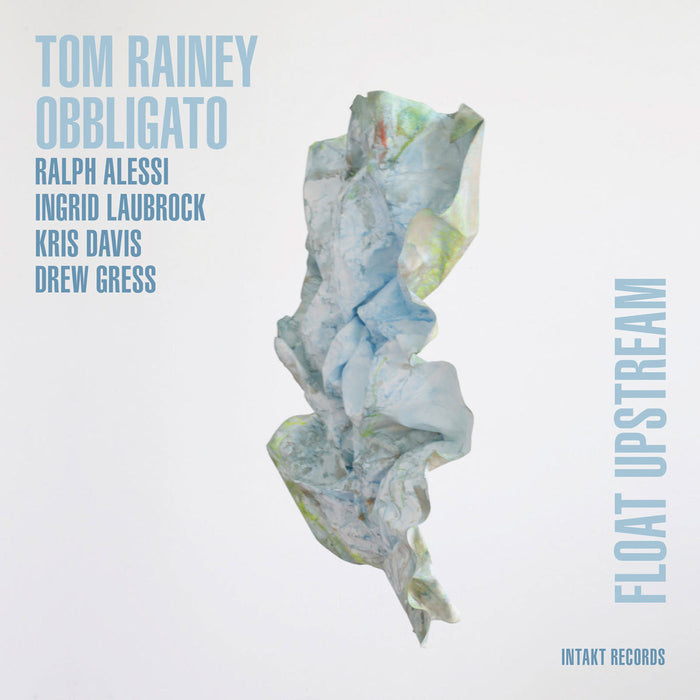
292: TOM RAINEY – OBBLIGATO. Float Upstream
Intakt Recording #292/ 2017
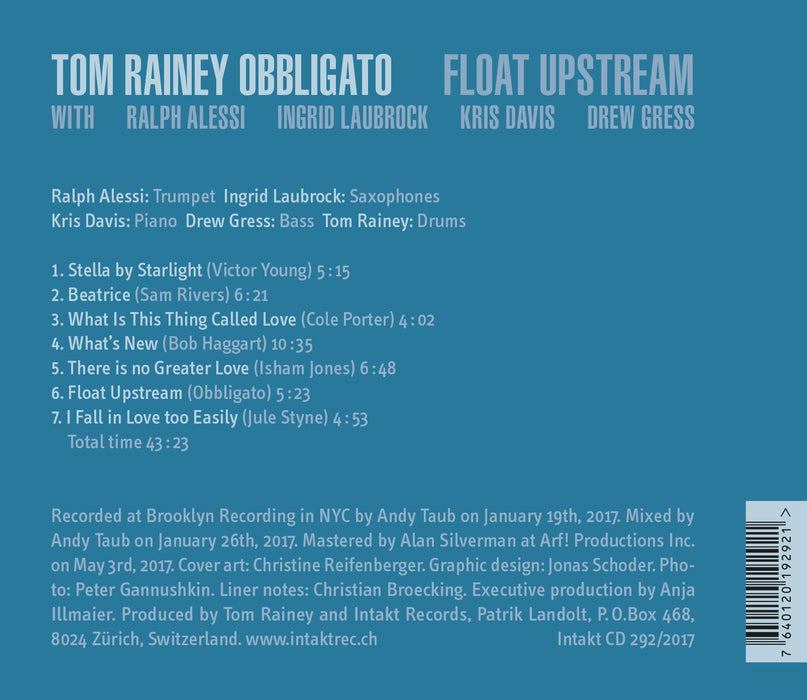
Recorded at Brooklyn recording in NYC by Andy Taub on January 19th, 2017.
Original price
CHF 12.00
-
Original price
CHF 30.00
Original price
CHF 30.00
CHF 12.00
-
CHF 30.00
Current price
CHF 30.00
More Info
Album Credits
J
The jazz standard may be the most renewable resource in popular culture. Even though some of these tunes have been in circulation for nearly a century, they remain infinitely malleable and eternally fresh. Obbligato, drummer Tom Rainey's "standards" band, takes an approach that respects the melody and harmonic structure of these compositions while employing strategies from collective and free improvisation.
Take the torch classic "What's New." Obbligato's take on it opens with a long and discursive solo by bassist Drew Gress. He follows the changes, but the restless invention of his line makes pianist Kris Davis' eventual statement of the melody almost a surprise. Davis takes things at a rubato tempo, with gull-like chirps from Ingrid Laubrock's soprano saxophone and a thrumming, coloristic pulse from Rainey. The performance evolves from there, with Ralph Alessi's trumpet evoking Chet Baker and Lester Bowie in equal measure. Yet the haunting Bob Haggart refrain remains front-and-center the whole time, offering the perfect bal- ance between the pleasure of a familiar melody and the thrill of hearing something entirely new.

p
In een ver verleden speelde Tom Rainey mainstream jazz in het eerste trio waarmee pianist Kenny Werner naam maakte. Intussen is de New Yorkse drummer heel andere wegen ingeslagen en is hij een kopstuk van de avant-garde. Maar kijk, hier pakt hij met zijn kompanen van de New Yorkse scene zowaar enkele standards aan. Rechttoe rechtaan versies moet u niet verwachten - de melodie van 'Stella by starlight' zal u bijvoorbeeld pas helemaal aan het eind herkennen. Liever kneden ze die overbekende nummers naar hun eigen visie op moderne jazz, vol interactie en improvisatie. Zoals trompettist Ralph Alessi, die mooie dialogen opzet met saxofoniste Ingrid Laubrock, zonder dat ze ooit unisono spelen. En in de solo's van pianiste Kris Davis klinkt zelfs de invloed van freejazz-icoon Cecil Taylor door. Hoogtepunt is 'What's new', met een sterke intro van bassist Drew Gress, die we ook kennen van bij Robin Verheyen.

C
When I first slipped Float Upstream into my player I half-attentively listened to it while doing something else, and so when I listened to it again closely and read the track list I was surprised to see that the bulk of the set consists of standards. And not just any standards, but some of the music’s most reliable warhorses: “Stella by Starlight” and “What is this thing Called Love,” among others. As Christian Broecking explains in the liner notes, Tom Rainey wanted to find a new, individual way to approach standards, and rather than writing prescriptive charts for the session he supplied his band with vague instructions for tunes they each knew well. Obbligato is a crack band, whose members – Ingrid Laubrock, Ralph Alessi, Kris Davis, and Drew Gress – achieved Rainey’s goal with a looseness and flexibility that allowed them to make these tunes new again in pleasantly surprising and charming ways.
On “Stella” – rendered here as a waltz – and “What is this thing Called Love,” Obbligato holds out on its listeners, teasing them with only the slightest taste of the tune right at the end. On both cuts we find that rather than highlighting the familiar melodies, Rainey places the focus on Laubrock and Alessi’s friendly sparring. Float Upstream’s emotional critical mass appears on a stirring and pathos-laden performance of “What’s New.” Here, Davis plays a beautiful reading of the song, and as she nears the end of her solo Laubrock and Alessi’s delicate obbligato lines slowly come to the fore as she transfers solo duties to Alessi. On her own solo Laubrock – whose tone sounds a bit weightier than I’m used to hearing – delivers a depth of feeling on the order of Coltrane’s solo on “Blue in Green.” The album is worth getting for “What’s New” alone. To add an extra element of intrigue, the title track is a collective improvisation. That its aesthetic matches so closely with the rest of the album demonstrates that there might not be as much distance between free improvisation and standards as some might assume.
If nothing else, Float Upstream reminds us that in the hand of inventive and committed musicians, there’s plenty of life left in songs that seem to have been played to death. This is a superb album.
https://www.pointofdeparture.org/PoD61/PoD61MoreMoments3.html

G
5 muzikanten uit de New Yorkse scene waar je tegenwoordig niet meer omheen kan. Ze doken samen de studio in om hun bewerkingen te
spelen van 6 overbekende standards aangevuld met een eigen nummer. Vergeet de vertrouwde versies van Stella by Starlight,
Wat is dit ding genaamd liefde van ik word verliefd? too Easily. De muzikanten vertalen alles naar hun typisch grootstedelijk jazzidioom. Weg
met gestroomlijnde melodielijnen en meteen herkenbare thema's. Welkom complex gelaagde structuren, het spel ook van aantrekken en afstoten of van verleiden en
verwerpen, Opmerkelijk hoe de solo's bijna totaal ingebed zitten in de improvisatiepassages en er niet expliciet uitspringen (met
uitzondering van een paar intro's). Nog maar eens een schoolvoorbeeld dat standards geen overbodige luxe zijn in moderne jazz.

R
The legacy of the great Miles Davis '60s quintet continues to shape contemporary music and that's hardly a negative influence, especially when it is executed with the kind of élan that drummer Tom Rainey, saxophonist Ingrid Laubrock, trumpeter Ralph Alessi, pianist Kris Davis and bassist Drew Gress demonstrate on Float Upstream. There is a concept at work here, that being a decidedly free interpretation of well-worn standards. With these particular players, a certain level of transcendence is achieved.
From the very oblique opening strains of "Stella by Starlight", each horn whinnies and wails in search of a mutual focal point and when they light upon it, at midpoint, everything becomes brutally clear. The rhythm team play their respective roles closer to the vest while trumpet and tenor are given wide latitude. Sometimes, as on Sam Rivers' "Beatrice", the melody gets jettisoned altogether and the form becomes the blank slate. Alessi's delicate sound and penchant for broken notes join forces with intuitive piano to begin as a duet, but when the full band enters, a glorious groove emerges on the strength of Gress' walk. It all comes together on "What's New", which the bassist outlines alone, sounding only slightly smaller than a fully mature redwood. Alessi and Laubrock enter with mocking commentary from the sidelines. Again, there is a shift from an 'outside' perspective to something closer to the center and the piece develops into a higher plane. Rainey leads off "There is No Greater Love" with a superlative bit of solo drum storytelling, inviting Laubrock and Alessi to shadowbox across the stereo curtain until Davis, rather unexpectedly, inserts herself into the mix, laying down a metrically dense and melodically intricate solo - definitely a highlight.
The title track, the one improvisation, evolves in an almost identical scenario as the standard material, making a powerful case for this group's ability to create something out of nothing.

M
There are few drummers in New York who rival Tom Rainey in terms of versatility. Like hand in glove, he fits into any context, be it mainstream or more freely improvised situations. Sought after as an accompanist, he rarely assumes leadership duties. In this album, however, he has found a perfect showcase for his abilities. On the one hand, he enjoys the company of four cutting-edge talents in New York City, one of these being his life partner, German saxophonist and American resident Ingrid Laubrock. On the other, his ensemble tackles a program of six jazz evergreens, including “Stella by Starlight”, “What’s New” and “There’s No Greater Love”, and one collective improvisation, “Float Upstream”, as an aside. If the repertoire is well worn, the interpretations are anything but, because no one sticks to the rules here, unlike those strictly adhered to in the previous album under review. Most notably the tunes can surface anywhere, sometimes explicitly, elsewhere more obliquely, even fleetingly; solos are not consistently strung one after the other but can occur simultaneously; more importantly, chord changes are discarded outright to allow free-form interplay. Such standards were once the bread and butter of mainstream players alone and were dismissed outright by more experimental musicians. Fortunately there have been some attempts at bridging that gap, and this group is proof-positive that it can be done, and very convincingly too.
https://myscena.org/marc-chenard/the-record-roundup/

M
Vétéran de la scène américaine, le batteur Tom Rainey joue aisément toutes les formes de jazz, qu’elles soient traditionnelles ou expérimentales. En tant qu’accompagnateur, il est d’une efficacité redoutable dans tous les contextes. Pourtant, on le voit rarement diriger un groupe, ce qui est le cas de ce disque qui lui permet de combiner ses deux mondes. D’une part, il est entouré de musiciens d’actualité à New York, parmi eux sa compagne la saxophoniste d’origine allemande Ingrid Laubrock; d’autre part, le programme musical comporte six vieux standards de jazz, entre autres Stella by Starlight, What’s New ou There’s No Greater Love, et une improvisation collective en guise de contraste. Si le répertoire est convenu, les interprétations, elles, ne le sont nullement, car le groupe fait fi de toutes les règles d’usage (comme celles qui font loi dans le disque de Perry). Les thèmes surgissent souvent en cours de route ou sont à peine effleurés; des solos de facture très libre se superposent au lieu de se suivre à la queue leu leu, délaissant les trames harmoniques sous-jacentes. Pendant longtemps, de telles lectures étaient assez exceptionnelles : les tenants de l’avant-garde n’avaient que faire des rengaines surannées, pendant que le jazz mainstream voyait la libre improvisation comme une pure aberration. De nos jours, la ligne de démarcation entre ces camps s’est estompée considérablement et un groupe comme celui-ci en est un bel exemple.
https://myscena.org/fr/marc-chenard/the-record-roundup/

A
Multifaceted American drummer Tom Rainey reunited his all-star band Obbligato for their second outing, Float Upstream, following the same philosophy of picking out classic tunes from the Great American Songbook and transforming them according to a modern point of view.
The quintet, both responsive and malleable, features Ingrid Laubrock on saxophones, Ralph Alessi on trumpet, Kris Davis on piano, and Drew Gress on bass, each of them staggering improvisers and distinguished bandleaders.
The music passes a feeling of delight, showing the respect and admiration these adventurous musicians have for the repertoire, even if they’re mostly known for different voyages, certainly less accessible yet widely exciting. However, fans of their probing style can relax because the fearless, risky attitude and proneness for experimentation are all here, well adapted to the softer nature of the pieces, whose new aesthetics blooms under a loose-jointed predisposition.
“Stella by Starlight” gives the example, opening the recording with a breezy Motian-esque flow hinged to the natural swinging environment. The melodic conversation between Alessi and Laubrock finds Davis as a meddler, each of them contributing to the balanced hybridity of tradition and modernity.
Soaring like a feather in the wind, Sam Rivers’ “Beatrice” is subjected to a cultivated sonic treatment. The balladic journey starts with sophisticated trumpet lines over sparse piano textures. After interlocking bass lines and distinctive brushwork get aligned to build a solid ground, Laubrock’s saxophone pops up, weaving melodies in and out, as the gentle yet propelling swinging inflection takes over.
An intrepid avant-jazz invasion takes hold of the uptempo “What is This Thing Called Love”, which features thoughtful horn interplay and a jagged piano exhilaration cooked up with intelligence. Here, the tune’s melodic statement can be glimpsed during the last seconds, but on “What’s New” it's perfectly recognizable from the beginning on account of Davis, who never abandons the main melody completely, exploring around it. Before she appears, one may indulge in Gress' solo bass intro populated with gorgeous woody phrases, elastic slides, and brief quick trills. The saxophonist, less expansive than usual and working alongside Alessi, still tosses a few elliptical punches to keep things interesting, wrapping up the piece with melodic clarity.
Brandishing his unique sound and advanced rhythmic discernment, Rainey opens a surprisingly waltzing “There Is No Greater Love” with both wet and wry tonalities allied to other inventive percussive techniques. Expect nice call-responses throughout a soprano/trumpet improvisation.
Before closing the session with another well-known ballad, “I Fall in Love Too Easily”, there’s time for the uncompromising title track, the only piece composed by the quintet, which swinging straight, also explores boundlessly.
Only talented musicians create edgy perspectives from traditional forms and structures. Rainey’s Obbligato does it charmingly with a selfless commitment.
https://jazztrail.net/blog/2017/11/21/tom-rainey-obbligato-float-upstream-album-review

T
Ist es anachronistisch, wenn sich eine Gruppe profilierter Protagonisten des freien Ausdrucks Jazzstandards verschiedener Epochen vornimmt, und es dabei gar locker und ironiefrei swingt? Der Schlagzeuger Tom Rainey steht einem Kollektiv vor, das mit Ingrid Laubrock, Saxophone, Ralph Alessi, Trompete, Kris Davis, Klavier, und Drew Gress, Bass, wirklich nicht in Wohlfühlverdacht gerät. Zu progressiv arbeiten die MusikerInnen in anderen Kontexten – oft gemeinsam – an der Entwicklung einer zeitgemäßen und individuellen Klangsprache, als dass ihnen in ihrem Portfolio da wirklich eine Legitimierung fehlen würde. Aber Standards sind auch hier in der Musiker-DNA verankert, ihre melodiöse Gestaltungskraft hat dies bisher stets gezeigt. Wird hier also der zeitgenössische Blick auf Standards gesucht? Zumindest geht es Rainey und seiner Gruppe nicht um Dekonstruktion der Vorlagen. Hier wird kollektiv das melodische, harmonische und rhythmische Potenzial der Stücke ausgelotet. Wo andernorts das Standardmaterial nur Aufhänger für das „eigene Ding" ist, setzt Raineys Band eine ganz andere Brille auf: Was ist die Essenz dieses Stücks - und was hat das mit mir, jetzt, in diesem Moment zu tun? Fünf MusikerInnen geben darauf fünf Antworten, und das ist der Kern der Kraft, die diese nur knapp 44 Minuten ausstrahlen. Ein Beispiel: Bei „What's new" tastet sich Drew Gress zunächst allein in den Song hinein, öffnen Klavier und Schlagzeug die Tür zu den Tiefenschichten, bevor Alessis sehnsuchtsvolle Trompete über dem Ganzen irrlichtert. Nach gut sieben Minuten dann das Finale: Laubrock setzt mit dem Thema ein, ganz schlicht, ganz klassisch, und spätestens jetzt versteht man, was dieses Stück jedem Einzelnen bedeutet. In den anderen Stücken funktioniert es ähnlich, immer etwas im Grundgestus variiert. Man lernt mit der CD viel über die fünf Beteiligten, man lernt aber auch viel über die Stücke, die - wie ein Gemälde nach der Reinigung von jahrzehnteal- tem Staub - wieder in neuen/alten Farben funkeln.

T
Nouveauté. Avec le quintette Obbligato, Tom Rainey entend donner sa version de standards allant du What Is This Thing Called Love de Cole Porter au Beatrice de Sam Rivers. Autant dire un large spectre mais qui est avant tout prétexte à des exercices d'improvisation collective car il serait vain d'attendre de Rainey et de ses comparses une totale fidélité à la trame harmonique et à la mélodie de ces thèmes. Tantôt ces dernières n'apparaissent donc que furtivement au gré de développements libres qu'autorisent des arrangements très ouverts. A d'autres occasion la mélodie est davantage respectée et débouche sur des improvisations en contrepoint. L'interaction entre les instruments est au cœur de ces interprétations et à ce niveau la sonorité de chacun des protagonistes produit un son d'ensemble tonique et fluide dynamisé par la frappe sèche de Rainey. Ceci est particulièrement remarquable sur le seul thème signé collectivement par le groupe et qui donne son nom à l'album

U
Två skivor ifrån det schweiziska bolaget Intakt, båda med musiker som vanligtvis återfinns på den friare delen av New Yorks jazzscen.
Saxofonisten Chris Speed har funnits med sedan tidigt nittiotal och med sitt modulerade tenorsspel varit en stabil motvikt och ankare i mer vidlyftiga spelupplägg. På denna trioplatta, Platinum on Tap återvänder Speed till jazzens tidiga innovatörer som Lester Young, Coleman Hawkins och en tidig Sonny Rollins. Det är väldigt avskalat, naket och öppet trevande med mycket luft och vibrato, en avancerad enkelhet som känns genuin och nära. Basisten Chris Tordini spelar medvetet elegant och komprimerat med långa, stabila baslinjer. Den som avviker, tänjer och utmanar och stökar till det är trumslagaren Dave King, vilken intensivt markerar, punkterar och driver på de övriga. Resultatet blir en återhållen intensitet som man förväntar när som helst skall brisera och spräcka upp. Detta sker dock inte förrän på det avslutande spåret Spirits, en kortversion av Albert Aylers klassiker. Förutom Aylerkompositionen och en udda läsning av Hoagy Carmichaels Stardust är allt material signerat Chris Speed. En högst personlig skiva som väl är värd att uppmärksammas.
Även trumslagaren Tom Rainey återvänder med sin grupp Obbligato till jazzens grundfundament och presenterar ett antal standardlåtar i personliga tolkningar, ibland långt ifrån de gängse ramarna. Här handlar det mycket om frihetsgrader i ensemblespelet, där trumpeteren Ralph Allessi och saxofonisten Ingrid Laubrock medvetet drar åt olika håll. Speluppläggen ställs mot varandra och skapar en inre dynamik, som bryter de melodiska linjerna. Resultatet är varierande, ibland blir det segt och stillastående som i inledande Stella by Starlight, ibland vindlande uppsluppet som i What's New samt There is no Greater Love. Pianisten Kris Davis imponerar genomgående stort med sin frimodiga, öppna samtidigt sam- manhållande spelstil, vilken inte minst blomstrar i Sam Rivers Beatrice. Rainey och basisten Drew Gress är väl samkörda och håller spelplanen under kontroll. Som skivans titel, Float Upstream implicerar så är det en hel del motströmsarbete som presenteras med utfall som inte alltid är givna eller utan ansträngning.

S
There’s a special relationship between jazz and the Great American Songbook, that collection of old popular songs, Broadway show tunes and movie themes largely assembled from the 1920s to the 1950s. Whether approached casually, romantically, harmonically or ironically, that songbook links performers from Louis Armstrong to Anthony Braxton and almost everyone in between. Drummer Tom Rainey has explored it in depth in association with pianists Fred Hersch and Kenny Werner; with his band Obbligato, he has found a distinctive path, combining standards with collective improvisation.
Obbligato includes frequent Rainey collaborators, saxophonist Ingrid Laubrock and the émigré Canadian pianist Kris Davis, along with the similarly distinguished trumpeter Ralph Alessi and bassist Drew Gress. They establish an identity immediately, the collectivist Stella by Starlight extending the theme’s moody haze with the horns’ exchanges until Davis initiates a bright, fluid approach, animating the piece along with sparkling eruptions from Gress and Rainey as well.
The advanced harmonic language suggests composer George Russell at times, but Laubrock and Alessi also thrive on the original melodies, developing pointillist moments on Sam Rivers’ Beatrice and a pensive luminosity on I Fall in Love Too Easily. The counterpoint and sheer rhythmic energy of What Is This Thing Called Love? recall the invention of Sonny Rollins at his most exploratory, while the extended What’s New? takes the quintet furthest afield, a unique cross breeding of 50s cool jazz lyricism and contemporary impulses that’s at once familiar and fresh.
https://www.thewholenote.com/index.php/booksrecords2/jazzaimprovised/27396-float-upstream-tom-rainey-obbligato

K
Albums Featuring Drummer Tom Rainey Showcase 2 Styles Of Jazz CounterpointRainey plays on Jason Stein's Lucille! as well as on his own quintet's record, Float Upstream. Critic Kevin Whitehead says the albums demonstrate the range and glory of jazz counterpoint.TERRY GROSS, HOST:
This is FRESH AIR. Drummer Tom Rainey is featured on two new CDs. One is by Chicago bass clarinetist Jason Stein. The other is by Rainey's own quintet, Obbligato. Jazz critic Kevin Whitehead says they demonstrate two different approaches to playing jazz counterpoint. Here's his review.
(SOUNDBITE OF JASON STEIN QUARTET'S "DEXTERITY")
KEVIN WHITEHEAD, BYLINE: A couple of things you don't hear much on Jason Stein's new album "Lucille!" - one is the frontline of two subterranean clarinets. Also, the horns often improvise together - duo, not solo. Stein on bass clarinet and Keefe Jackson on contrabass clarinet or tenor sax play in counterpoint, fitting one spontaneous line to another on the fly. That's almost a lost art in modern jazz, but that busy sound is exhilarating, whether the musicians gracefully weave around each other or butt heads.
(SOUNDBITE OF JASON STEIN QUARTET'S "MARSHMALLOW")
WHITEHEAD: Low reeds playing rowdy versions of bebop classics by Charlie Parker, Warne Marsh and Lennie Tristano point to the influence of counterpoint-friendly reed man Anthony Braxton. Jason Stein and Keefe Jackson dig into the raspy, explosive properties of the big clarinets, the high overtones ready to burst out of any super low note. There's something a little comic about the sound, but jazz musicians are not above a little low humor.
(SOUNDBITE OF JASON STEIN QUARTET'S "LITTLE ROOTIE TOOTIE")
WHITEHEAD: Jason Stein's quartet on Thelonious Monk's "Little Rootie Tootie" with a deep and surefooted bassist Joshua Abrams and drummer Tom Rainey playing a bit of melody on his tom-toms. The other guys on Stein's album "Lucille!" are Chicagoans, but Rainey came in from New York. There, he unleashes some jazz counterpoint of his own with his quintet Obbligato. Their new CD is called "Float Upstream."
(SOUNDBITE OF TOM RAINEY OBBLIGATO'S "THERE IS NO GREATER LOVE")
WHITEHEAD: That's a more airy brand of counterpoint and not only because of the higher pitch of Ingrid Laubrock's soprano sax and Ralph Alessi's trumpet. They phrase around as much as on top of each other. The band Obbligato plays jazz standards like "There Is No Greater Love" in a conversational way. The musicians know these tunes so well; they can jump in and out anywhere without distracting anybody. They may play the melody or leave it alone.
(SOUNDBITE OF TOM RAINEY OBBLIGATO'S "STELLA BY STARLIGHT")
WHITEHEAD: That's "Stella By Starlight" with Ingrid Laubrock on tenor saxophone. Pianist Kris Davis makes a few delayed entrances and sometimes takes lean solos like piano is another horn. She won't throw the instrument's weight around. Davis plays thorny new music in so many bands. The standards quintet puts her in a whole other light. She illuminates classic ballads and their harmonies from within while the horns flutter about like birds. This is "I Fall In Love Too Easily."
(SOUNDBITE OF TOM RAINEY OBBLIGATO'S "I FALL IN LOVE TOO EASILY")
WHITEHEAD: Drummer Tom Rainey and bassist Drew Gress go back 30 years and umpteen bands. They anchor all that whirling on top and step out a bit themselves. There are many dozens of jazz bands that play the classic American Songbook, but few address them with the offhand freedom that Tom Rainey's Obbligato does. Plus, there's all that glorious improvised counterpoint. Did I mention we could use more of that?
(SOUNDBITE OF TOM RAINEY OBBLIGATO'S "WHAT'S NEW")
GROSS: Kevin Whitehead writes for Point of Departure and is the author of "Why Jazz?" He reviewed "Lucille!" by the Jason Stein Quartet and "Float Upstream" by Tom Rainey's quintet, Obbligato.
https://www.npr.org/2017/10/25/559942901/albums-featuring-drummer-tom-rainey-showcase-2-styles-of-jazz-counterpoint

B
Drummer Tom Rainey is an artist fluent in the languages of both straightahead jazz and the avant-garde. Early albums found him providing cast-iron support to mainstream artists such as pianist Fred Hersch and vocalist Roseanna Vitro, while more recent projects have planted him in exploratory bands led by saxophonist Tim Berne and violinist Mark Feldman. In 2013 Rainey recorded the album LARK (Skirl) with trumpeter/cornetist Ralph Alessi, saxophonist Ingrid Laubrock and pianist Kris Davis, and for the Tom Rainey Obbligato’s eponymous album in 2014, he added bassist Drew Gress. Rainey’s new album, Float Upstream, features the same lineup. The band’s mission objective has been to filter Great American Songbook standards through a light-scattering prism of avant-impressionism. Float continues in a similar vein, but it shifts the thematic focus to love songs. Lyrical content, melodic shape and harmonic structure are all fair game for Rainey’s musical abstractionism, and the results are astounding in their novelty and freshness. The standard “Stella By Starlight” is bent into angles almost unrecognizable here. The tune begins in a noir-ish mist, out of which emerge the sly, roving voices of Alessi and Laubrock. Signposts of the song’s familiar melody eventually become perceptible, landing a profound punch once it solidifies by tune’s end. “What Is This Thing Called Love?” projects a similar air of intellection, smearing the tune’s sharply delineated chord changes into a watercolor blur. Throughout, Rainey’s drumming is agile and heated. His solo on “There Is No Greater Love,” full of clattering bursts and tumbling fills, sets the stage for a vigorous round of group interplay.
https://downbeat.com/reviews/editorspicks/2017-10#4583
