
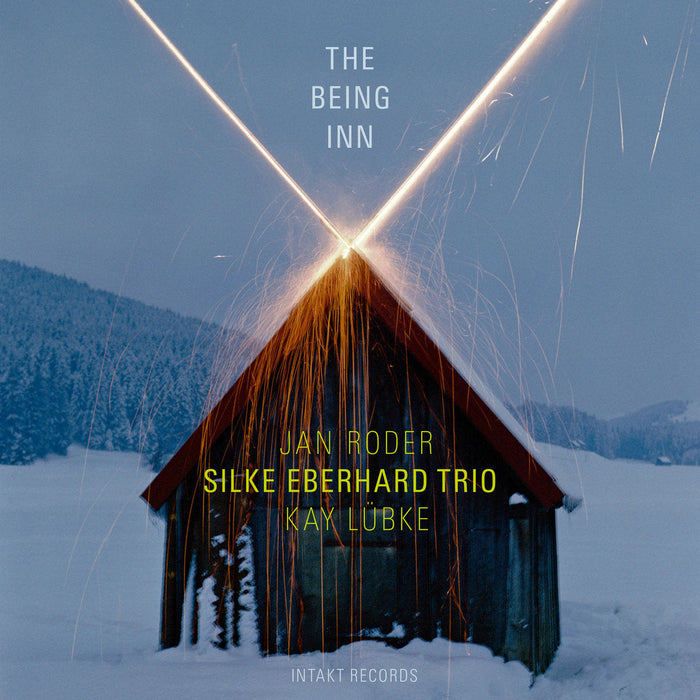
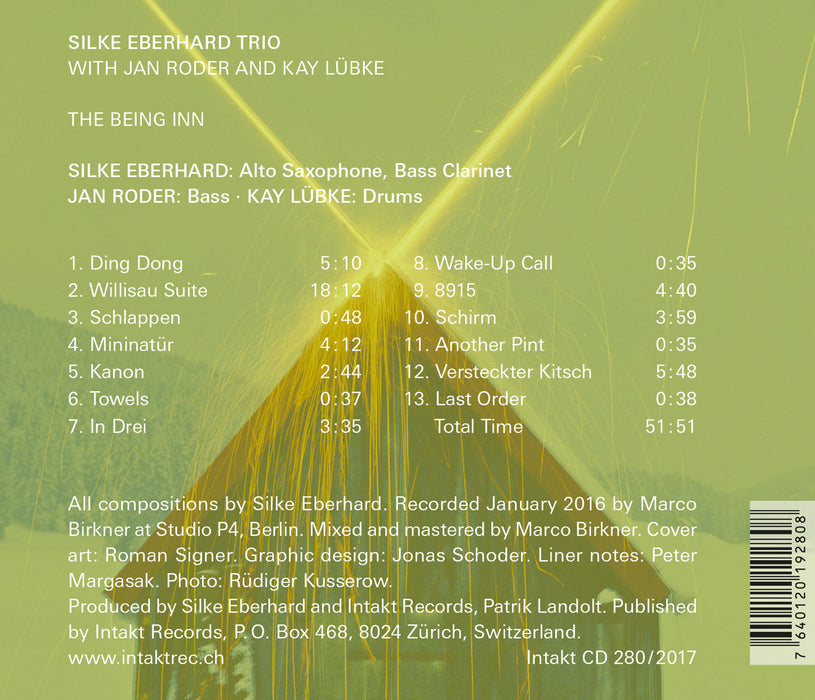
280: SILKE EBERHARD TRIO. The Being Inn
Intakt Recording #280/ 2017
Recorded January 2016 by Marco Birkner at Studio P4, Berlin.
Original price
CHF 12.00
-
Original price
CHF 30.00
Original price
CHF 30.00
CHF 12.00
-
CHF 30.00
Current price
CHF 30.00
More Info
Album Credits
M
Plus âgée que sa compatriote d’une quinzaine d’années, la quadragénaire Silke Eberhard (« The Being Inn ») est quant à elle restée en Allemagne où elle occupe depuis quelques lustres une place notable au sein de la scène nationale. La sonorité de son alto (elle pratique aussi la clarinette basse) est plus tranchante que celle de Charlotte Greve et c’est en leader qu’elle s’affiche avec un trio dont elle compose l’intégralité du répertoire. Elle y est accompagnée par les excellents Jan Roder (b) et Kay Lübke (dm) dont le jeu dynamique convient parfaitement aux improvisations fureteuses de la souffleuse.
https://blogdegarenne.blogspot.com/2020/10/gender-stories-2.html

J
Beaucoup plus aéré est le disque d’un second trio sax-contrebasse-batterie, celui de la saxophoniste allemande Silke Eberhard (saxo-alto et clarinette basse), fort bien accompagnée par Jan Roder et Kay Lübke. Son jeu, sinueux, son attaque franche, et son travail sur les intervalles renvoient un peu à Eric Dolphy, à Steve Lacy également, et peut-être à Arthur Blythe car elle navigue sur des thèmes et des structures rythmiques assez simples, mais parfaits pour susciter l’improvisation. Une suite de 18’, sept pièces qui n’atteignent pas 6’, et cinq intermèdes de 30/40’’ où le même thème est joué dans différentes tonalités, constituent un très bon disque de jazz contemporain. Silke Enerhard s’était déjà signalée avantageusement à nos oreilles dans des duos avec pianistes : Aki Takase « Ornette Coleman Anthology » (Intakt 129) et Uwe Oberg (cf. Culturejazz « Une année avec Leo (1) » 16/12//2016) et avec le trio I’m Three « Mingus, Mingus, Mingus » (LR 752 2016) . On voit qu’elle puise aux meilleures sources.
https://www.culturejazz.fr/spip.php?article3360

J
Det starter med at vi hører saksofonisten Silke Eberhardt gå fra venstre til høyre høyttaler på sine høyhælede sko, før trioen med henne på altsaksofon, bassisten Jan Roder og trommeslageren Lay Lübke setter an i noe som kunne vært hentet fra en av platene til Henry Threadgill og hans AIR-prosjekt.
Men her er all musikken laget av Eberhardt, som er godt bevandret innenfor den moderne delen av den europeiske jazzen med en rekke prosjekter, som for eksempel hennes strålende hyllest til Ornette Coleman i duo med pianisten Aki Takase, og med Eve Rissers store orkester, for å nevne et par av høydepunktene.
Og at akkurat hun har gjort en hyllest til Ornette Coleman virker svært naturlig når man hører hennes spill. Det er mye Coleman i spillet, men kanskje like mye de andre saksofonistene som fulgte i sporene etter Coleman, og som fulgte hans ideer og musikalske retning. Som for eksempel Henry Threadgill.
Eberhardts tone i altsaksofonen er relativt lys, men hun trakterer også bassklarinett på denne innspillingen, et instrument man i første rekke forbinder med Eric Dolphy, en musiker fra 60-tallet som Eberhardt kjenner godt. I tillegg kan man også høre referanser til Charles Mingus, noe som, selvsagt kan ha noe med Mingus sitt nære samarbeid med Dolphy i noen år.
Med Jan Roder som fjellstø bassist, som sender avgårde flere strålende solier gjennom hele platen, og Kay Lübke som sprelsk, kreativ og spennende trommeslager, sammen med Eberhardts klare referanser til 60-tallets helter, får vi en flott kombinasjon av nyere jazz og tradisjonene som fungerer perfekt.
Alle tre kommuniserer nærmest perfekt, vi har med tre strålende musikere å gjøre, og sammen har de laget et album som oser av kvalitet, energi og spennende samspill. Og sitter du på Henry Threadgills AIR-plater, og er ute etter mer i samme landskapet, så er dette den perfekte platen å skaffe seg.
Anbefales til alle venner av heltene fra 60-tallet, som gjerne vil høre hvor den musikken har havnet.
https://salt-peanuts.eu/record/silke-eberhardt-trio/

A
Quarantacinque anni, tedesca di Heidenheim an der Brenz (ma ormai di stanza a Berlino), Silke Eberhard guida da alcuni anni il trio protagonista di questo album, diretto, corporeo, al cui interno il suo contralto (più di rado il clarone) si distende con estrema libertà, di misura e di dizione, con un senso della forma che definiremmo sostanzialmente veicolato al singolo episodio (e alcuni sono brevissimi, poco oltre il mezzo minuto) e il risultato, di conseguenza, che un disco senz'altro di lodevole fattura finisce via via per scorrere un po' prevedibile, scontato, lievemente schematico.
L'idioma è un free-bop—secondo una definizione che ebbe un certo seguito anni fa—non esageratamente spericolato (tutti della sassofonista i tredici brani in scaletta), forte di sonorità per lo più nette, anche acuminate, e un procedere d'insieme (generalmente a ranghi compatti) che ha momenti anche tumultuosi, tendenzialmente affermativi, estroversi ma senza eccessi. Da ricercare fra i brani dispari (l'iniziale "Ding Dong" e poi "Schlappen," "Kanon" e "8915") i momenti più significativi che il disco ci offre.
https://www.allaboutjazz.com/the-being-inn-silke-eberhard-intakt-records-review-by-alberto-bazzurro

R
Nicht ganz zu Unrecht erinnert das Silke Eberhard Trio an das Ensemble, mit dem Sonny Rollins in den fünfziger Jahren das Format Bass-Saxophon-Schlagzeug begründete. Das seit 2006 bestehende Trio der Berliner Altsaxophonistin bezieht sich zwar nicht explizit auf Rollins, den Giganten, dessen Geist ist aber spürbar. Eberhards Kompositionen entspringen, wie sie bereits mehrfach bewiesen hat, dem Geist Eric Dolphys, Charles Mingus' oder Ornette Colemans.
Auf dem neuen Album sind über ein Dutzend stimmungsvoller Stücke versammelt, denen sich der Hörer nicht entziehen kann. Dieser wird unvermittelt mit einem witzigen „Ding Dong" ins imaginäre Gasthaus (The Being Inn) geführt, das auf dem Cover mit einer Holzhütte angedeutet wird. In einer Holzhütte fand einstmals das Jazz Festival Willisau statt, dem Eberhard mit der 18-minütigen Willisau-Suite Tribut zollt. Auch die „Schweizer Naturwelt", die Eberhards einmonatige Residenz in Willisau ebenso reflektiert, wird von den Instrumentalisten berücksichtigt. Bassist Jan Roder und Schlagzeuger Kay Lübke fügen sich glänzend ein. Hard- bop reinsten Wassers mit expressiven Zügen.

K
Part of the ever-burgeoning stratum of Berlin-based improvisers, alto saxophonist/bass clarinetist Silke Eberhard doesn’t limit herself to any one band or musical configuration. In fact she has partnered with players across the age spectrum from pianist Ulrich Gumpert to trombonist Matthias Müller. Additionally, while her ensembles usually concentrate on original material, she has also recorded interpretations of classic works by Ornette Coleman, Eric Dolphy and others. These trio discs succinctly reflect her bilateral approach. Together since 2006, the trio of the reedist, bassist Jan Roder and drummer Kay Lübke plays 13 of Eberhard’s own compositions on The Being Inn, while I Am Three, completed by trumpeter Nikolaus Neuser and drummer Christian Marien tries its hand on a dozen of bassist Charles Mingus’ pieces on the other CD.
Mingus Mingus Mingus appears to be aiming for a snarky, punk-like reappraisal of the bassist’s work, and can be commended for reviving more obscure Mingus tunes as well, as his greatest hits. At the same time the lack of a chordal instrument and the undue prominence of Marien, who has been associated with Müller and bassist Clayton Thomas, almost makes it seem as if the horns are accompanying him. Lübke, who has recorded with bands led by reedists Ernst-Ludwig Petrowsky and Uli Kempendorff, and Roder, whose groups have included Die Enttäuschung, provide more equitable contributions to the other session, making the performances more balanced.
Demonstrating this three-pronged approach, the trio is most effusive on “Willisau Suite”, which at 18 minutes plus is almost twice the length of the next two longest tracks combined. A real suite, it moves from a splintered and shuffling introduction through a variety of duos and trios in tandem and in counterpoint, to end up a pleasing amble, encompassing cymbal shakes and a walking bass line. After a drum roll introduces bugle-call-like stuttering from Eberhard, her timbres accelerate to altissimo as she gesticulates theme variation on theme variation, Roder plucks and string pops with a watchmaker’s attention to detail, and is soon joined with equivalent rhythm precision by Lübke. When the percussionist eventually toughens his attack with New Thing-like rotary stick work the reedist’s irregular vibrations and honking eventually splutter to a moderato finale.
Among the aural light and darkness propelled by the trio during a series of short (staring at 38 seconds) and longer (a maximum of nearly six minutes) improvisations are other instances which let the three demonstrate their instrumental prowess. “8915” and “Schirm” for instance, confirm Eberhard’s debt to Dolphy, with an innate rhythm section swing on the former interrupted by a reed squall; while the bassist’s alternating high and low pulses and the drummer’s clockwork-like beats on the latter pace moody mellowness portrayed by Eberhard’s on the second. Simple and bracing, the bass clarinet solo on “Kanon”, tracked only by the drummer, shows how a profound idea can be expressed without massive elaborations. The contracts between the trios are most obvious with the other group’s treatment of the equivalent “Canon” on Mingus Mingus Mingus. While suitable as a final track, it appears more concerned with Marien’s heavy drumming then Neuser’s ex cathedra elaborations.
Otherwise the performances, recorded six months after the first disc, seem to swerve from POMO archness to livelier interpretations. A couple of tracks appear distantly lo-fi, hopefully a salute to Mingus’ 1950s mono records rather than a studio glitch; while a rather solemn reading of “Jelly Roll” is prefaced by the static and crackle of a stylus hitting a well-worn LP groove in a way that detracts from the overall performance. Plus it’s certain that its composer didn’t figure that the profound sentiments of “Self-Portrait in Three Colors” would be expressed by an explicit back-beat drum solo that has more in common with John Bonham than Dannie Richmond.
When the group pays fealty to the Mingus canon, the results aren’t that encouraging either. Performances such as “Oh Lord, Don’t Let Them Drop That Atomic Bomb on Me” or “Goodbye Pork Pie Hat” come across as Mingus-lite, with musical nourishment stripped from them along with extraneous calories. Bludgeoned with percussion pressure, the trio doesn’t realize that the first tune is supposed to be played with satiric humor. The second is also a celebration not a dirge and is also weakened when the trumpeter’s exposition is close to “Taps”.
Nimble elsewhere, the band’s interpretations are more notable when it recasts other tunes, almost ignoring the originals. While Neuser’s exaggerated blowing reference Louis Armstrong rather than Ted Curson on “Fables of Faubus”, he later harmonizes perfectly with Eberhard’s alto saxophone and construct an original bent-note finale. As well, “Moanin’” is probably the liveliest cut with snorting saxophone smears doubling plunger trumpet l...

H
独のフリー系女性リード奏者が活動の柱とするトリオの新作
高瀬アキとの共同名義によるオーネット・コールマン曲集で知られるエバー ハルトが、今回は全曲を作曲。オーネットとエリック・ドルフィーを土台にし たアルトは、現代的なスピード感も兼ね備えて自由自在に飛翔する。1分未満 の演奏を5曲点在させて場面転換のメリハリをつけた構成が特色。2012年 のスイス ス《ヴィリザウ・ジャズ祭》でレジデンス・アーティストを務めた時に 書いた②は、対照的に18分超の組曲で、トリオの魅力を集約。

M
Om met de deur in huis te vallen: The Being Inn' roept bij deze luisteraar gemende gevoelens op. Enerzijds is er bewondering voor het inventieve en geestdriftige samenspel. Voor de ideeënrijkdom van vooral rietblazer Silke Eberhard. Voor haar lichte, speelse toon die camoufleert hoe hard er moet worden gewerkt. Voor de manier waarop ze nadrukkelijk maar niet koket of blasé laat horen dat ze haar klassiekers kent. Voor de fantasievolle aanpak en het even verbeeldingsvol doortrekken van de lijn Ornette Coleman, Eric Dolphy naar nu. Hoewel dat nu zit bij deze luisteraar de appreciatie het meest in de weg. Niet in een fraai lichtvoetig stuk als Miniatür maar wel in een paar andere. Leunen op het verleden is niet erg, toch roepen vooral de door free jazz gevoede exploraties de vraag op, hoeveel kans op ontwikkeling die stiel biedt. Zelfs bij een even intelligente als gevoelige blazer als Eberhard liggen constant de citaten en herhalingen op de loer. Dan is er nog de contradictie dat deze muziek bevrijd wilde zijn en wilde bevrijden, dat juist deze muziek als een gegeven wordt genomen, lets waarop kan worden voortgeborduurd. Misschien vraagt deze muziek een conceptuele aanpak van de beschouwer, zoals een kunstenaar die op Mondriaan voortbouwt vragen kan oproepen over de haalbaar-en wenselijkheid om op Mondriaan voort te bouwen. Misschien zijn ook gemende gevoelens niet erg, maar zeker zijn er vragen.
https://www.jazzmo.com/recensie/silke-eberhard-trio-the-being-inn/

T
Silke Eberhard
Im Hier Und Jetzt
„Das Sein bestimmt das Bewusstsein", sagte Karl Marx. Dabei kannte er noch nicht einmal das Silke Eberhard Trio. Deren neues Album - das dritte mit dem Wort „Being" im Titel - hätte auch sein Bewusstsein erweitert.
„In dieser Musik bin ich als Musikerin wahrscheinlich am meisten ich selbst", sagt Silke Eberhard über ihr Trio mit Jan Roder (b) und Kay Lübke (dr). „Es ist meine eigene Musik, sind meine eigenen Improvisationen - vor allem mit den Leuten, mit denen ich gerne zusammenspiele." Und lange. Seit sie in den 90ern nach Berlin kam, kennt sie die beiden, auch wenn sie sich erst 2006 zum Trio zusammenfanden. Seitdem sind sie zu einer musikalischen Einheit zusammengewachsen. So selbstverständlich swingen nur wenige Bands.
Das buchstäbliche EinVerständnis der Mitglieder ist nur einer der Gründe, weshalb das Silke Eberhard Trio wirklich besonders ist. Ein anderer ist die Namensgeberin selbst. „Wenn ich komponiere, dann denke ich dabei zuerst an das Trio." Denn hier sind mit Saxofon, Bass und Schlagzeug die fundamentalen Kategorien Melodie, Basslinie und Rhythmus ideal verkörpert. Die Harmonie ergibt sich aus dem Zusammenspiel. Wie überflüssig ein vierter Player wäre, zeigt ein Titel wie „Versteckter Kitsch" mit seiner pointilistischen Einleitung, die bald in quirlige Wellen und sturzbachartige Abwärts-Arpeggien übergeht.
Alles drängt nach vorne, auch der entspannt gezupfte Bass, dann stimmt Kay Lübke sogar einen klassischen Ride-Cymbal- Swing an. Kontrapunktisch verschränkt sind die Patterns von Bass und Bassklarinette in „Last Order", der letzten der fünf Miniaturen, die das Album programmatisch tragen: „Schlappen", „Towels",.,Wake-up Call", „Another Pint" und eben „Last Order" beleuchten wichtige Aspekte von The Being Inn- jenem imaginierten Gasthof, den Silke Eberhard in den ersten Sekunden des Albums hörbar betritt. Und in dem das Trio offenbar als Hausband engagiert ist.
Eine Metapher, wohlgemerkt. Solche längerfristigen Gigs sind selten geworden.
Praktische Erfahrung konnte Silke Eberhard in den vergangenen Jahren dagegen öfter mit Residencies sammeln, so war sie 2012 im schweizerischen Willisau als Artist in Residence eingeladen, 2015 in Wuppertal bei der Peter Kowald Gesellschaft und 2016 im Rahmen einer Fellowship am Omi International Arts Center in Ghent, New York. „Im besten Fall sind Residenzen dazu da, dass man als Künstlerin einfach nur da sein darf und Zeit hat, einmal ohne äußeren Druck seine Arbeit zu machen", sagt sie. In Willisau hatte ich mir z.B. vorgenommen, nur zu improvisieren. Und was war? Am Ende hatte ich dann doch ein Stück geschrieben." Die Willisau-Suite" ist mit 18 Mi- nuten sogar das längste Stück des Albums- und bleibt auch als Komposition ein improvisiertes Stück mit viel Raum für Soli aller Beteiligten.
Im Booklet des Albums erzählt Eberhard von den Spaziergängen in der Schweizer Natur, die sie inspirierten, und vom Archiv des Willisau- Festivals, in dessen unveröffentlichten Aufnahmen sie stöbern durfte: ein unschätzbarer Inspirations-Quell für die Saxofonistin und Komponistin, die auch als Forscherin bekannt ist. 2015 erhielt sie den Preis der Deutschen Schallplattenkritik für ihr Album Potsa Lotsa Plus Plays Love Suite by Eric Dolphy. In den Jahren davor hatte sie schon die Complete Works of Eric Dolphy arrangiert - und dabei Hinweise gefunden, der 1964 jung verstorbene Dolphy habe für seine Hochzeit eine „Love Suite" komponiert, aber nicht mehr aufführen können. Das unvollendete Manuskript fand sie schließlich bei Gunther Schuller, der ihr eine Kopie zum Studium überließ. So kam Dolphys letztes Werk schließlich 50 Jahre zu spät beim JazzFest in Berlin zur Uraufführung. Schon 2007 hatte Silke Eberhard mit Aki Takase ein Doppelalbum mit Musik von Ornette Coleman eingespielt, im vergangenen Jahr erschien das erste Album des Trios I Am Three, das Kompositionen von Charles Mingus ins Zentrum stellt. Silke Eberhard versteht Dolphy, Coleman, Mingus und Co. - besser gesagt, deren Stücke - als Freunde. „Ich hab von denen allen gelernt. Meine Lehrer waren meine Schallplatten. Da bleibt die Inspiration nicht aus."
Dass Komponieren aber auch ein Handwerk ist, deutet der „Kanon" auf The Being Inn an. Obwohl er nicht als Kompositions-Etüde entstanden ist. „Ich versuche das manchmal, Schreib-Übungen", erzählt Silke Eberhard. „Und dann kommt ganz was anderes dabei heraus. Das ist ja oft so: Wenn man sich was vornimmt, dann passiert das Gegenteil. Das muss nicht schlechter sein, eher eine andere Variante." Und dann macht sie mit ihrem Trio wieder deutlich, dass aufgeschriebene Noten auch nur Anhaltspunkte, Inspirationsquellen sind: „Wir spielen auf der CD-Release-Tournee natürlich die Musik von The Being Inn, aber nicht Stück für Stück die Platte nach. Wir sind doch keine Pop-Band. Aber das wird heute erwartet, auch im Jazz." Lieber greifen sie auf das in zehn Jahren gewachsene Repertoire des Trios zurück, inklusive der Kompositionen, die g...

P
Silke Eberhard, die sich auf früheren Alben intensiv mit Ornette Coleman oder Eric Dolphy befasst hat und sich von ihnen zu eigenen Interpretationen inspirieren liess, spielt auf "The Being Inn" mit Jan Roder und Kay Lübke ihr eigenes Material. Das zentrale Stück ist die 18-minütige "Willisau Suite", die sie mit mehreren kurzen Tracks und kürzesten Interludes ergänzt. Die "Willisau Suite" basiert auf ihren Eindrücken anlässlich eines Atelier-Aufenthaltes 2012 im Städtchen, den langen Spaziergängen in der Natur der Umgebung und den Höreindrücken aus Niklaus Troxlers Willisau-Jazz-Archiv. Alle drei Musiker exponieren sich im Verlauf des Stücks mit solistischen Interventionen, die an nicht vorhersehbaren Stellen aus dem Interplay erwachsen. Dabei läuft das Fliessgleichgewicht des Trios nie aus dem Ruder, sondern macht über Stock und Stein die unterschiedlichsten Wandlungen durch. Eberhard hat einen klaren und pointierten Sound, den sie fantasievoll in melodischen Linien zirkulieren lassen oder rabiat zuspitzen kann. Roder und Lübke gefallen mit ihrer Wendigkeit und Prägnanz. Das Trio spielt seit über zehn Jahren zusammen. Diese Vertrautheit der Musiker miteinander hält ihr Interplay elastisch und ermöglicht es, dass auch in den kargeren Zonen der Energiefunke springt.

R
Die Intaktler, mit den 'Intakt in London/London in Zürich'-Festivitäten in den stolzen Knochen und zusätzlich bestärkt durch den Preis der deutschen Schallplattenkritik für "Sakura" von Aki Takase & David Murray, kehren ins alltäglichere Geschäft zurück mit The Being Inn (Intakt CD 280). Was will uns das neue Geschwisterchen von "Being" (2008) und "What A Beauty Being" (2011) sagen? Dass nicht Sprache, sondern Musik das Haus des Seins ist? Und sich bei näherer Betrachtung als Kneipe erweist, in der 'Another Pint' und 'Versteckter Kitsch' gezapft, aber vor allem Coleman, Dolphy und Mingus ausgeschenkt werden? Vom Lübecker Berliner Jan Roder am Bass, den wir zuletzt ganz glücklich mit JR3 hörten, und dem Karlsruher Berliner Kay Lübke (von Hornbeef) an den Drums als bewährten Thekenkräften. Mit Silke Eberhard, einer nicht gerade typischen Prenzlschwäbin, die mit Altosax & Bassklarinette und mehr als Freundin denn als Chefin den Ton angibt. Sie schreitet - hörbar - zur Tat, aber dem zu 'Take Five'-ähnlichem Groove gekrähten 'Ding Dong' zu Beginn folgt nicht 'die Hex ist tot', sondern die 18-min. 'Willisau Suite'. Die Hommage an Nikolaus Troxlers Lebenswerk mischt Schweizer Impressionen mit jazzgeschichtlichen Reminiszensen, mit markantem Bogenspiel, rollendem Drive, joggendem oder scharwenzelndem Pizzikato, flippernder Perkussivität, ostinatem Stau und all der kapriziösen und gepfefferten Sangeskunst, zu der Eberhard geradezu altmeisterlich fähig ist. In der anschließenden Lang-Kurz- / Bier-Schnaps-Folge flotter Cheerios und kleiner, sich gleichender Intermezzi auf ex kommen 'Schlappen' und 'Kanon' mit Bassklarinette daher, 'Miniatür' filzweich und mit Besenstrichen. Aber warum die vertrackte und freigiebige Spielkunst der drei verkürzen auf hier ne Repetition (die wie vor ner roten Ampel auf der Stelle tritt), da das raffinierte Wechselspiel von tanzenden Lippen, Fingern oder Stöcken und dort ein Tirili - meist ja schon innerhalb eines Stückchens? Eberhard zeigt sich im spritzig Liquiden forellig wohl und singt auch noch, wenn bei 'Schirm' dunkle Wolken wankend näher rücken. Der Kitsch allerdings, der fällt, schnipp-schnapp, der Schere zum Opfer. Lieber noch n schneller Absacker... - Aaah.

A
It is difficult to not recognise Silke’s personal touch for someone like myself who is so familiar with her recordings. Accordingly the reason for that is exactly this tradition following path she continues to step on. As a die hard fan of Dolphy’s, Coleman’s or Mingus’ music I am finding the natural consequence in what she is doing. Additionally the fact that she made another recording with trio she long time co-operates with guaranties the flow that I like so much in her music. It took ten years to get back to Intakt but it was same worth awaiting for as it was a duo she debuted there with.
From an opening Ding Dong, which is a facetious act with its walk & door opening noises it takes one straight into the the serious game. You can hear that this section is a super comfort zone to her. She can fly high and she does it on the heart rate. Al that rhythmical figures that evolved from Dolphy’s tradition, she not only perfected and adopted her own style and sense of humour but also perfected conceptually. (Potsa Lotsa reviews’re here & here)
Following Willsau Suite is a longest piece on that set and it possesses this looseness in form suggesting it being vastly improvised. Silke leads here doubtlessly and the section follows with great feeling. Everyone has enough space to include the solo into the tissue. As well as contribute into fast running ideas coming to the table. Roder’s Bass sounds wonderfully natural walking with such a feeling of pace, which adds vastly into highly imaginative sax lines. The way the Drums comes together with framing space-scape embracing sax cannonades She blows out is nothing but genial.
Here is where complete Lubke’s Tour de Force takes place. And walking with Silke like that takes a lot of guts, believe me. This is also the best piece on here. Hugely imaginative and with quirky sense of humour. And some dirty jokes had being said between the lines too. Here tears and laughs merge into one. Tensions find perfect culminations and then realise back into an open space.
Additional piquancy comes from the short figurative interludes, which are acting like little brakes but also a foreplays: Schlappen, Towels, Wake Up Call and closing Last Order are all like that.
Funky named Mininatur explores the series of pictures gently sketched by Silke’s sax underlined with fat and dance bass walks. All that on the carefully brushed percussive background which is like a snowy-white page for them.
This, then 8915 and Verstecker Kitch are all reminding me the mood present in Arthur Blythe & David Eyges collaborations. Or Julius Hemphill with Abdul Wadud, but obviously spiced and energised with Eberhard’s own temper. Ogh,…Yammy !
The Kanon, beautifully looped into the rhythmic repetitions from the section is a Bass Clarinet bravado wonderfully executed, but also highly demanding on partnering musician’s empathy and musical imagination. My absolutely 2nd best here. It continues in further triumphal clarinet walk in the Schirm. A dark suspense-ish theme stepping into the fade like Davis’ tunes composed for The Lift to the Scalfold, an iconic French Noir Movie.
This is fantastic recording which I continue to return to and listen for more. You wouldn’t believe how many layers are still waiting there to be revealed. That made one great soundtrack to ongoing holiday laziness spiced with an intriguing intellectual twists.
Just the way I love it!
http://jazzpress.gpoint-audio.com/2017/08/1203/

G
For someone like myself, who is so familiar with all her recordings, it is difficult not to recognise Eberhard's personal touch, and as a fan of Dolphy, Coleman and Mingus, I find her playing is a natural consequence. Those rhythmic figures that evolved from Dolphy's tradition, she not only perfected and adopted her own style and sense of humour, but also perfected conceptually.
Willsau Suite is the longest piece and its looseness in form implies improvisation. Eberhard leads and the others follow with great feeling. Everyone has enough space to include solos, and Roder's bass sounds wonderfully natural, walking with such a feeling of pace that it adds to the highly imaginative sax lines. The drums then come and embrace the sax 'cannonades'. This is the best piece on the disc, as it's hugely imaginative and has a quirky sense of humour.
Additional piquancy comes from the short figurative interludes, like Schlappen, Towels, Wake Up Call and Last Order. The Mininatur explores a series of pictures gently sketched by Eberhard's sax, underlined by a walking bass.
The Kanon is wonderfully executed, and is also highly demanding on the partnering musician's empathy and musical imagination, but is certainly my second favourite. It continues with a further triumphal clarinet walk in Schirm, a dark suspense-like theme a little like the Miles Davis composed soundtrack for The Lift to the Scaffold (an iconic French Noir Movie). This is a fantastic recording to which I'll regularly return, as so many layers are still waiting to be revealed.