
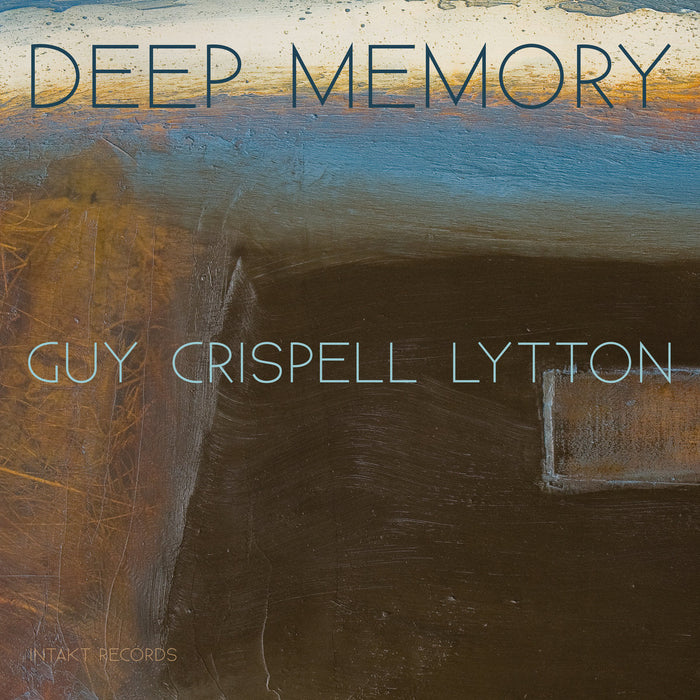
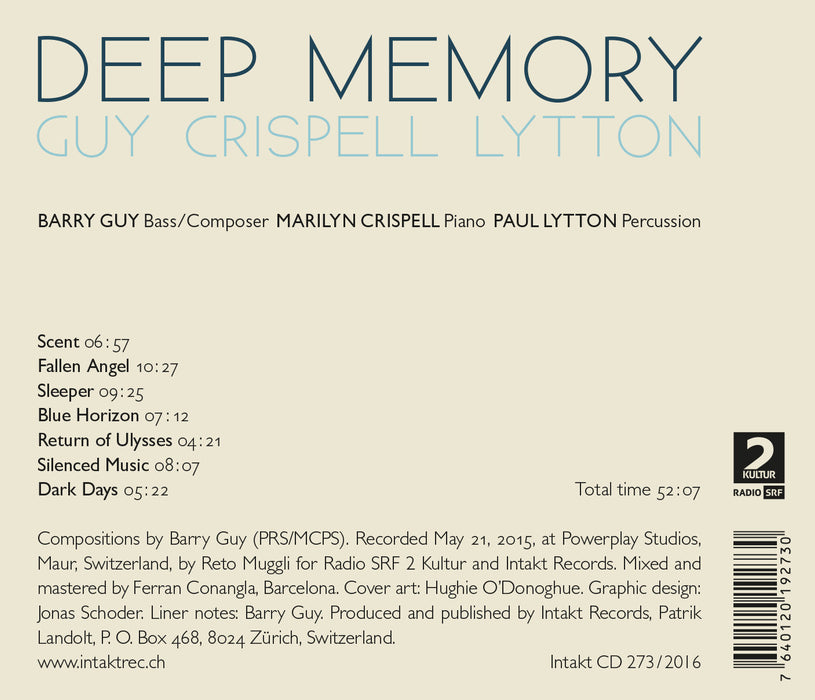
273: BARRY GUY – MARILYN CRISPELL – PAUL LYTTON. Deep Memory
Intakt Recording #273/ 2016
Recorded May 21, 2015, at Powerplay Studios, Maur, Switzerland.
Original price
CHF 12.00
-
Original price
CHF 30.00
Original price
CHF 30.00
CHF 12.00
-
CHF 30.00
Current price
CHF 30.00
More Info
Album Credits
R
The profound and innovative virtuosity of each of these three protagonists on Deep Memory is always in in danger of gobbling up the other. But at no time is this evident on this recording. Barry Guy, Marilyn Crispell and Paul Lytton are all content in their own skins while strutting forth their individuality in these performances. The music gets interesting from the first bars of each of the pieces. Guy, Crispell and Lytton hold nothing back and each piece is played with controlled rhythmic fire, harmonic tricks and flaming melodies. I hear nothing ‘lyrical or contented’ or ‘sweetly ardent’ about any of this music. In each instance, thematic statements grow increasingly elaborate and the brilliance of Guy, Crispell and Lytton is incandescent with their leaping soli, deliberate ‘wrong note’ landing points and fiery scales it often feels as if the musicians are duking it out – tastefully, of course.
https://jazzdagama.com/music/intakt-adventure-continues/3/

K
Suspended between expressive romanticism and energetic atonality, the fourth CD by bassist Barry Guy, pianist Marilyn Crispell and drummer Paul Lytton (the latter pair both turning 70 this month) confirms the solidity of this sporadically assembled trio and its suitability as vehicle for Guy's compositions. Deep Memory's seven pieces throb with reflections on the draftsmanship and color application of selected works by British artist Hughie O'Donoghue, whose paintings provide the track titles and cover image.
O'Donoghue's highly abstracted figure paintings are musically echoed as the players meld swinging tonality with departures from the expected, yet never lose momentum. A tune such as "Return of Ulysses" balances Crispell's double-time kinetics with regularized patterns from the piano's lowest pitches, which maintain the theme even as she creates new variations, as if making indentations on cooling asphalt. Crispell was initially influenced by Cecil Taylor, so a piece like "Dark Days" approximates Taylor's jagged power, especially when coupled with Guy's spiccato string slices, but she is also enough of a melodicist to throw in references to the bagpipe air "The Campbells Are Coming".
"Sleeper", initially played with tortoise-lumbering deliberation, showcases the pianist's pedal-pressured soundboard vibrations plus hard patterns from Lytton. Cymbal smacks and piano glissandi prod the melody to triple its pace in its final two minutes.
Throughout the CD, the three are like fine art restorers of neglected canvases. The ambulatory allusions they bring to the material via buzzes, stretches and echoes sonically brighten themes suggested by O'Donoghue's mostly murky colors-a key instance of this is titled "Silenced Music" - communicative music due to the sophisticated interaction.

P
Barry Guy's most recent music has taken a deeper dive inside a concept that has long provided Guy the composer, as opposed to the improvising double-bassist, with a framework around which to organise musical form. Obliging styles normally considered incompatible to coexist generates disruptive energy - witness last year's The Blue Shroud for a large ensemble of improvisers whose contributions were wrapped around slivers of borrowed music by Bach and Biber - and the seven new compositions Guy has written for his long-standing trio with pianist Marilyn Crispell and drummer Paul Lytton range from singing melodic sequences to abrupt outbreaks of itchy, non- tonal slipstreams of motion that obviously links into Guy's history as a free improviser. Sometimes this convenient marriage of styles feels mannered. 'Fallen Angel' opens with stampeding piano clusters and shuddering double- bass tremolos, tumbling atonal masonry that falls away to reveal delicately sweetened piano triads underneath. More purposeful is the opening track, 'Scent', where melodic cells, evocative of what Jelly Roll Morton might have termed the 'Spanish Tinge', are transformed by being massaged more as acquiescent sound than functional harmony. Elsewhere 'Blue Horizon' unfolds as a soulful ballad: and if the frenetic webs of counterpoint that 'Return of Ulysses' spins fall somewhere between Don Pullen and Greek maximalist composer lannis Xenakis, 'Silenced Music' is, for a long time, hardly there - until Crispell's inconspicuous tickles and pointillistic groans from Guy and Lytton inch towards forging longer
paragraphs.

N
Quarto CD di questo trio di storici improvvisatori, che come gli altri esce per l'etichetta Intakt. Qui la musica, tutta di Barry Guy, prende spunto da una mostra di quadri del pittore Hughie O'Donoghue, tanto che ogni brano è relativo a una delle sue opere, riportate (anche se con immagini troppo piccole per poterle apprezzare appieno) nel libretto che accompagna il disco.
A prescindere dall'interpretazione delle immagini, la musica che vi si ascolta è molto bella, in un senso anche tradizionale del termine. Cosa che non sempre si può dire dei lavori di questi musicisti, dai quali ci si aspetta di solito musica stimolante, creativa, non convenzionale, fatta di interazioni e invenzioni, suoni espressivi ma liberi, tutte cose che sono presenti anche qui -si ascoltino, esemplarmente, la concitazione alla tastiera di Marilyn Crispell e gli interventi percussivi di Paul Lytton in "Return of Ulysses" -ma non da sole.
È infatti qui dominante un afflato lirico, in alcuni momenti quasi romantico, che si unisce con le forme e le invenzioni espressive della contemporanea. E che con esse si fonde magnificamente, completandole e lasciandosi completare.
Ne è emblematico esempio la traccia d'apertura, "Scent," nella quale a dominare è il lirismo, ma ove la narrazione a lungo condotta dalla profonda cavata di Guy al contrabbasso si nutre anche di artifici espressivi meno tradizionali, i quali producono piccoli straniamenti che esaltano le altre parti. Dopo un lungo episodio (oltre dieci minuti) quasi esclusivamente lirico, dominato dal pianoforte, incontriamo "Sleeper," che si avvia con una calma linea narrativa per diventare poi sempre più tormentato: i tre strumenti interagiscono liberamente, con un potente lavoro percussivo di Lytton, ora assecondato e ora rallentato dalla Crispell, che passa da interventi tambureggianti ad ampie fasi di rarefazione. Non viene tuttavia mai meno l'intento descrittivo, peraltro dovuto, vista l'ispirazione data dalle immagini.
Dopo un nuovo episodio principalmente lirico, nel quale solo la batteria apporta elementi atipici, "Return of Ulysses" è invece un brano di avanguardia jazzistica, con la Crispell impegnata su interventi percussivi a là Cecil Taylor, sostenuta adeguatamente dai due partner. L'effetto dinamico, comunque, mantiene la comunicazione di una chiara drammaturgia, così come nella successiva "Silenced Music," invece giocata su eco, riverberi, rumori, che producono un forte effetto evocativo, interrotti solo da un'accellerata caduta di suoni dalla tastiera.
Il disco si chiude con un'altra traccia emblematica, di impianto più classicamente proprio dei piano trio del jazz contemporaneo, nel quale però i molti stilemi e le diverse forme espressive -percussioni e cluster della tastiera, rumori e distorsioni del contrabbasso e della batteria -si fondono e, assieme a una vivacissima gestione della dinamica, completano un lavoro di notevole spessore artistico unito a una sempre grande fruibilità d'ascolto.
https://www.allaboutjazz.com/deep-memory-barry-guy-intakt-records-review-by-neri-pollastri

C
Un trio sulle orme di Tiziano
Molti jazzisti europei, formatisi sul free anni Sessanta, lo hanno superato con sapienza. Fra loro spicca il contrabbassista londinese Barry Guy, settant'anni ad aprile, che per la Intakt firma Deep Memory con il suo trio: Paul Lytton alla batteria, la statunitense Marilyn Crispell al pianoforte. Sono sette brani ispirati ai quadri <>> del pittore britannico Hughie O'Donoghue, e come lui agiscono in
una libertà controllata dal bel sapore selvaggio.

M
Tiefe Gedächtnismusik
Für Deep Memory hat sich Barry Guy, der die CD im Trio mit Marilyn Crispell und Paul Lytton aufnahm, von den Bildern Hughie O’ Donoghues zu Kompositionen anregen lassen. Die sieben Stücke tragen die Titel der Bilder: Sleeper, Dark Days, Fallen Angeld oder Silenced Music heißen sie etwa. Das sind aber keine musikalischen Ekphrasen, sondern eher Kompositionen, die sich von dem Bild — seinen Farben, seiner Gestalt und vor allem vielleicht: seiner Stimmung — zu akustischen Eindrücken inspirieren lassen. Vieles davon lässt sich in weiten Bögen, oft verträumt-versponnen und/oder nachdenklich, tragen und speist sich nicht unwesentlich aus dem intimen Zusammenspiel des Trios, das ja schon seit gefühlten Ewigkeiten immer wieder miteinander musiziert und der Effekthascherei ausgesprochen abhold ist. Und das auch auf Deep Memory vor allem durch seine kammermusikalische Dichte und Intensität der farbenprächtigen, tendenziell melancholischen Klangmalerei gefällt. Die befinden sich, so hört es sich an, eigentlich immer auf der gleichen Wellenlänge, um dieses strapazierte, hier aber sehr passende Bild zu benutzen.
https://matthias-mader.de/musik/hineingehoert-1/

S
The trio of bassist Barry Guy, pianist Marilyn Crispell and percussionist Paul Lytton has a long- standing history.
Assembled to interpret Guy's compositions, the group recorded Odyssey in 1999, Ithaca in 2003 and Phases of the Night in 2007. Clearly there's a continuing theme apparent in the first two releases, and the group's latest CD seems to reference it with a piece called Return of Ulysses. Guy may be one of the great free improvisers, but his work is often inspired by other arts and both mythic and modernist themes. Here the titles come from paintings by Hughie O'Donoghue whose dreamlike works fuse representation and fields of welling colour - both trigger and analogue to this richly diverse work.
The group intuition here is at an exalted level, as the three take the conventional jazz piano trio into new terrain. It's sometimes hard to distinguish where Guy's compositions end and the collective improvisation begins, motifs sounding elastic in their first appearance. The opening Scent hints at flamenco sources, with Crispell and Guy vying to assume the guitar part. Fallen Angel juxtaposes tumultuous descending figures with a gently determined lyric rise, while Sleeper is at once minimalist melody and profound reverie.
There's a Romantic power and sweep at work here, each piece stretching at emotional constraint, whether it's a subtle weave of melodies from Guy and Crispell, memories coming into view on the rise of Lytton's drums, or an explosion of percussive energy and ricocheting shards, as in the startling rhythmic unison of piano and drums on Return of Ulysses.

K
Scent (engl.) Duft, Witterung, Spur, Fährte. So der Titel der ersten von sieben Kompositionen für Trio von Barry Guy auf diesem erstaunlichen Album. Die ersten sieben Minuten sind schon die ganze Platte wert. Genauer ab dem angerissenen Bassakkord, dem zwei Sekunden später das Klavier antwortet. Sofort steigt ein musikalischer Duft auf wie Weihrauch, den 49 Sekunden danach Beckentöne anreichern. Die Tremolo-Figuren des Klaviers gleiten irgendwann über in einen narrativen Teil. Während der gesamten Dauer dieses Fährtenlegens ertönt ein phänomenales Bassspiel, freies Improvisieren über einer andalusisch anmutenden Tonskala. Mit diesem grandiosen Auftakt hat sich das Trio Guy-Crispell-Lytton eine Bühne geschaffen, auf die in „Fallen Angel" ein kurzer Hagelschauer herabregnet und Blitze aufleuchten, während es erstmal merkwürdig ruhig bleibt.
Obwohl sich jedes Stück auf ein Gemälde des britischen Malers Hughie O'Donoghue bezieht, ist dies keine Programmmusik, nichts wird illustriert, die Töne entwickeln ihre eigene Logik und Dynamik. Die drei Spieler sind nicht nur Klangerzeuger, sie reagieren auch teilweise heftig bis robust auf alles, was an ankommender Information ihr Ohr trifft. Die Dichte dieser Ereignisse ist hochkomplex, und kein Komponist könnte sie exakt aufnotieren, etwa wie Lyttons Beckenschlag mit dem Klavierspiel Crispells nicht nur rhythmisch, sondern auch melodisch korreliert. Einfach vergessen, dass man einem Pianotrio, improvisierter Musik lauscht - nur dem folgen, was da geschieht: Dafür eignet sich „Deep Memory" bestens. Dann hört man vielleicht mal nur auf das Klavier wie in „Sleeper", bis einem irgend- wann frei nach Magritte „This is not a piano" in den Sinn kommt, sondern ein riesiges präpariertes Instrument neuester Bauart, an dem sechs Hände Saiten zupfen, Klöppel schwingen, den Korpus abklopfen usw. In „Silenced Music" läuft das Trio gegen Ende nochmal zu großer Form auf, und der Kreis schließt sich.

R
Auch die Mythopoesie von BARRY GUY, MARILYN CRISPELL und PAUL LYTTON, die sich
auf Deep Memory (Intakt CD 273) von 'Blue Horizon' bis 'Dark Days' in die gemalten "Last
Poems" von Hughie O'Donoghue versenkt, findet dort einen Schläfer ('Sleeper') und
einen gefallenen Engel ('Fallen Angel'), der von seiner Rückkehr träumt. 'Return of
Ulysses' spielt dabei archetypisch auf ein Ithaka an, als dem blauen Horizont an Ende
dunkler Tage, dunkler Nächte. Heimkehr ist das große Leitmotiv von "Odysseey" (2001),
"Ithaka" (2004) und "Phases Of The Night" (2008) bis hierher, wo Guy seine 'Klaglieder'
fortsetzt über den Bruch der Gefäße ('Shard'), sein Lamento über den Sturz der Engel.
Mit 'Scent' evoziert er wehmütig einen Nachgeschmack von al-Andalus als Sinnbild für
ein verlorenes Paradies. Mit 'Fallen Angel' reißt er in splitternder Dramatik den
Katastrophenhorizont auf, und lässt nicht nach, sich mit brutalen Gesten und zartester
Elegie als der erstaunlichste Kontrabassist unserer Tage der Erinnerung einzubrennen.
Spekulierten Origenes und Isaak Luria, wenn sie über Luzifers Rebellion, die
Lichtemanation des Schvirat ha-Kelim, die Rückname des Abfalls und Aufhebung der
Trennung (Apokatastasis) als Reparatur der Welt und Wiederherstellung des Anfangs
(Tikun Olam) spekulierten, nicht über das Gleiche? Ist es diese Gnosis, die O'Donoghue
enigmatisch andeutet und die im archetypischen 'Return of...' widerhallt? Mit
bluesblauem Blau und leiser Hoffnung. Aber auch springend und rasant, Odysseus als
unaufhaltsamer Buster Keaton. Dann wieder als 'Silenced Music' aus flimmernden
Funken und erst tropfenden Tönen, die im Innenklavier Schatten werfen, dann aber auch
sprudelnd der Lichtquelle entgegen hasten. 'Dark Days' springt, hämmert und sägt
zuletzt als tobende Unordnung, heitert unter Crispells Fingern aber auf, um sich trillernd
vom belämmernden Gehämmer abzusetzen. Vom Zeitgeist, den wir riefen.

J
É uma categoria, a da memória profunda, que se identifica no nível da memória dos sentidos ou da memória involuntária. Nem por acaso, o primeiro tema desse novo CD de Guy, Crispell e Lytton, após "Odyssey" (2001) e "Ithaca" (2004), se chama 'Scent' e aparece informado por aquele tipo de repentismo capaz de alterar a direção do vento numa planície e polvilhado por melodias saídas de um lanho em terras andaluzas, quase se pressentindo pelo ar as fragrâncias da alcaravia, do alecrim, do cravo e da canela. De modo igualmente sugestivo, se de fato desviarmos as atenções de "Phases of the Night" (um disco que o trio viu ser lançado em 2008 e que, de certa forma, não se alinha com estes três), encontramos mais à frente 'Return of Ulysses', o que quer dizer que, mais do que a Homero, se dá mostras de regressar a Joyce, que em "Ulisses" disparava o gatilho do exotismo e do erotismo com uma canção como 'In Old Madrid', com andamento marcado a castanholas e aroma de Peau d'Espagne colado a cada palavra. Irlandês, como Joyce, o pintor Hughie O'Donoghue serviu de estro para Guy, que escreve: "[Os seus quadros] São um ato emocional sob uma perspectiva histórica". Há, aliás, uma frase de O'Donoghue acerca do seu próprio trabalho que se poderia aplicar
às composições de Guy: "Pintar é como fazer arqueologia às avessas." Em entrevista ao site da Academia Real Inglesa, ele diz: "Na minha obra nunca há um motivo só para as coisas serem como são. Suponho que busco a intensidade na cor para igualá-la à intensidade do sentimento que a memória desperta." É uma força da qual Guy, Crispell e Lytton não abrem mão. Você ouve 'Dark Days', por exemplo, e imagina uma cidade reduzida a escombros, tiros e gritos, execuções e explosões. Quando O'Donoghue criou uma série de quadros inspirados na Primeira Guerra Mundial, ele disse: "As pessoas pensam que a memória é estática, mas não é. Se não lembrarmos desses eventos de 100 anos atrás, estamos fadados a repeti-los". Também a música de Guy vem lembrar que do mundo não se espanta jamais a luta entre o bem e o male que o mal às vezes vence.

A
Bassist Barry Guy's two new albums for Intakt both take inspiration from works of art. In the case of the first one, it also incorporates the way a work of art can be presented and the resulting way in which the work is interpreted, with possible political motives coming out in the process. Vastly different in structure and instrumentation, both mine the visual medium to create strong, enduring works.
When Colin Powell went on t.v. from the United Nations to present a case for the U.S. invasion of Iraq in 2003, he stood near a reproduction of Pablo Picasso's Guernica. The painting was inspired by the 1937 bombing of that city, and due to the nature of it, Picasso's work was draped in a blue shroud prior to Powell's talk. Presumably the images of war were too much for the public to see as a declaration of a new war was being made.
When writing The Blue Shroud, a 71-minute piece presented in 11 sections on disc, Guy was inspired by all of the acts - the bombing itself, Guernica and the act of shrouding it before Powell's speech. To bring it to life he assembled a 14-piece band, including a vocalist, strings, reeds, low and high brass and two drummers. Along with his original score, he incorporates pieces by classical composers H.I.F. Biber and J.S. Bach.
The work gets wild and there are moments of full blown chaos, but those are fleeting sections amidst bigger pieces. Ben Dwyer's guitar evokes flamenco as he strums furiously over a droning, bowed bass. Saxophones pop furiously, leading to vocals, quickly followed by piano clatter and low chattering strings. The overall feeling is minor, although hope feels like it could be on the horizon. This is especially true when the ensemble plays the Biber's pieces (which refer to Stations of the Cross) and Bach's "Agnus Dei."
Irish poet Kerry Hardie composed "Symbols of Guernica" which vocalist Savina Yannatou recites in sections throughout the piece. The use of voice and intense imagery never makes the work polemic or bombastic. Rather it elevates the feeling of the work. Since the liner notes, like all Intakt releases, appear in both German and English, it was hard to tell at first if Yannatou's recitation was in English or not, since it, wisely, was not pushed to far forward in the mix. This added to the overall impact of The Blue Shroud, making this element just one piece of a stronger whole.
The seven tracks on Deep Memory all derive titles from works by British painter Hughie O'Donoghue, from a 2007 Berlin exhibition titled Lost Poems. Though Guy didn't attempt to transform each canvas into music there can be parallels drawn between the vast, sometimes dark, swaths of color and Guy's performance with longtime collaborators Marilyn Crispell (piano) and Paul Lytton (percussion).
More than anything else, this collection reveals that wide array of moods this trio can create. After the opening "Spirit" - a tranquil rubato piece that unfolds slowly with gentle piano and a plucked bass solo - the group explodes, quite literally, in the opening seconds of "Fallen Angel," with furious bowing and crashes on the keys. The mood of the track also turns calm, but builds up to a climax a few more times, sustaining energy all along.
"Return of Ulysses" proves why Crispell is so highly regarded as a post-Cecil Taylor proponent of energy and technique. She unleashes blocks of sound over some furious bass scrapes that might have put the future of Guy's bow in jeopardy. "Dark Days" begins with her firing repeatedly on one note before taking off across the whole keyboard.
Yet for all of the wildness, Crispell draws on her deeply meditative side as well, which is felt in "Silenced Music" as well as the aforementioned opening track. Lytton colors the music perfectly, whether he's sitting back or adding some hard rolls to the stop-start theme of "Sleeper." And Guy, who composed everything, sounds great, especially in his "Spirit" solo which made my car's speakers vibrate wonderfully during a recent listen. Which proves that the best way to listen is by sitting right in front of two strong speakers.
https://shanleyonmusic.blogspot.com/2016/11/cd-review-barry-guy-blue-shroud.html

R
Lucian Freud parlava di “tirannia della memoria”, sintetizzando quel bisogno di guardare al passato che molti pittori vivono come un’ossessione, impedendo loro uno sguardo lucido e oggettivo sul presente, giocando invece un ruolo esiziale sulla propria opera.
Essenziale e non esiziale è invece per la ricerca pittorica di Hughie O’Donoghue (1953), artista inglese di origine irlandese che ha fatto dei ricordi il punto di partenza di un’esplorazione profonda della storia e della identità umana attraverso la contrapposizione tra figurativo e astrattismo. Ispirandosi concettualmente al pittore, il compositore e bassista inglese Barry Guy riunisce il suo incredibile trio composto dalla pianista americana Marylin Crispell e dal batterista Paul Lytton già in precedenza rodato con gli ottimi album "Odyssey, Ithaka e Phases of the night" registrando questo quarto capitolo dal titolo significativo “Deep Memory”. Attorno al ciclo di dipinti “Last Poems”, i tre costruiscono una musica della memoria, dove l’intensità lirica dei temi pianistici disegnati dalla Crispell viene lentamente destrutturata in un continuo cambio di prospettiva, dove l’improvvisazione arriva a rimescolare le carte rendendone sempre sorprendente il percorso. Dalla magnificenza di Scent che l’immaginazione spinge vicino alle pagine più belle del compositore catalano Federico Mompou, alla malinconia sospesa di Sleeper e di Blue Horizon i tre disegnano melodie fortemente espressive, spesso malinconiche, alternate a momenti totalmente liberi e astratti, come nell’esplosione di colori di Return of Ulysses e di Dark Days dove respirare a pieni polmoni tutta l’aria fresca della migliore musica creativa dei tempi andati, da Paul Bley a Cecil Taylor.
“Deep Memory” è uno splendido lavoro di introspezione, utile a rinnovare la tradizione del classico piano trio e dirigendolo con la fantasia e la creatività verso nuove e inesplorate avventure servendosi di quell’indispensabile indice chiamato memoria.
http://www.argonautamagazine.com/single-post/2016/10/30/%E2%80%9Cpainting-is-archaeology-in-reverse%E2%80%9D

L
Entre méditations et exaltations voguent les compositions de Barry Guy, inspirées, celles-ci, par les toiles du peintre irlandais Hugh O’Donoghue. Ici, la révolution n’est plus : Barry Guy, Marilyn Crispell et Paul Lytton ont déjà donné. Pour autant, se contentent-ils d’entretenir et de cultiver une expression maintes fois – et à juste titre – admirée au risque de ne plus l’alimenter aujourd’**** ?
La réponse est non. Parce que Guy, Crispell et Lytton connaissent le danger des redites, ils ne taisent en aucune façon leur souci des consonances heureuses. Ils savent aussi que le drame n’est jamais loin. Parcelle de romantisme hispanisant ici (Scent), touche de minimalisme contemporain là (Silenced Music), frénésies maîtrisées ailleurs (Return of Ulysses), les voici embarqués dans des structures mouvantes et non cadenassées. Chacun est propulseur de l’autre et si l’excès de zèle du contrebassiste dans la première plage (l’art de déborder sans raison) pouvait inquiéter, la suite ne fait aucun doute : ces trois-là savent que les noces demandent parfois prolongation. Ici, donc.
