
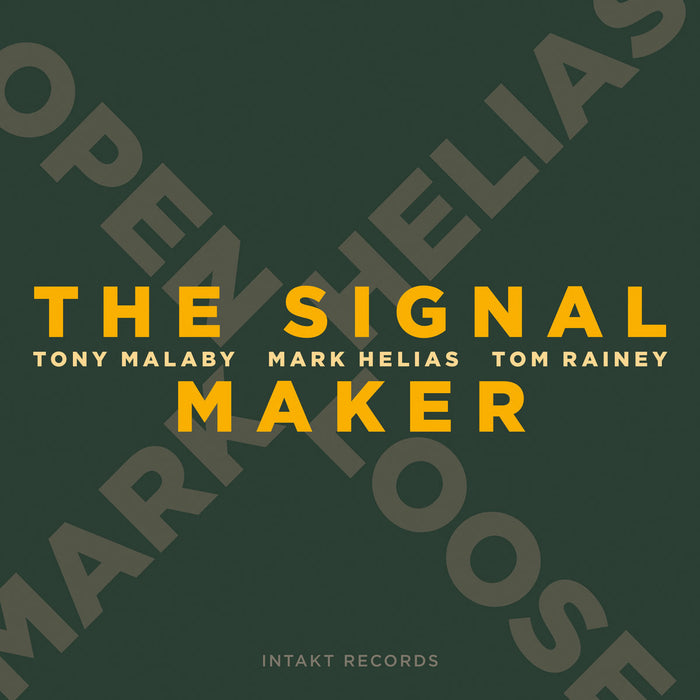
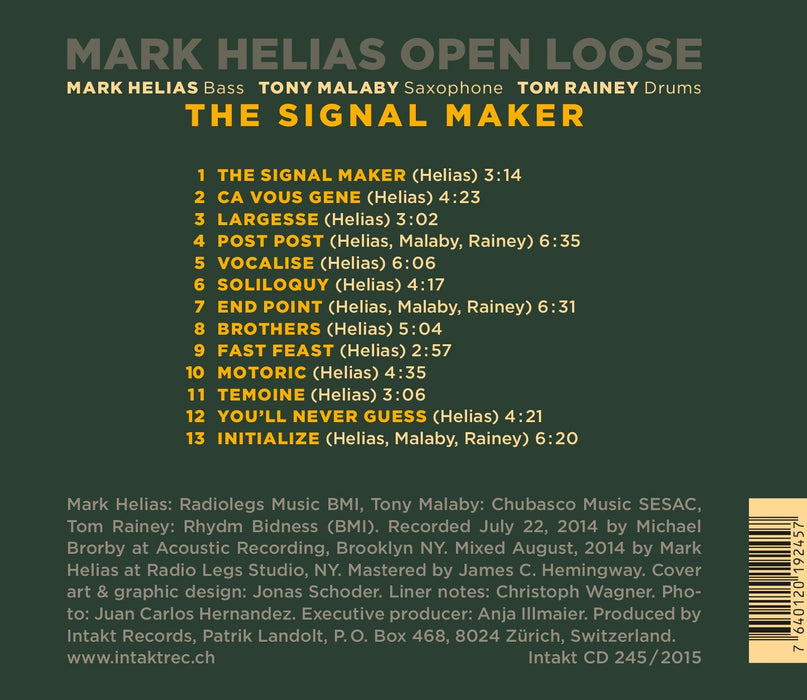
245: MARK HELIAS – OPEN LOOSE. The Signal Maker
Intakt Recording #245 / 2014
Recorded July 22, 2014 by Michael Brorby at Acoustic Recording, Brooklyn New York.
Original price
CHF 12.00
-
Original price
CHF 30.00
Original price
CHF 30.00
CHF 12.00
-
CHF 30.00
Current price
CHF 30.00
More Info
Album Credits
J
Le niveau reste haut avec le trio Open Loose du contrebassiste Mark Helias, avec Tony Malaby (sax) et Tom Rainey (drums), un trio très ouvert qui existe depuis 1996, et demeure constamment en recherche. Une belle musique, bien écrite et impeccablement jouée : « The Signal Maker »
http://www.culturejazz.fr/spip.php?article2855

A
The American bassist, who's worked with Don Cherry, Anthony Braxton, Muhal Richard Abrams and Cecil Taylor, founded the trio Open Loose in 1996 with Tom Rainey and Tony Malaby. The aim was to play his own compositions, which allow open form improvisation, with the pieces recomposed live. "The most interesting developments come when we start altering the compositions in a creative way, maintaining the spirit of the piece but taking it somewhere else," Helias comments. It's clearly been a productive partnership – 'The Signal Maker' is the trio's seventh release.
Tony Malaby is a muscular, big-toned player who ranges from lyricism to vocalisation and overblowing. Helias matches him for muscle and tone on bass; Tom Rainey is an incredibly versatile, responsive drummer who knows how to use dynamics, and his time is superb. The results are challenging – mostly groove-based, for sure, but dark and unobviously melodic. Largesse is a gaunt, spare theme; it's hard to tell when or if it ends, and improvisation begins. Vocalise is a haunting piece at ad lib tempo, that turns into a loose Latin feel – a highlight of the album.
Fast Feast begins in a swing groove, that soon becomes free – this band switches metre and feel on a dime, a feature also of Rainey's performance on Ingrid Laubrock's new disc also on Intakt, 'Roulette of the Cradle'. In addition to Helias's compositions are three group improvisations, Post Post, End Point and Initialize. These sound less structured, more episodic, but equally compelling. It's been remarked that the trio could dispense with the safety net of written parts, but there's an attraction also in hearing crafted arrangements being developed in performance. This is cerebral music in the best sense – thoughtful, engaging, inspiring.

M
American bassist Mark Helias has played with the likes of Ed Blackwell, Don Cherry, Anthony Braxton, Cecil Taylor and Muhal Richard Abrams. Here, though, he occupies the leader spot himself with the trio he founded in the mid-1990s; Rainey's been there since the start, with Malaby arriving only slightly later. Helias is solely responsible for most of the compositions, all of which leave plenty of space for open form improvisation – and the lack of a chordal instrument (except when Helias goes in for bowed, gliding double-stops, as in the middle of 'Ça Vous Gene') means it really is open. He also makes good on his claim, in the liner notes, to demonstrate the potential of the bass as 'an amazing house full of sonic possibilities'. With Tom Rainey and Tony Malaby reliably brilliant too, this is a highly recommended release from a band that is a staple of the New York improvising scene.

S
The Signal Maker is the latest effort by the Open Loose Trio, comprised of Mark Helias (bass), Tony Malaby (saxophone), and Tom Rainey (drums). It is a no nonsense affair, muscular in attitude, and as creatively involving as any jazz trio album I have ever heard. Tony Malaby's playing is his finest on record. Prodded constantly by Helias' pulsating bass and Rainey's dynamic percussion, Malaby is stretched well beyond his usual range, notes pouring forth Mahanthappa like in intensity and lyrical, Kontiz like in quiet but intense improvisation.
The album opens with the title track "The Signal Maker," with Rainey firing off an opening salvo of cymbals, simmering to a bubbling beat as Malaby and Helias launch into an exhilarating free bop throw down. Other outstanding tracks are: "Ca Vous Gene," with its snake like interplay and rhythm between the musicians and "Post Post," for it's balancing act of delicate emotion that threatens to veer into total chaos. "End Point" is aggressive and fierce, each musician trading blows like fighters, highlighted by an amazing funky break 2/3 into the piece, a counter to the frenetic free form that preceded it. Motoric" by comparison, is straight forward, but Rainey's machine gun beats and changes are outstanding, and Malaby responds with some of his most intensely lyrical playing to date.
Throughout The Signal Maker is a passionate, intense work that exploits the best of their abilities. Post bop mixed with improv at its finest. Highly recommended.
https://www.freejazzblog.org/2015/06/open-loose-signal-maker-intakt-2015-12.html

S
Mark Helias è persona cordiale, generosa, empatica. Un carattere aperto, bilanciato tuttavia da un rigore assoluto che caratterizza la sua attività di bandleader e di contrabbassista. Ricordiamo che il suo curriculum è aureo avendo suonato con maestri come Ed Blackwell e Dewey Redman, Anthony Braxton e Ray Anderson, garantendo una versatilità ed una affidabilità assolute.
Da molti anni guida propri gruppi il più longevo dei quali è Open Loose, trio che in passato comprendeva Ellery Eskelin, ora sostituito da Tony Malaby. Un trio che si muove agilmente tra i sentieri del jazz contemporaneo più avanzato, non rinunciando ad una leggibilità immediata, garantita dalle forme brevi e da una ampia varietà strutturale.
Lontano dagli schemi da blowing session, dove il sassofono la fa da padrone sopra i ritmi, il gruppo preferisce scandagliare una musica frastagliata ma lucidissima nei suoi assunti. Fin dall'iniziale "The Signal Maker," si percepisce la volontà di far emergere melodie ritmiche dagli intervalli larghi e dagli eloquenti silenzi interni, imprevedibili nel loro sviluppo intuitivo, quasi mai legato alla ripetizione.
Un melodismo paritario dunque, con spazio importante al dialogo contrappuntistico, al rilancio improvvisato, dove le voci in gioco si fanno piccola orchestra. Si alternano brani dalla scansione ritmica esplicita ed altri invece più aleatori: ciò che si mantiene è la compattezza del trio, la confidenza felice delle intenzioni e delle pronunce sonore.
I brani più complessi sono "Post Post" e "End Point," mentre tracce come "Largesse" e "Fast Feast" vanno subito al dunque. In "Brothers" si sceglie per una volta la sovraincisione dei sassofoni tenore e soprano, con risultati forse non del tutto a fuoco.
Ma la più parte dell'album è serrato, avvincente. Helias funge da baricentro naturale e sfoggia una gran tecnica sia in pizzicato che con l'arco; Rainey si conferma percussionista eccezionale per insaporire qualsiasi tipo di situazione; Malaby è splendido al tenore, un po' meno al soprano, ma riesce ancora a stupire e ad evitare i clichè.
Un trio che merita grande attenzione.
https://www.allaboutjazz.com/the-signal-maker-mark-helias-intakt-records-review-by-stefano-merighi__16508

T
Bassist Mark Helias founded his cooperative trio Open Loose in 1996 with tenor saxophonist Ellery Eskelin and drummer Tom Rainey, although Tony Malaby replaced Eskelin as primary saxophonist just after the first album, Come Back Ahead (Koch, 1998). The Signal Maker is the band’s seventh record and one of the most varied in its discography; none of the thirteen tracks – ten are Helias’ – last more than seven minutes, with most clocking in around four. This relative brevity enables Helias to explore numerous genres and styles over the course of the set, while Malaby’s occasional doubling on soprano adds extra tone color to the ensemble’s palette.
Avoiding simple head melodies, Helias favors themes where bass and saxophone play in contrary motion or interlocking harmony, as on “Fast Feast,” with its surprising transition from fleet bop to bluesy half-time, or the odd-metered muscular funk of “End Point.” Whether pre-written or spontaneously composed, the trio’s intuitive rapport on each piece is palpable. The three collective improvisations are also the longest cuts, which capture the threesome’s triadic interplay in nuanced detail. Helias’ grounded, conversant bass lines, Rainey’s surprisingly inventive interpolations, and the distinctive timbre of Malaby’s idiosyncratic phrasing all conspire towards a cooperative goal, using dynamic silences and volumetric outbursts to convey a range of expressive extemporizations on skeletal themes.
“Ca Vous Gene” stands as one of the group’s most elaborate works, transitioning seamlessly from taut counterpoint to freewheeling rubato, concluding with a terse coda underscored by Helias’ frenetic bowed bass. The up-tempo swing of “Motoric” similarly serves as one of the unit’s most extreme undertakings, a blistering post-bop line brashly deconstructed by Malaby’s gruff tenor variations. Conversely, his romantic ruminations on “Largesse” are some of the most elegant he has committed to tape – and a testament to Open Loose’s unrestrained eclecticism.

H
Das US-Trio „Open Loose" wurde 1996 vom Bassisten Mark Helias gegründet. Zu den Band-Mitgliedern gehörten weiter der Schlagzeuger Tom Rainey und zunächst auch der Tenor- saxophonist Ellery Eskelin; heute ist es Tony Malaby auf dem gleichen Instrument und gelegentlich auch auf dem Sopransaxophon. Im Booklet macht Helias in einem „primer", einer Art Stichwort-Verzeichnis, aufschlussreiche Ausführungen in neunzehn Punkten über sich und seine Musik. Er schreibt zunächst, dass er anfangs Klarinetten-Studien betrieben hätte und relativ spät zum Kontrabass gekommen sei. Er weist auch auf die instrumental gleich bzw. ähnlich besetzten Trios von Ornette Coleman und Sonny Rollins hin, ebenso auf die Trios von Barry Altschul, Ray Anderson und Dewey Redman, in denen er selbst mitgespielt hat, ohne seine Musik nach einer dieser Band ausrichten zu wollen. Helias führt weiter aus, er wolle auch keinen Druck auf seine Mitmusiker ausüben, auch nicht von seinen Kompositionen her, sondern ihnen ihre freie Entfaltung ermöglichen (auch der Band-Name weist bereits auf diesen Gedanken hin). Er selbst möchte die akustischen Möglichkeiten des Kontrabass-Spiels erforschen, auch auf dem Weg über sein Interesse u. a. an der Musik des Barock und Westafrikas gleichermaßen. Diese Art der Hinwendung zu ihren Instrumenten haben auch Helias' Trio-Kollegen Tony Malaby und Tom Rainey, wie man auf der CD hören kann. Von den dreizehn Kompositionen gehen allein zehn auf Mark Helias zurück, die restlichen sind in Gemeinschaftsarbeit des Trios entstanden. Die beiden ersten Stücke der CD sind abstrakt gehalten und haben aufgelöste Strukturen mit teils sperrigem Charakter. Man fühlt sich in einer Art Experimentalstudio mit Workshop- Atmosphäre und wird Zeuge spontaner Kreationen, die durch die wache Aufmerksamkeit aller Trio-Mitglieder entstehen. Zuweilen sind ganz freie, ungestüme Passagen mit einer Art Signal- oder Morsezeichen (CD-Titel!) wie zu besten Free-Jazz-Zeiten zu hören, als noch musikalische Zäune eingerissen und niedergetreten wurden: track 10 ist so ein Beispiel - er lautet nicht umsonst „Motoric"! Aber auch ganz ruhig und meditativ verlaufende Stücke vernimmt man, etwa track 3 „Largesse" oder track 5 „Vocalise". Es ist da ein etwas anderes Denken zu spüren, das hier zum Ausdruck kommt - da haben sich wirklich drei Gleichgesinnte gefunden - track 8 lautet dazu passend „Brothers", auch der Hinweis auf ihre intensive Interaktion (neben rein solistischen Phasen) darf in diesem Zusammenhang kommen. Dass das Trio eine zukunftsorientierte Einstellung hat (und in ihm etwas lebt!), darf man, bei aller gebotenen Vorsicht, auch aus folgendem ableiten: einige relativ kurze Stücke von nur wenigen Minuten Dauer (etwa tracks 1,3, 9 und 11) haben einen skizzenhaften Charakter und könnten sich gege- benenfalls später, in Verbindung mit formellem Gestaltungswillen, zu größeren Kompositionen entwickeln. Hierzu nochmals Mark Helias: Form ist das Ergebnis einer interaktiven Kommunikation, wie sie in der Improvisation entsteht. Das mag man als Bestätigung dafür sehen, dass neben der den Jazz bereits stark prägenden Improvisation (mit wunderbaren Ergebnissen!) auch die Form immer mehr ins Spiel kommen wird. Das letzte Stück, vom Trio gemeinsam geschrieben, weist vom Titelnamen her („Initialize") auf diesen von den Musikern gesehenen Neubeginn hin - die Suche geht also weiter.

P
Nearing its second decade, this limber trio led by the muscular yet agile bassist Mark Helias serves up another powerful missive guided by trust and intuition. Of course, those are both qualities that mark the best sort of improvisational music, but for Open Loose they are bedrock traits that turn the malleable themes penned by its leader into peerless models of spontaneous invention. From the beginning, Helias has worked with the wildly inventive drummer Tom Rainey (with the ruddy-toned saxophonist Tony Malaby replacing Ellery Eskelin a few years into the trio's long run), and together they've forged a remarkable rapport that affords them to endlessly reinvent the repertoire each time they take the bandstand. For The Signal Maker, Malaby augments his striated tenor with soprano on five of the album's 13 tracks, broadening the group's timbral range, but ultimately it's the lines-sharp, usually contrapuntal, often diverging-that make this group so strong.
"Ça Vous Gene" is one of the tunes featuring soprano, as Malaby hurtles through the Helias theme like it was a steeplechase, with the rhythm section laying out a nimble, loping groove perpetually ornamented by Rainey's terse fills before the trio melds together for a furious unison outro. "Largesse" is one of several lovely ballads; Malaby's plush tenor intimates the melody over gentle cymbal skittering and a sparse elucidating of the bass part, with plenty of silence, both open and loose, and composure. The statement is more direct on the sultry "Vocalise," with a lengthy extrapolation of the long and winding theme giving way to a nimble, shape-shifting solo by Helias, thriving in his instrument's upper range but hitting its stride in the bottom. The entire album is marked by such seamless transitions, with a sort of communication that propels any given tune in infinite directions or moods. The Signal Maker embraces the same basic premise that's guided every Open Loose record, but I don't know if that premise has ever worked better.

A
Braccio profondo delle formazioni di Ed Blackwell e Don Cherry, Muhal Richard Abrams e Anthony Braxton, l'iperattivo contrabbassista Mark Elias segna un ulteriore passo di un percorso palesemente votato alle espressioni e alle formule oltre confine, peraltro confermate con coerenza nelle ormai variegate esperienze collaborative ed individuali.
Quanto alle più quotate e convincenti partnersips, a seguire le prove discografiche New School (Enja, 2001), Verbs of Will e Atomic Clock (Radio Legs, 2003 e 2006), The Signal Maker è per il trio Open Loose "reunion" di verifica ed aggiornamento – se mai dell'uno e dell'altra avesse bisogno un tridente di personalità decisamente con scarsa vocazione a vegetare sugli allori, non fosse che per le fitte sortite concertiste regolarmente dispensate nelle rispettive agende.
La maturità del sentire blues e la plasticità infuocata del soffio di un ispirato Tony Malaby, l'invenzione continua, il drumming sferzante e sempre vigile di Tom Rainey dinamicamente (e assai liberamente) convergenti entro le cornici aperte, tratteggiate dalle dieci dita e dall'arco del titolare, di spiccato interventismo solistico e di incisivo controcanto.
Una tensione eloquente e una corrente di musicalità di circolare naturalezza e spiccata quota energetica pervade un album di carattere ed appagante, che spicca per la notevole tenuta e per i marchi caratteriali dei maiuscoli e tonici co-protagonisti, forgianti un avant-jazz di lirismo crudo e peculiare eleganza, che mai depone il senso di una spiccata forza inventiva e un marcato, naturale istinto per stilizzazione forte e coralità stentorea.
https://www.jazzconvention.net/2015/06/09/heliasmalabyrainey-the-signal-maker/

M
Musicians who thrive in the realm of free improvisation need to be flexible, stopping and rerouting their path as a performance calls for it. While the possibility exists to extend and expand during solos, the most attentive players can make a point succinctly as well. The name Open Loose doesn’t describe Mark Helias’ music as much as epitomize the mindset his trio brings to it. In his notes for The Signal Maker, the bassist says, “The most interesting developments come when we get really comfortable with the music and we start altering it in a creative way.” This level of ease-which only comes when a band has the chance to grow, as this group has-dovetails with Helias’ compositions on this album.
Open Loose includes drummer Tom Rainey and tenor/soprano saxophonist Tony Malaby. The only tracks in this baker’s dozen that go beyond the six-minute mark are the three group compositions. The remainder, all penned by Helias, are surprisingly accessible. “Largesse” feels like a ballad, with a languid tenor line that is answered with spare commentary from bass and drums. Right when it feels like it could open up into an extended solo it ends, yet it still feels complete.
Emotions vary throughout the set. In “Motoric” Rainey plays on top of the trio, sounding aggressive but not bombastic and inspiring some braying tenor vibrato. Malaby plays “Vocalise” with a more romantic use of vibrato, but after a short, buoyant bass solo, Helias shifts the amorous mood toward something more upbeat. True to form, nothing goes smoothly, in the best possible way.
https://jazztimes.com/reviews/albums/mark-helias-open-loose-the-signal-maker/

S
Wer mit Musikern wie Ed Blackwell, Chet Baker, Dewey Redman, Don Cherry und Cecil Taylor gearbeitet hat, gehört zur Top-Liga und ist dem Jazz- Aficionado schon mehrmals begegnet. Erstmals vielleicht mit Anthony Braxton, Barry Altschul und George Lewis Ende der Siebzigerjahre. Es sei merkwürdig gewesen, beschreibt Mark Helias seinen ersten Auftritt in diesem Quartett, der ohne Probe erfolgte: "Braxton galt damals als abstrakt und intellektuell, und ich stand auf der Bühne und lernte seine Musik während des Auftritts, einfach, indem ich zuhörte und um das nackte Leben spielte." Mit solch tief greifenden Erfahrungen in Kopf und Bauch gründete Helias 1996 sein Trio mit Tom Rainey und Ellery Eskelin. Tony Malaby löste dann den Saxo- phonisten ab, und seit Jahren spielt das Trio nun zusammen aber nicht allzu häufig, wie Helias betont. Seine Kompositionen dienen als Sprungbrett für offene Improvisationen, wobei Wiederholungen bewusst vermieden werden. "Die interessantesten Entwicklungen stellen sich ein, wenn wir die Musik in- und auswendig kennen und sie dann auf kreative Weise verändern, ohne dass der Geist des jeweili- gen Stücks verloren geht."

P
Nouveauté. "Open Loose", c'est l'épine dorsale de l'ensemble des formations de Mark Helias, contrebassiste très actif depuis la fin des années 80, compagnon de route d'Ed Blackwell ou Anthony Braxton pour ne citer que les plus connus, et membre de formations régulières comme "BassDrumBone" et quelques autres. Ce trio (son trio) existe depuis au moins - 1998 et comprenait au départ le saxophoniste ténor Ellery Eskelin, remplacé dès 2001 par Tony Malaby. Comme le fait remarquer le contrebassiste, l'idée "d'ouverture" implique, par la liberté qu'elle instaure, celle d'un "être perdu", un peu à la manière de la philosophie existentialiste. En règle générale, chaque enregistrement de cette formation contient deux tiers de compositions du leader et un tiers de titres signés par les trois instrumentistes, puisque résultant d'improvisations menées collectivement. Et si Ellery Eskelin, par sa manière feutrée et sinueuse, apportait une dimension d'imprévisibilité attachante à la musique proposée, Tony Malaby lui donne une droiture qui la rend d'une belle lisibilité.

J
Bassist Mark Helias runs a tight ship. Not in the sense of tricksy arrangements or impossible time signatures. It's more the laser sharp focus his accomplished Open Loose combo brings to the job in hand. And that job is breathing bustling and unpredictable life into the baker's dozen selections that constitute The Signal Maker, the unit's 7th release since 1998. Drummer Tom Rainey has been there since the inception, while saxophonist Tony Malaby is the new boy, having joined a year later. What's impressive is that they still find worthwhile things to say together, helped in no little regard by the ten varied frameworks which the bassist provides, designed to encourage open improvisation.
Malaby deploys a pliable muscularity that sees his lines edging into overblowing then pulling back and veering into other areas, be that lightly lyrical licks or muffled vocalization. He has a chameleon-like ability to sound like different players between or even within cuts, though there are actually two of him on the lilting "Brothers" where overdubs enable his soprano and tenor saxophones to intermingle on the head. Rainey forges his customary amalgam of rhythmic ingenuity and timbral smarts, and completes a highly simpatico pairing with the leader's deep growling bass.
Interspersed among Helias' charts, three group inventions, clocking in at over six minutes each, form not only the longest tracks on this studio session but also the most compelling. That's because after 16 years as a working band they possess the trust and shared knowledge to go beyond the norms of extemporization truly into the realms of spontaneous composition. Both Malaby and Rainey are masters of deconstruction: they sketch out collective ideas with the merest gestures which don't need to be filled out to succeed. They allow silence to ring, and undertake sudden switches of gear, as with the spirited outburst that emerges towards the close of "End Point ."
It proves that if they are looking for future options they could do a lot worse than dispense with the safety net of written parts entirely.

A
Sowohl der Übertitel ihres Trios als auch jener der aktuellen Einspielung "The Signal Maker" unter dem Primus Inter Pares, Bassist Mark Helias, kann als künstlerisches Credo gelesen werden. In einer vom Mainstream und zumeist nur kommerziellen Überlegungen bestimmten Kunstszene sind die geistig "offenen" und "freien" Künstlerpersönlichkeiten mit Sicherheit "Signalsetzer" für eine andere Auffassung. Expressive Diskussionen über die von ihnen wie Bildtitel gewählten Themen, Fragmente, Bauelemente und den Ausgang ihres Experimentierens sind schon an dessen Beginn kaum vorhersehbar und im Ergebnis letztlich völlig ungewiss und überraschend. Neben dem Bandleader Mark Helias sprechen noch Saxophonist Tony Malaby und Drummer Tom Rainey im selben Idiom über die zumeist von Helias kommenden "Stücke", die Basisstationen ihrer konzentrierten Reisen. Sinnstiftende Bezeichnungen wie "Post Post", "End Point, "Motoric", "You'll Never Guess" oder "Initialize" führen wie einzelne rote Fäden in das kreative Labyrinth des Trios, was ebenso intensive Hörarbeit bei den Fans dieser konzeptuellen Welt einfordert und durch hohen inspirierenden Mehrwert dankt. Einfacher gesagt, Musik erschließt sich wie hier nicht durch die schönste Beschreibung, sondern erst mit den eigenen Ohren.
