
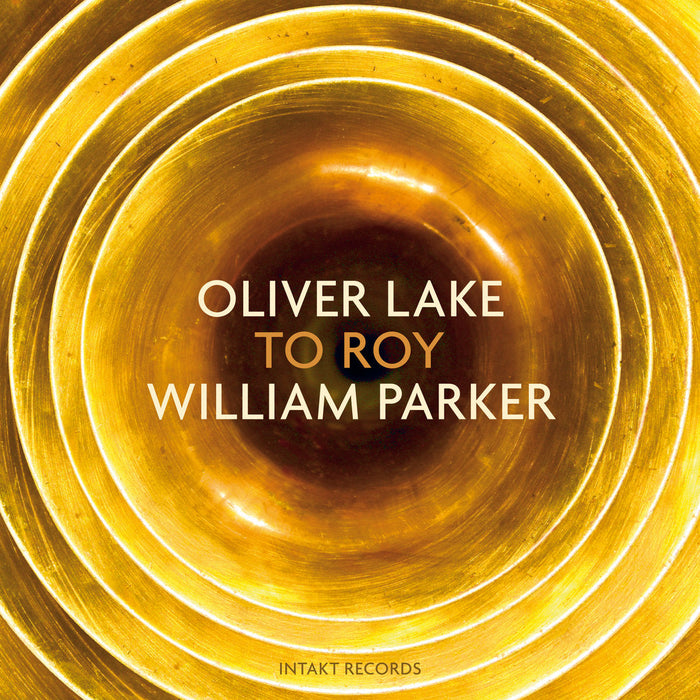
243: OLIVER LAKE – WILLIAM PARKER. To Roy
Intakt Recording #243 / 2014
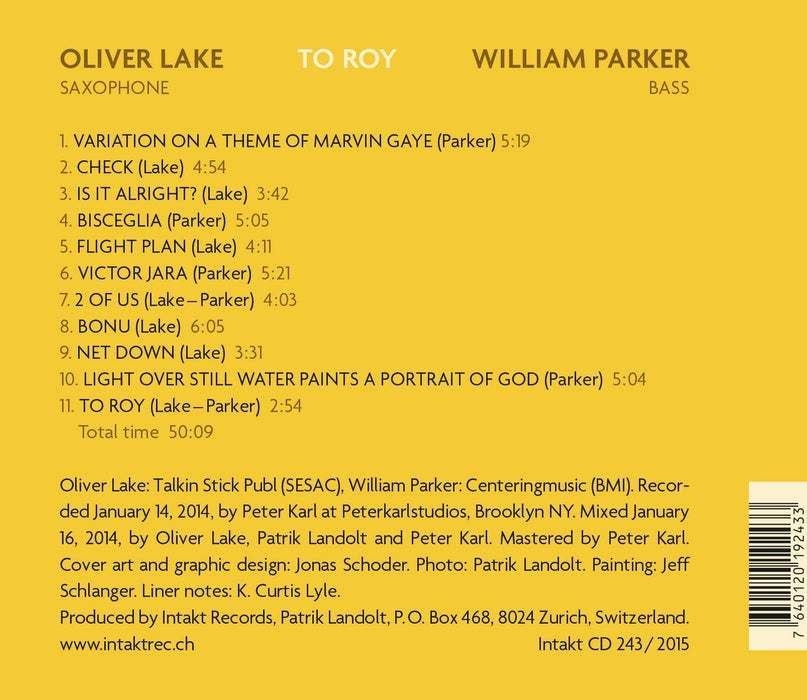
Recorded January 14, 2014 by Peter Karl at Peterkarlstudios, Brooklyn New York.
Original price
CHF 12.00
-
Original price
CHF 30.00
Original price
CHF 30.00
CHF 12.00
-
CHF 30.00
Current price
CHF 30.00
More Info
Album Credits
D
Dans la foulée de leur album en duo, « To Roy » en hommage à leur ami le trompettiste Roy Campbell disparu en 2014, Oliver Lake et William Parker posaient leurs valises sur les bords de la Garonne – dont le théâtre qui les accueille surplombe les berges – à l’occasion du « Printemps de Septembre », festival biennal dédié à la création contemporaine.
Théâtre Garonne, Toulouse, 30 septembre 2016
Oliver Lake (ss, voc), William Parker (b)
Une première pièce ardue à la durée conséquente laissa quelques spectateurs sur le carreau, qui quittèrent les lieux sans attendre la pause. Les autres, nettement plus nombreux, prirent un vif plaisir aux volutes cubistes de Lake comme aux généreux grondements de Parker, d’autant que la suite fut plus clémente. Lake (quelle discographie, quelle carrière…), que l’on n’a pas si souvent l’occasion d’entendre, impressionne au soprano courbe, dont il maîtrise toutes les nuances. Il utilise l’acoustique de la salle, arpente la scène ou pivote d’un mur à l’autre, et ne pose le saxophone que le temps de déclamer un texte de sa plume, impliquant un débit rapide et une énonciation précise. Qu’il s’agisse de pièces écrites ou d’improvisations rythmées, le son mat et la variété d’approches de Parker garantissent un plaisir d’écoute permanent. Le bassiste semble moins en quête de précision que du maintien d’un courant poétique, et ne subordonne pas les idées affleurant à sa conscience en temps réel à la dimension cérébrale ou préméditée qui existe aussi dans son travail.
Théâtre Garonne, Toulouse, 1er octobre 2016
« Les visiteurs du soir » : William Parker (b, flute en bambou, voc) solo
Le lendemain, c’est au bar du théâtre que Parker joue en solo des pièces abstraites et d’autres très formées, dont une partition du saxophoniste Marion Brown. Chacune repose sur une idée forte, et toutes ont pratiquement le format de miniatures. Entre elles s’intercalent des anecdotes drolatiques, narrations d’interactions avec des musiciens de générations antérieures. Le concert se termine par quelques minutes de flûte en bambou (shakuhachi), « pour apaiser les gens nerveux ». Parker entonne aussi quelques vers mi-parlés mi-chantés, dans un langage simple, exprimant son souhait de paix aux Etats-Unis et sur la planète (« change guns into trumpets, rifles into trombones… »). Il envisage la pratique d’instruments de musique comme un élément apte à promouvoir une meilleure communication entre les êtres. Ce n’est pas le seul ni le premier: Sun Ra ou Wadada Leo Smith ont tenu des propos semblables. Une fois la salle vidée de son public, Parker range ses affaires sous le regard fasciné du fils d’un technicien, incapable de décoller les mirettes de cet homme au langage incompréhensible, à l’aspect inhabituel, aux instruments couverts de mystérieux symboles. Avec l’aide d’un organisateur s’improvisant traducteur, Parker demande à l’enfant s’il joue de la musique, et celui-ci répond par la négative. « Est-ce que tu aimerais jouer d’un instrument ? » Le petit opine avec enthousiasme. Et Parker de s’enquérir de l’adresse des parents afin de faire parvenir un instrument au bambin : « je ne sais pas encore lequel, on va trouver quelque chose… » assure-t-il. Une jolie conclusion à deux belles soirées.

J
Un volet important de la production Intakt est réservé aux musiciens américains, de générations et de communautés différentes, parmi les plus intéressants au niveau de l'engagement, de la recherche musicale, de l'honnêteté artistique et de l'idée qu'ils se font de leur travail.
Familier du label avec le Trio 3, le saxophoniste Oliver Lake rencontre cette fois le contrebassiste William Parker, soit, d'un mot, le tranchant de l'alto face à la basse profonde, et d'un autre, la création qui s'appuie sur la grande tradition afro-américaine. Ils sollicitent ainsi Marvin Gaye et poursuivent avec une série de duos d'autant plus intenses – l'un porte le nom de notre regretté ami Jacques Bisceglia – qu'ils sont encore sous le choc de la disparition, survenue cinq jours avant la séance, de leur ami le trompettiste Roy Campbell. D'où le titre de leur album : « To Roy »
http://www.culturejazz.fr/spip.php?article2855

L
De ces deux musiciens, rarement réunis et se rattrapant aujourd'**** pour évoquer la mémoire de Roy Campbell, on imagine assez bien la rencontre. Et notre imagination, de faire mouche.
Le soyeux ne sera pas de mise. Les arrêtes seront vives, tranchantes, limite raides. L'alto sera acéré et les saillies ne surprendront que les non-initiés. La contrebasse annoncera l'harmonie et n'en dira pas plus. Du moins jusqu'à cette balade (Bisceglia) où tous deux partent en connivence. L'archet sortira de son étui, et les cordes grogneront quelque Afrique proche (Victor Jara), le blues se retrouvera, les phrasés se feront de plus en plus cabossés, la convulsion sera reine. Et Oliver Lake et William Parker, de rêver à leurs futures aventures. Et nous avec.

C
Ein Bassist predigt den Gospel
Als der deutsche Künstler A. R. Penck den Bassisten William Parker und Peter Kowald vor 30 Jahren eine Plastiktüte mit 50 000 D-Mark mit auf den Weg von Berlin nach New York gab, hatte er nur eine Be- dingung: dass sie damit etwas Aufrichtiges, Wahrhaftiges veranstalten. Das daraus entstandene „Vision Festival", das Parker mit seiner Frau Patricia leitet, fand gerade zum 20. Mal in New York statt. Bei diesem Sommerfestival steht die afroamerikanische Avantgarde-Musik im Zentrum. William Parker geht es auch in seiner eigenen Musik um die Botschaft, er hängt den Anspruch des sozial und politisch engagierten Künstlers heute noch weit höher als alles Gerede um Tradition und Kulturbewahrung. Er ist der Netzwerker der afroamerikanischen Improvisationsmusik; wenn seine Kollegen sagen „Parker predigt den Gospel", meinen sie dessen unerschütterlichen Glauben an den Kampf des Künstlers für die Freiheit, radikal zu sein, und dies mit den Bedürfnissen der Menschen, die er erreichen möchte, musikalisch in Einklang bringen zu können. Seine neue Duo-CD mit dem Saxofonisten Oliver Lake, „To Roy", ist dem 2014 verstorbenen Trompeter Roy Campbell gewidmet. Herausragende Stücke wie die Improvisationen über ein Thema von Marvin Gaye und die Hommage an Victor Jara thematisieren kreatives Handeln und Lebenshaltung, aber auch materielle Not, Durststrecken, mangelnden Respekt und Tod. Bei „A L'ARME!" spielt William Parker am 8. August im Radialsystem V.

S
In January 2014 the innovative jazz trumpeter Roy Campbell died from cardiovascular disease. "To Roy," is a spirited and powerful tribute to him, by two of his peers: Oliver Lake and William Parker. While both have an extensive discography, this is the first pairing of the two on record.
And while the duets of alto saxophone and bass is nothing new, this short, intense free form effort is magnificent in its originality and creativity. For one thing, Oliver Lake is at the top of his game here. Occupying mostly at a high register, he draws from way back to the sound of Albert Ayler and Frank Wright, aggressive and acerbic, yet never too abrasive, with clean notes. At times his sound is like an electronic instrument, percussive notes that dart in and out, trading off against Parker's equally percussive bass. Parker is in fine form as well, whether stringing or plucking, his sound does not take a back seat to the strong alto sound. In fact, he matches Lake's high register, complementing his sound, though at other times he counterpoints by pushing the bass' naturally lower register.
The album feels unusually short, yet it is 50 minutes long. That's how engaging their interplay is. Standout tracks are: the opening track "Variation on a Theme by Marvin Gaye," a jubilant and exciting free form play on "Inner City Blues," Parker echoing the funky bass line while Lake riffs all over it. Flight Plan" is a muscular track, the two artists slugging out a variety of textures and sounds with almost supernatural speed. "2 of Us," and the final track "To Roy," both feature intricately woven interactions by the pair, intertwining their sounds to almost create a third, combined voice.
There is joy, sorrow, intelligence, rip roaring instinctive play, that all together create a spellbinding effort that is spiritually moving and creatively stimulating. Easily one of the best albums I've heard this year, as well as containing some of the finest efforts that either artist has produced in a while. Especially Oliver Lake; his playing is jaw dropping.
https://www.freejazzblog.org/2015/06/oliver-lake-william-parker-to-roy.html

C
Zwei prägende Persönlichkeiten der afro-amerikanischen Community, die den letzten und radikalsten Schritt zur klanglichen wie strukturellen Öffnung des Jazz in zweiter Generation weiterentwickelt und ausdifferenziert haben, bringen erstmals ihre musikalischen Energien und Visionen in Einklang. Der Zeitpunkt war ohrenfällig richtig gewählt, hatte aber auch eine traurige Komponente: den überraschenden Tod des wunderbaren Trompeters Roy Campbell, dem Lake und Parker hier einen würdigen Nachruf erweisen. In eindringlichen Diskursen, in denen die beiden Meister das ganze Spektrum jazzmusikalischen Musizierens der letzten fünf Dekaden reflektieren und in ihrer Eigenart ausloten. Da entfaltet sich eine ergreifende Walking-Bass-Line, in die sich heißspornige Saxofonkaskaden verbeißen, oder man vertieft sich in abstraktes Sinnieren. Die kurzweiligen, am Innersten rührenden Dialoge schreiten im Midtempo voran, strotzen vor melodischer Gestaltungskraft, kompakter Stringenz, vor Dynamikschattierungen, die geschmeidiges Flanieren mit kontrapunktischer Finesse ebenso einschließen wie explosive, clusternde Attacken von beeindruckender, altersloser Vitalität und Beweglichkeit. Es sind die Umsichtigkeit, das enorme Wissen, der souveräne Umgang mit der Klanggestaltung, die musikalische Fokussierung, das Atmenlassen der Ereignishaftigkeit, was diese beiden Musikerlegenden auszeichnet und ihrem Dialogisieren eine faszinierende Sogwirkung angedeihen lässt.

A
"Roy" is trumpeter Roy Campbell, who died in 2014. After a concert at The Stone in New York, part of Intakt's festival in January 2014, Lake and Parker were invited to record their first album together – which they did just five days after Campbell's death. The resulting disc is divided almost equally between compositions by each, with 2 of Us and the title piece jointly-credited.
Lake’s compositions, of which Check is a notable example, tend to look back to the duo’s loft jazz days – free jazz with Parker strumming furiously and Lake offering the full range of extended techniques. Parker's compositions are more involving, with a clearer pulse – standouts are the opening Variation on a Theme of Marvin Gaye, based on Inner City Blues, and the plangently Ornette-ish dirges Bisceglia – named after the French photographer – and Victor Jara. Parker’s formidable arco technique appears to full effect on Lake’s Flight Plan and Net Down, supporting the honks and cries of the saxophonist.
Lake's playing is intensely bluesy, notably on Variation on a Theme of Marvin Gaye, and he uses flutter-tonguing on occasion. On his own Bonu he plays tinkling bells as Parker strums, in what's aptly been called a blues-tinged processional. Light Over Still Water Paints a Portrait of God is one of Parker’s ornate, evocative titles, with prominent sul ponticello, as it's known in the trade – the bass played close to the bridge to create an eerie, whispering sound. The result is a fine example of latterday free and more traditional playing.

K
Between them Lake and Parker have played in all manner of configurations over the years, but this horn-bass duo is impressive for the way the players negotiate the stark nakedness of the setting. On much of the set composition is as important as improvisation, the restraint, and the wisdom not to be excessively busy so as to offset the absence of a drummer or pianist, really allows the performance to breathe. The spirited opener, 'Variation On A Theme Of Marvin Gaye' really sets the tone in any case, as the sidewinder bassline shifts the harmony of James Jamerson's immortal lick on 'Inner City Blues' but retains all its gravitas. The soulfulness of that arrangement pervades the rest of the material and melodic riches really come to the fore on 'Bonu' and 'Bisceglia', where the kind of acidly sweet lament that has been one of Lake's great marks of distinction, is effectively offset by the oceanic depth of Parker's tone and the precision of his time. Then again the latter's dramatic Moroccan guimbre style chording on the intensely moving 'Victor Jara' is also a highlight. The stripped down, somewhat spartan nature of the music may be unsettling for some but the strength of character of the players more than carries the day.

A
Encontro inédito entre dois mestres da música criativa em homenagem a um terceiro, Roy Campell Jr. (1952-2014). Um diálogo irretocável, com momentos de muito lirismo e improvisações geniais. A música soa de forma fácil, com Lake ao sax alto e Parker alternando arco e dedilhado em seu baixo. “Flight Plan” e “Net Down” trazem as passagens mais ariscas do diálogo sax/baixo. Já “Light Over Still Water Paints a Portrait of God” talvez represente a síntese do conjunto, em que podemos ouvir os músicos mostrando várias faces de sua estética, com Lake alternando-se entre solos livremente construídos e pequenos temas emotivos, e Parker criando atmosferas hipnotizantes, especialmente quando empunha o arco.

J
Bassist William Parker has formed productive liaisons with some wonderfully expressive alto saxophone players in the past—Rob Brown and Jemeel Moondoc both spring to mind. But To Roy represents his first time on record with Oliver Lake, best known as a third of Trio 3 and a quarter of the World Saxophone Quartet. They recorded their duo album during the month of dedicatee trumpeter Roy Campbell's unexpected passing at age 61 in January 2014. Each brings a sheaf of compositions to the session. They form the basis for an intimate exchange which celebrates as much as it mourns.
The pair exploit the attractive blend of alto saxophone and arco bass to its full potential. Lake's bittersweet alto inhabits the post-Ayler domain, mixing a snarling vocalized edge, throaty squeals, and tonal manipulation into a vivid discourse. Parker's resonant bass provides the often skeletal underpinning, although he embellishes the basics with reflective asides and percussive flurries. But it's how closely their individual lines interrelate that creates both the interest and tension. Tight alignment holds sway on the bassist's opening "Variation on a Theme of Marvin Gaye." Parker sets out a foot tapping groove which insists on movement. Lake obliges with a sweet and raggedy paean.
But resolution doesn't necessarily arrive in the written material elsewhere. Sometimes the pieces are obliquely sketched and remain ultimately mysterious. After an explosive initial burst, the saxophonist's episodic "Check" proceeds via a lean abstract theme which presages a pattering bass solo replete with harp like plucks, then open dialogue and a unison dirge. Parker proposes another elegy on "Bisceglia" in which tender but melancholic alto floats above sparse bass as a sensitive memorial to the titular French photographer.
At other times unfettered interaction rubs alongside the tune notably on Lake's energetic "Net Down" in which abrasive sawing gives rise to a squalling alto surge, before a honeyed unison tag at the end. And similarly on Parker's "Light Over Still Water Paints a Portrait of God" where the spiraling bowed harmonics and darting altissimo saxophone crossfire bears little relationship to the graceful concluding ditty. Perhaps surprisingly the closing jointly extemporized title track eschews lament in favor of a vital off kilter staccato interplay, which says more about their future than the past.
https://www.allaboutjazz.com/to-roy-oliver-lake-intakt-records-review-by-john-sharpe

J
Diese Widmung für den 2014 verstorbenen Trompeter Roy Campbell ist effektiv das erste Projekt Oliver Lakes (*1942) mit dem zehn Jahre jüngeren William Parker. Der flexible Parker ging noch bei markigen Time-Keepern wie Wilbur Ware in die Lehre, wurde aber auch Cecil Taylors Bassist. Auch Lakes Musik begreift Jazz als eine grosse Evolution und Modifikation. Ein Merkmal dieser elf Tracks ist die ständige Interaktion zwischen Individuen, Plan und Spontaneität, Zeitstilen, Gangarten, formalen und tonalen Auffassungen usw. Die (bluesige) Geschichte ist immer präsent, doch entscheidend ist das Wie, das die Konventionen relativiert. Es läuft ein ständiger Diskurs zwischen Spielern, Gestalten und Stilen. "Check”, fordert Lake mit einem Stück auf: Dolphy-verwandt schiesst das Altosax mit einem verschmierten Glissando los. Abbruch nach ein paar Sekunden. Eine gemessene Melodie leitet ein Basssolo ein, gezupft im Wechsel tief und hinter dem Steg. Dann unisono ein neues Motiv, das in freie Sounds ausfasert und zu einem gesprächsartigen Dialog wird. Und wieder ein neues Motiv übergehend in eine Sax-Improvisation mit weiten Tonsprüngen und wechselnd zwischen Reden und Singen in Lakes typisch aufgekratztem Sound. Nach einem erneuten Stopp ein weiteres moderates Unisono. Ein Zögern und der Bass beginnt eine neue Linie, über die Lake wie eine Amsel losschmettert, dann aber das Tempo übernimmt und zunehmend Ayler-artig geräuschhaft wird. Auch Parker benutzt weite Intervalle und improvisiert lebhaft, begleitet von einem repetierten Motiv Lakes. Zwei Töne markieren den plötzlichen Schluss.
Die Gospelmusik hat die Hammondorgel schlussendlich auch im Jazz domestiziert. Das "Organ Quartet" repräsentiert immer noch überwiegend eine traditionellere Seite von Lakes aktuellem Schaffen. Die Qualität der ausgezeichneten Themen lang und mit viel Spacing - erinnert an Andrew Hill und Dolphy (Iron Man). Die reibende Stimmführung gibt den tonalen Themen eine gewisse Schärfe, und die Soli schrauben sich oft in expressive Free-Jazz- Soundpassagen. Aufgepasst auf den Trompeter Freddie Hendrix! Mit chromatischen Einfärbungen verlängert Jared Gold den Pfad Larry Youngs. Im Kontrast dazu die diskrete Nachtklub-taugliche Begleitung von Chris Beck.

S
Non mi risulta che Oliver Lake e William Parker abbiano mai collaborato prima di questo ottimo To Roy, almeno in studio. Dal vivo avevano comunemente affiancato la compositrice e suonatrice di zither coreana Jin Hi Kim. E probabilmente si saranno incontrati più volte nei club newyorkesi in tutti questi anni. Ma poco importa. Il loro magistero si illumina naturalmente a vicenda, lasciando scorrere più l'intuito dell'immediatezza che la riflessione soppesata.
Sembra spesso che i due si siano dati il tema della perdita come atmosfera su cui improvvisare, e che di conseguenza il tono generale sia quello della malinconia, rinvigorito da sussulti di vitalità rabbiosa, ma presto ricondotto su registri controllati, di saggia maturità. Lake e Parker ripensano a Roy Campbell, a quella ritrosia garbata che rafforzava ancor più la sua bravura, la sua apertura stilistica, la sua competenza. E in questo ricordo si intreccia l'omaggio per il fotografo Jacques Bisceglia, scomparso due anni fa, oltre che la dedica di Parker a Victor Jara, l'artista cileno assassinato dai golpisti di Pinochet nel 1973.
Oliver Lake conferma qui il suo eloquio anomalo al sax contralto, che incorpora un sicuro senso del blues ma che al contempo lo situa in un ambiente aleatorio, memore di quel linguaggio inaudito elaborato decenni fa all'interno del Black Artists Group. Un fraseggiare ellittico che sinesteticamente traduce una nota in graffio quasi fisico e che fa scivolare il soffio nello strumento come un dripping pittorico. William Parker è contrabbassista solido come una quercia, anch'egli radicato nella lezione dei maestri neri, attento più al peso specifico del suono che all'esattezza virtuosa. E questo ricade nell'elaborazione dei brani, che tutti inseguono una forma, con temi e variazioni, ma che presto la rifuggono, sospinti dall'amore per la digressione e la scintilla improvvisa. Così "Check" e "Is It Alright?," angolari, eruttive, gestuali, fofrtemente "incompiute."
"Bisceglia" ci conduce invece su solennità quasi da requiem, a sancire come già detto la concentrazione sulla perdita, seguita da una abrasiva "Flight Plan" dove Parker sfodera la sua intensità con l'archetto, prima di ritornare alla ballad intima del ritratto di "Victor Jara." Il brano che titola il CD è posto in conclusione, un veloce e astratto call and response, in memoria di Roy Campbell.
https://www.allaboutjazz.com/to-roy-oliver-lake-william-parker-intakt-records-review-by-stefano-merighi__7315

P
NOUVEAUTÉ. En janvier 2012, lors du Festival Intakt, au Stone, à New York, Oliver Lake, cofondateur du World Saxophone Quartet, et William Parker, l'homme contrebasse, avaient pour la première fois duettisé librement et s'étaient promis de poursuivre ces explorations. C'est ainsi qu'ils sont entrés en studio, deux ans plus tard, cinq jours après la mort du trompettiste Roy Campbell. L'âme bienveillante de ce solide compagnon de route de William Parker plane tout au long de cette session d'une grande intensité émotionnelle. Nos deux maîtres-artisans, sculpteurs de notes free-sonnantes, ont apporté dans leur besace des compositions stimulantes. Le sage Parker dédie sa musique profonde à Marvin Gaye, au chanteur militant communiste chilien Victor Jara et à Dieu. La sombre ballade Bisceglia rend un ardent hommage au photographe français avec lequel il avait noué une solide amitié. Bonu, écrit par Oliver Lake, permet d'évoquer avec vivacité l'audacieux Eric Dolphy. Les généreux échanges entre ces deux bons génies de la Great Black Music sont énergiques et poignants. La robuste contrebasse de Parker offre un soutien sécurisant et favorise le jeu virulent de l'alto dont la sonorité incisive pourrait tailler des silex. Cette séance inventive se termine par To Roy, feu d'artifice librement improvisé, adressé à l'ami trompettiste.

A
Wieder einmal ein starkes Lebenszeichen des Saxofonisten Oliver Lake, der hier im Duett mit dem Bassisten ein wundervolles Beispiel einer perfekten Duo Einspielung abliefert. Dabei ist dies erst ihre erste gemeinsame Einspielung. Auf die Idee, dass diese beiden Spitzenmusiker noch nie miteinander gearbeitet haben, wäre man gar nicht gekommen, bespielen sie doch beide seit Jahrzehnten ein ähnliches Feld, nämlich jenes, auf dem wunderbar improvisierter, freier, spannender Jazz gemacht wird. Noch verblüffter ist man dann nach dem Hören dieser CD, die dem im Jänner verstorbenen Trompeter Roy Campbell Jr. gewidmet ist, denn Lake und Parker agieren hier bestens aufeinander abgestimmt und voneinander beflügelt, dass es eine wahre Freude ist, egal ob bei der Titelnummer oder bei " Variation on a theme of Marvin Gaye oder einem Victor Jara gewidmeten Tune.

J
Oliver Lake und William Parker haben die Jazzentwicklung der letzten 50 Jahre mitgeprägt. Die dem jüngst verstorbenen Trompeter Roy Campbell gewidmete CD stellt elf Improvisationen vor, die sich vielgestaltig entfalten. Die avantgardistischen Elemente stehen nicht im Widerspruch zum bluesig gesanglichen Grundcharakter. Lakes Saxofon jubelt wie ein Vogel, während Parkers Bass zwischen rhythmischer Bodenständigkeit und Melodie vermittelt.
